
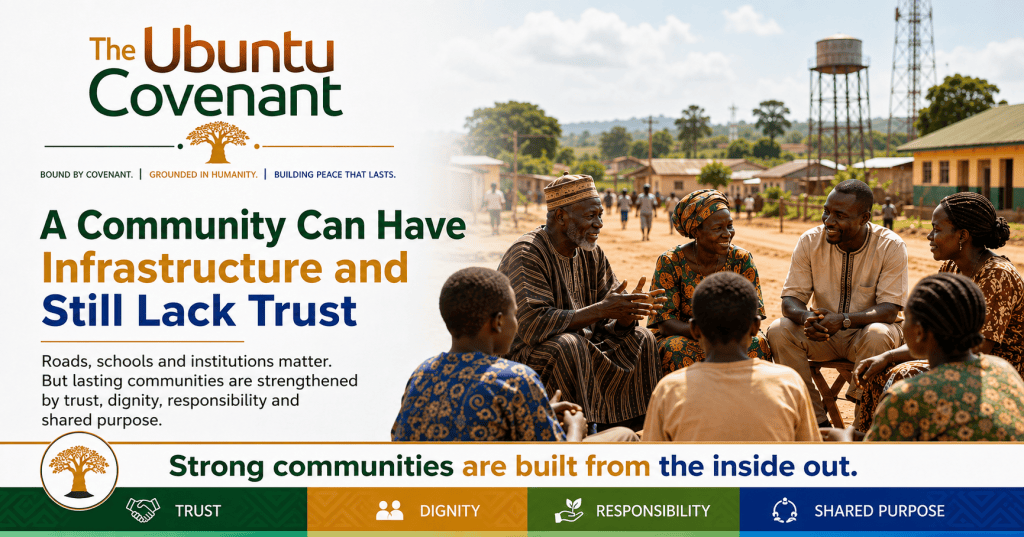
What Holds a Community Together After the Buildings Are Built?
Roads connect people to markets, schools and essential services.
Hospitals protect life.
Water systems improve health and dignity.
Schools create opportunities for future generations.
Public institutions help communities organise responsibilities and respond to common needs.
These visible forms of development matter. They can transform everyday life and open possibilities that were previously beyond reach.
Yet experience also shows that infrastructure alone cannot make a community flourish.
A community may have new buildings while trust continues to weaken.
It may have policies while people feel unheard.
It may have leadership structures while responsibility is avoided.
It may have development programmes while relationships remain divided.
This invites an important question:
What holds a community together after the buildings have been completed?
Every visible system rests upon invisible foundations
A school is more than classrooms, books and desks.
It also depends upon teachers who serve responsibly, parents who remain involved, learners who value the opportunity before them and leaders who protect the purpose of education.
A hospital is more than equipment and medicine.
It also depends upon compassion, professional integrity, public confidence and respect for every person’s dignity.
A public institution is more than offices, policies and procedures.
It also depends upon leaders who understand authority as service, citizens who believe participation matters and systems that treat people fairly.
A peace agreement is more than signatures on a document.
It also depends upon listening, truth, restraint and the willingness to rebuild relationships after disagreement.
These foundations are not always visible.
They cannot be photographed as easily as a road or a building.
They may not appear prominently in project reports.
Yet they often determine whether visible progress will be trusted, protected and sustained.
Trust cannot be built according to a construction plan
A building can be completed within a scheduled period.
Trust usually cannot.
Trust grows slowly through repeated experiences of honesty, fairness, consistency and respect.
It grows when leaders keep their word.
It grows when people are consulted before decisions are made on their behalf.
It grows when institutions listen rather than merely announce.
It grows when disagreement is handled without humiliating those involved.
It grows when responsibility is shared instead of being transferred entirely to government, donors or outside organisations.
Once trust is weakened, even a well-designed programme may be received with suspicion.
People may question motives, resist participation or protect themselves from disappointment.
This is why development must pay attention not only to what is being built, but also to how people are treated while it is being built.
Progress must reach beneath the surface
Visible development can improve conditions.
Human development strengthens the relationships and responsibilities required to sustain those improvements.
Communities become more resilient when people can work across differences, care for shared resources and recognise that their well-being is connected to the well-being of others.
They become stronger when leadership is understood as stewardship rather than status.
They become safer when dialogue begins before disagreement becomes hostility.
They become more hopeful when people see themselves not only as recipients of assistance, but also as participants in shaping their shared future.
The deeper question is therefore not only:
What resources does this community need?
It is also:
What human foundations must be strengthened so that those resources can serve the common good?
Infrastructure and human foundations belong together
This is not a choice between physical development and human development.
Communities need roads, schools, healthcare facilities, markets, water systems and effective public institutions.
But visible progress becomes more durable when it rests upon invisible foundations such as:
Trust.
Dignity.
Integrity.
Dialogue.
Shared responsibility.
Stewardship.
A common sense of purpose.
These foundations help people care for what has been built, use it responsibly and preserve its benefits for those who will come after them.
Without them, infrastructure may remain standing while the community around it becomes increasingly divided.
From shared humanity to shared responsibility
Ubuntu reminds us that human beings do not flourish in isolation.
Our lives are shaped by relationships, responsibilities and the way we treat one another.
But recognising our shared humanity is only the beginning.
That recognition must become practical.
People must learn to listen together, decide together, serve together and take responsibility for what they hold in common.
This is where Ubuntu finds expression through Harambee—shared humanity becoming shared responsibility and collective action.
Stewardship then asks a further question:
How faithfully are we caring for the people, relationships, institutions and resources entrusted to us?
Together, these ideas help us see that strong communities are not formed only through what is constructed around people.
They are also formed through what is cultivated within people and between them.
The work beneath lasting progress
The Ubuntu Covenant strengthens the human foundations upon which strong and resilient communities are built.
Our concern is not only whether communities have institutions, programmes and resources.
It is also whether dignity is protected, trust is nurtured, responsibility is shared and leadership serves the common good.
Because lasting development is not only about constructing what people can see.
It is also about cultivating what communities must carry within themselves.
An invitation to reflect
Look at your own community.
What visible progress has taken place?
And beneath that progress, which human foundation still needs attention?
Is it trust?
Dialogue?
Integrity?
Responsibility?
Stewardship?
Perhaps the next important step is not another structure.
Perhaps it is a conversation that helps people recognise what they are responsible for together.
Strong communities are built from the inside out.
Rooted in Ubuntu. Expressed through Harambee. Guided by Stewardship.

Leave a comment