
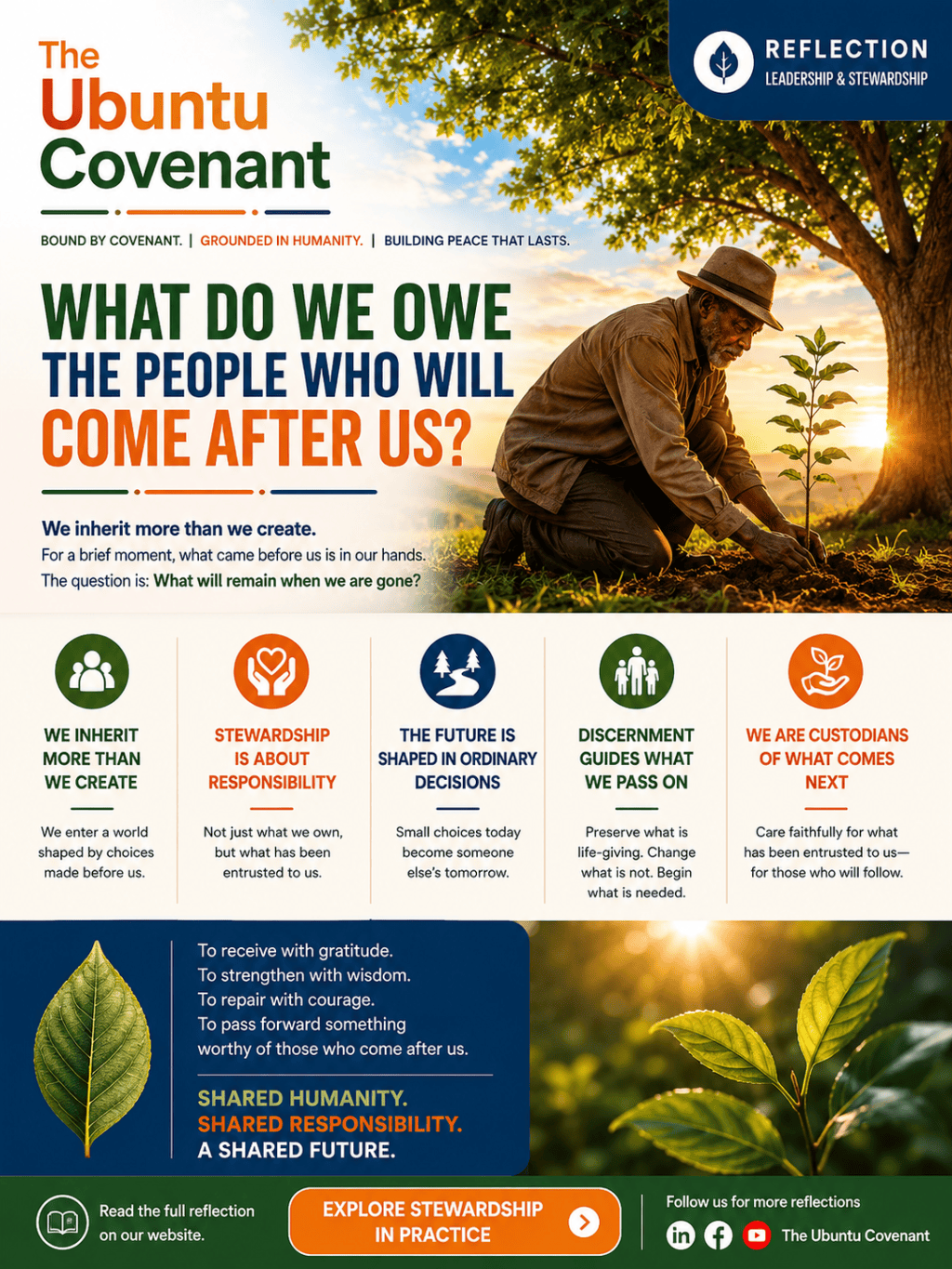
Many years ago, an old man planted a tree near his home.
Someone watching him asked why he was planting it so late in life.
The tree would take years to mature. Its branches would not offer much shade for a long time. There was every possibility that the old man would never sit beneath it.
The question was reasonable:
Why plant a tree whose shade you may never enjoy?
The old man continued planting.
Perhaps he understood something that is easy to forget.
Not everything worth doing must benefit the person who does it.
Years later, someone else may rest beneath that tree.
A child may play under its branches.
A family may gather there.
Birds may make their home in it.
And those who enjoy its shade may never know the name of the person who planted it.
Much of human life is like this.
We live among things we did not create.
We speak languages shaped by generations before us. We inherit stories we did not begin, knowledge we did not discover, institutions we did not establish and communities built through sacrifices we may never fully know.
Someone planted before we arrived.
And now, for a brief period, some of what they left is in our hands.
That leads to a question larger than the tree:
What do we owe the people who will come after us?
We Inherit More Than We Create
None of us begins with nothing.
We enter a world already shaped by other people’s choices…
We inherit languages we did not invent, roads we did not build, knowledge we did not discover, institutions we did not establish, cultures we did not begin and landscapes shaped long before we arrived.
Even our understanding of who we are is partly carried to us through other people.
Some of what we inherit is beautiful.
Some of it is damaged.
Some of it is unfinished.
But inheritance always presents us with a choice.
Will we simply consume what has reached us, or will we also care for what must continue beyond us?
Ownership and Stewardship Are Not the Same
We often speak about what belongs to us:
Our land.
Our organisations.
Our resources.
Our positions.
Our traditions.
Our communities.
But perhaps another question is equally important:
What has been entrusted to us?
Ownership asks:
What can I do with this?
Stewardship asks:
What responsibility comes with having this in my care?
That difference can change how we understand leadership, land, institutions, culture and even relationships.
A leader may occupy a position for several years, but the institution must continue after the leader leaves.
A generation may use a river, forest or piece of land, but others will depend upon it later.
A family may inherit stories and traditions, but those memories survive only if someone chooses to carry them forward.
What we possess temporarily may still carry responsibilities that extend far beyond us.
The Future Is Being Shaped in Ordinary Decisions
We sometimes imagine the future as something distant.
But much of tomorrow is being formed quietly today.
It is shaped when a leader chooses integrity when no one is watching.
It is shaped when a community protects a shared resource rather than exhausting it.
It is shaped when elders tell younger generations why certain traditions, places and memories matter.
It is shaped when disagreement is addressed before it becomes inherited hostility.
It is shaped when institutions develop people rather than depending permanently on one individual.
These actions may appear small.
But generations often inherit the accumulated consequences of ordinary decisions.
Not Everything We Inherit Must Be Preserved Unchanged
Stewardship does not mean protecting everything simply because it came from the past.
Every generation must examine its inheritance.
Some traditions carry wisdom and belonging. Others may need to change.
Some institutions deserve strengthening. Others may require reform.
Some practices should be preserved. Others should be left behind.
Faithful stewardship therefore requires more than preservation.
It requires discernment.
We must ask:
What deserves to continue?
What needs to change?
What must be repaired?
And what should we begin today that future generations will be grateful to inherit?
From Inheritance to Responsibility
This is where stewardship becomes more than a concept.
It becomes a way of seeing our place in time.
We are recipients of what came before us, but we are also custodians of what comes next.
Ubuntu reminds us that our humanity is bound together.
Harambee reminds us that shared humanity calls us into shared responsibility.
Stewardship extends that responsibility beyond the present moment.
It asks us to care faithfully for what has been entrusted to us—not only for ourselves, but for those who will follow.
At The Ubuntu Covenant, this understanding shapes how we think about leadership, community, culture, institutions, natural resources and development itself.
The question is not only whether something works today.
We must also ask:
What will remain when we are gone?
Perhaps that is one of the deepest measures of responsibility:
To receive what has been entrusted to us with gratitude, strengthen what we can with wisdom, repair what we can with courage, and pass forward something worthy of those who come after us.
Shared Humanity. Shared Responsibility. A Shared Future.

Leave a comment