
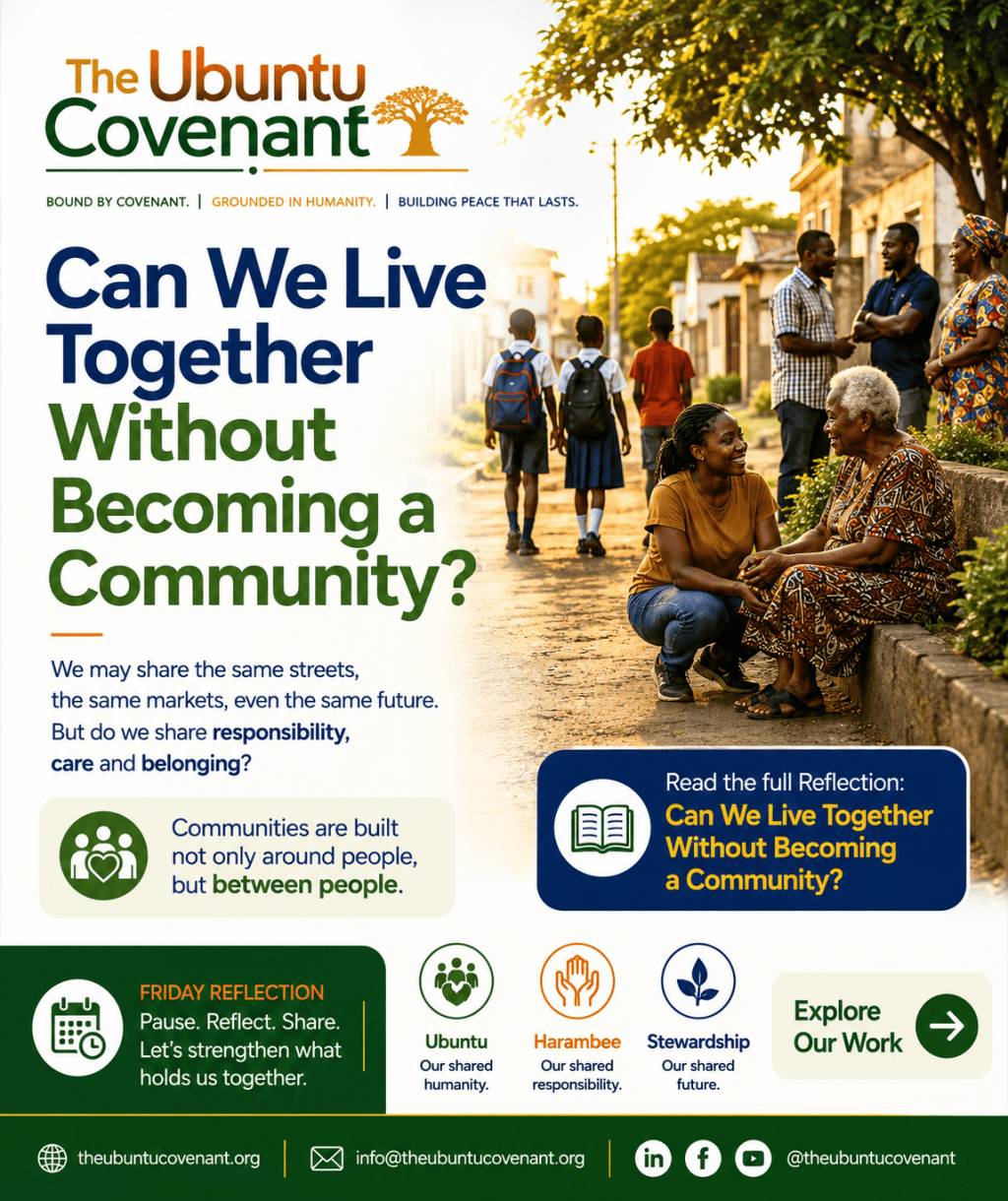
Every morning, an elderly man opened the gate outside his home and sat beneath a small shade tree.
People passed him on their way to work.
Children passed on their way to school.
Some greeted him.
Some stopped for a few minutes.
He knew which family had welcomed a new baby.
He knew whose daughter had gone away to university.
He knew when someone had been ill.
And if a child was behaving badly on the road, there was every possibility that the child’s parents would hear about it before evening.
Then, gradually, the neighbourhood changed.
New houses appeared.
More people arrived.
The road improved.
Shops opened nearby.
Homes acquired higher walls and stronger gates.
By almost every visible measure, the neighbourhood was developing.
But the old man noticed something else.
People seemed to know less about one another.
One morning, he did not open his gate.
People passed.
The next morning, the gate remained closed.
People passed again.
Several days later, someone finally asked:
“Has anyone seen him?”
It was a simple question.
But perhaps another question was hiding inside it:
How can we live so close to one another and still become strangers?
What Would We Notice If It Disappeared?
Imagine a place with good roads.
Reliable electricity.
Schools.
Businesses.
Homes.
Internet connections.
Health services.
Everything we normally associate with a place that is progressing.
Now imagine that nobody knows their neighbour.
An elderly person can disappear from daily life without anyone noticing.
A struggling family suffers quietly behind a closed door.
Children grow up surrounded by adults who feel no responsibility for them.
A newcomer can live somewhere for years and remain a stranger.
When problems arise, everyone waits for someone else to respond.
Something is missing.
But what?
It cannot easily be photographed.
It may never appear in an infrastructure report.
There may be no budget line for it.
Yet when enough of it disappears, people feel its absence.
Some Things Are Built Without Concrete
A woman notices that her elderly neighbour’s curtains have not opened.
Someone remembers that a child normally passes their shop every afternoon but has not appeared for several days.
A family experiences loss, and people arrive before being invited.
A newcomer moves into the neighbourhood and someone learns their name.
Young people know there are adults beyond their own parents who care what happens to them.
People disagree, but eventually find a way to speak again.
Someone sees a problem affecting everyone and asks:
“What can we do?”
These moments seem ordinary.
Most will never be recorded.
But perhaps communities are built through precisely such moments.
Not only through what we construct around people.
But through what develops between people.
Living Near One Another Is Not the Same as Living Together
Two hundred families can occupy the same neighbourhood without becoming a community.
Thousands of people can share a town while living largely separate lives.
People can work in the same institution without trusting one another.
We can share roads, markets, schools and public spaces while carrying little sense of responsibility for the people with whom we share them.
Physical proximity can place us beside one another.
It cannot make us care.
That requires something else.
And perhaps this is where an important distinction begins to appear.
A place answers the question:
Where do you live?
A community begins answering another:
Who would notice if you were missing?
When “Someone” Becomes “Us”
Something changes when people begin to feel responsible for what happens around them.
A broken public space is no longer simply somebody else’s problem.
A struggling child is not only somebody else’s child.
An isolated elder is not merely somebody else’s relative.
A disagreement between neighbours is not automatically dismissed as somebody else’s affair.
This does not mean everyone must interfere in everyone else’s life.
Nor does it remove the responsibilities of families, institutions or government.
It means something simpler.
There are moments when people stop asking only:
“Who is responsible?”
and begin asking:
“What can we do?”
That small change in language reveals a much larger change in relationship.
“Someone” has become “us.”
But What About Difference?
Perhaps community was easier when everyone knew everyone.
But today’s communities can be remarkably diverse.
People may speak different languages.
Come from different places.
Belong to different generations.
Hold different beliefs.
Carry different histories.
See the world differently.
Does belonging require us to become alike?
If it did, many modern communities would have little hope.
Perhaps the deeper challenge is not learning how to live with people who are exactly like us.
It is learning how to recognise responsibility toward people who are not.
Can we disagree and remain neighbours?
Can we carry different histories and still care for what we share?
Can someone be unfamiliar to us without becoming irrelevant to us?
Those may be among the defining questions of community today.
Perhaps This Is What Belonging Feels Like
Maybe belonging is not simply the feeling that I am at home here.
Perhaps it also carries the knowledge that:
I am known here.
My presence matters here.
Someone would notice my absence.
I have responsibilities here.
And there are people here whose wellbeing cannot be completely separated from my own.
Belonging, then, is not merely something a community gives us.
It is something we create for one another.
Every time we notice.
Every time we listen.
Every time we participate.
Every time we take responsibility for something shared.
Every time we make room for someone who might otherwise remain outside.
We are answering the question:
What kind of place are we becoming together?
An Old African Wisdom Gives This a Name
Long before modern language about social cohesion and community development, African societies carried a profound understanding of human life:
Ubuntu.
At its heart is the recognition that our humanity is relational.
We become who we are through others.
But if our humanity is shared, another question follows naturally:
What responsibility do we carry toward one another?
That movement from recognition to responsibility finds practical expression in Harambee.
Not merely someone should do something.
But:
What can we do together?
Ubuntu reminds us of shared humanity.
Harambee calls that humanity into shared responsibility.
And suddenly the ordinary acts we began with—the greeting, the neighbour who notices, the community that responds, the person who refuses to remain a spectator—do not seem quite so ordinary.
They are part of how communities are held together.
What Are We Building Between Us?
At The Ubuntu Covenant, we describe these relationships, values and practices as part of the human foundations upon which peaceful, flourishing and resilient communities are built.
Buildings matter.
Roads matter.
Institutions matter.
Economic opportunity matters.
But development also leaves us with another question:
As we build more around people, are we also strengthening what exists between them?
Perhaps that is the question the old man’s closed gate leaves with us.
A neighbourhood may have changed enormously.
Its roads may be better.
Its homes may be larger.
Its walls may be higher.
But somewhere behind one of those walls, someone may still be waiting to be noticed.
And perhaps community begins again when one person stops, looks toward the closed gate and asks:
“Has anyone seen him?”
Then does something about it.
What would change where you live if more people began to notice one another?
Shared Humanity. Shared Responsibility. A Shared Future.

Leave a comment