
What Helps Good Work Take Root?
Across communities, people are constantly working to improve life.
Leaders serve. Families make sacrifices. Communities organise. Institutions develop programmes. Governments invest in services and infrastructure. Organisations bring knowledge, resources and experience.
Much of this work matters.
Yet experience raises an important question:
Why do some efforts take root and continue to strengthen communities, while others struggle to endure?
Resources matter.
Good institutions matter.
Policies, programmes and technical expertise matter.
But beneath them are less visible conditions that often shape whether progress can be sustained.
Do people trust one another?
Do they feel that they belong?
Can they navigate disagreement without destroying relationships?
Do leaders understand authority as responsibility?
Are people able to participate meaningfully in decisions that affect their lives?
Do communities have the confidence and capacity to carry progress forward themselves?
These questions point toward something deeper.
Lasting development depends not only upon the structures we build, but also upon the human foundations that enable people and institutions to flourish.
It is within this understanding that the story of The Ubuntu Covenant begins.
Why a Covenant?
A covenant is more than an agreement.
An agreement can describe what people intend to do together.
A covenant asks something deeper:
What responsibilities are we willing to carry toward one another and toward the future we share?
Every community depends upon commitments that cannot always be written into policies or contracts.
The commitment to recognise the dignity of another person.
The responsibility to listen when disagreement arises.
The willingness to contribute rather than simply receive.
The courage to exercise leadership as service rather than privilege.
The discipline to care for resources, institutions and relationships that must outlive us.
These commitments shape the character of community life.
They remind us that building a flourishing society is not simply the responsibility of governments, organisations or leaders.
It is a responsibility we share.
The word Covenant therefore expresses something central to our understanding of change.
Lasting progress requires more than programmes.
It requires people willing to recognise their shared humanity, carry shared responsibility and care faithfully for what has been entrusted to them.
Who We Are
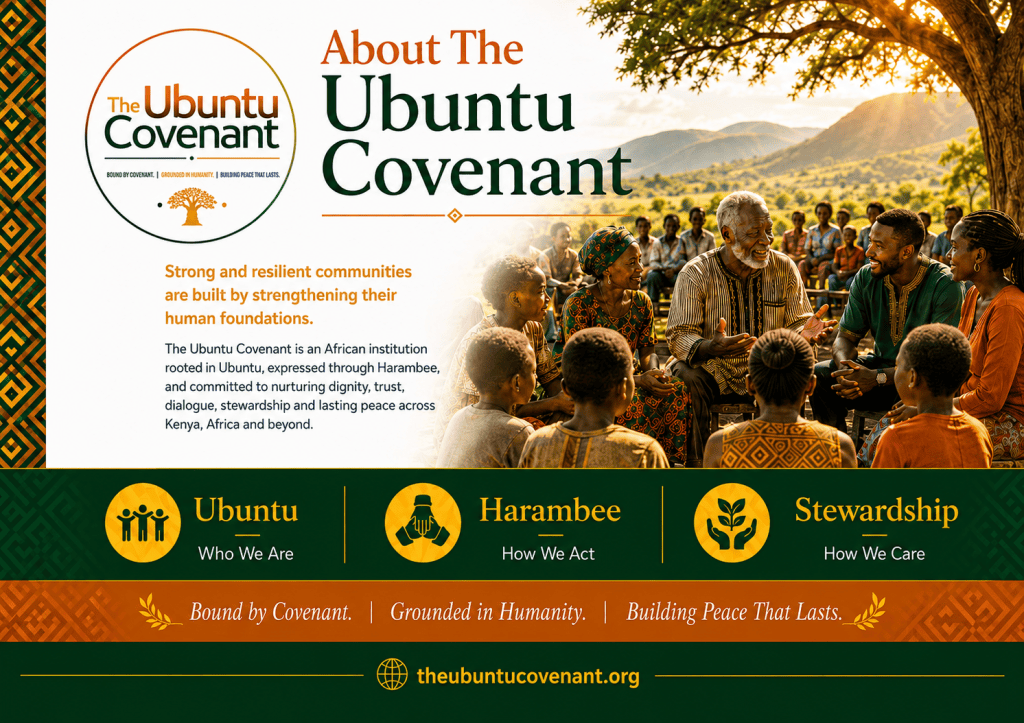
The Ubuntu Covenant is a Kenyan Public Benefit Organization working to strengthen the human foundations upon which peaceful, flourishing and resilient communities and institutions depend.
We begin from a simple observation:
Communities do not flourish through structures, resources and programmes alone.
They also depend upon what happens between people—whether dignity is recognised, trust can grow, differences can be navigated, leadership carries responsibility, people experience belonging, and communities are able to take responsibility for what they share.
These are what we describe as human foundations.
Our understanding is grounded in three connected principles:
Ubuntu — shared humanity.
Harambee — shared responsibility in action.
Stewardship — faithful care for what has been entrusted to us.
Together, they shape how we understand people, relationships, communities, institutions and the responsibility of one generation to another.
Why We Exist
Many of the challenges communities face appear first as visible problems.
Conflict.
Weak participation.
Leadership challenges.
Fragile institutions.
Loss of trust.
Unsustainable development initiatives.
Disconnection between citizens and institutions.
These realities require practical responses.
But practical responses become stronger when we also ask what may be happening beneath the surface.
A conflict may also reveal weakened relationships.
Low participation may reveal a loss of belonging or trust.
A struggling community initiative may reveal limited local ownership.
A leadership challenge may reveal a deeper understanding of authority without stewardship.
An institution may have strong structures while the relationships necessary to sustain those structures remain fragile.
The Ubuntu Covenant exists to work at this deeper level.
We seek to strengthen the relationships, values, capacities and responsibilities that help people and institutions work together, navigate differences, exercise leadership responsibly and sustain progress over time.
Our concern is therefore not simply:
What can be done for a community?
We are equally interested in asking:
What can become stronger within a community so that people are increasingly able to shape and sustain their own future?
How We Understand Our Role
Communities are not empty spaces waiting for solutions.
Long before an organisation arrives, people have been living, learning, adapting, leading, resolving problems and carrying responsibility.
Communities possess knowledge.
They carry memory.
They understand relationships that outsiders may not immediately see.
They know the history behind present challenges.
They have leaders, institutions, traditions, experience and capacities of their own.
This does not mean that communities possess every answer.
Neither do outside institutions.
Meaningful change often begins when different forms of knowledge can meet with humility.
For this reason, our work begins with listening and understanding.
We seek to create spaces where people can reflect upon their own experience, engage different perspectives, identify what already works, confront what needs to change and strengthen their capacity to respond together.
Our role is not to replace local leadership or community responsibility.
Where appropriate, we convene, facilitate, accompany, connect, strengthen capacity and support learning.
The aim is not dependence upon The Ubuntu Covenant.
The aim is stronger people, stronger relationships, stronger institutions and communities increasingly able to carry their own progress forward.
Rooted in African Wisdom, Open to the World
The Ubuntu Covenant is rooted in Africa.
This matters.
Africa carries deep traditions of thought about personhood, community, responsibility, reconciliation, leadership and our relationship with one another.
Ubuntu is one expression of this intellectual and moral inheritance.
Harambee carries another powerful insight: that shared challenges often require shared contribution.
These ideas should not be treated merely as cultural language from the past.
They continue to offer serious ways of thinking about some of the most important questions facing societies today:
How do we live together despite our differences?
What responsibilities accompany leadership?
How do individuals flourish without losing sight of the communities to which they belong?
How do institutions build trust?
How do communities participate meaningfully in shaping their own future?
What responsibilities does one generation carry toward the next?
Our roots are African, but these questions are human.
We therefore seek to learn from African wisdom while remaining open to knowledge, experience and insight from communities and institutions across the world.
This is not about romanticising the past.
Nor is it about suggesting that one tradition contains every answer.
It is about recognising that societies move forward more wisely when they are able to draw upon the knowledge they inherit, examine it thoughtfully, learn from others and apply what remains valuable to the realities of the present.
The Commitment We Carry
The name The Ubuntu Covenant carries a responsibility for us as well.
If we speak about dignity, we must practise dignity.
If we speak about dialogue, we must be willing to listen.
If we speak about participation, we must resist treating people merely as beneficiaries.
If we speak about stewardship, we must be accountable for what is entrusted to us.
If we speak about local ownership, our work must strengthen rather than replace the capacity of communities and institutions.
And if we speak about shared humanity, the way we work must recognise the worth and contribution of every person.
We will not always have every answer.
No institution does.
But we can commit ourselves to a way of working:
To listen before prescribing.
To understand before acting.
To recognise dignity before defining need.
To strengthen capacity rather than dependency.
To encourage responsibility rather than passive participation.
To learn from experience rather than assume that knowledge belongs to us alone.
And to care faithfully for what has been entrusted to us.
This is the covenant we seek to carry into our relationships with communities, institutions, partners and one another.
Because stronger communities are not built by institutions alone.
They are built when people recognise their shared humanity, accept responsibility for the life they share and care for what must endure beyond them.
Shared Humanity. Shared Responsibility. A Shared Future.
Stewarding the Beginning
Every organisation begins with a period when its foundations matter enormously.
The early decisions—what to prioritise, what not to pursue, how resources are handled, whose voices are heard, what relationships are built and what kind of institutional culture takes root—can shape what the organisation eventually becomes.
For The Ubuntu Covenant, this beginning is being stewarded deliberately.
Brian N. Munywoki serves as the Founding Steward of The Ubuntu Covenant, carrying responsibility for the organisation’s early vision, institutional development, partnerships and day-to-day leadership as it builds the foundations for its future work.
His role is not to make the organisation dependent upon one person, but to help establish the purpose, governance, relationships, systems and culture from which a strong institution can grow.
As The Ubuntu Covenant develops, this stewardship is intended to be exercised within accountable governance, appropriate professional leadership and an increasingly capable team.
The aim is to build an institution whose purpose can endure beyond the person who began it.
Institutional Standing
The Ubuntu Covenant is a registered Public Benefit Organization in Kenya, regulated by the Public Benefit Organizations Regulatory Authority.
Registered: 6 July 2026
As a young institution, we are building deliberately—strengthening governance and institutional systems, developing our practice, building trusted relationships and establishing the foundations for responsible growth.
We believe institutional credibility should be demonstrated not simply by registration, but by how responsibly an organisation governs itself, stewards resources, learns from its work and remains accountable to the people and partners with whom it works.
