
Lasting Change Cannot Simply Be Delivered
A community may receive a well-designed programme, new resources or outside expertise and still struggle to sustain the progress after the intervention ends.
Sometimes the programme addressed a genuine need.
The activities were completed.
The targets were reached.
Yet something did not take root.
Why?
Because lasting change is rarely something one group can simply deliver to another.
People sustain what they understand.
They protect what they value.
They take responsibility for what they have helped to shape.
And they are more likely to continue what strengthens capacities already rooted within their own community.
This changes the way we think about development.
The question becomes not only:
“What can be done for this community?”
But also:
“What can become stronger within this community so that progress can continue long after an intervention ends?”
Begin by Listening
A community can be described through reports, statistics and plans, yet still be understood poorly.
Numbers may tell us what is happening.
They do not always tell us why.
To understand that, we have to listen—to people’s experiences, to different perspectives, to what has worked before, to what has been lost, and sometimes to what is difficult to say.
Listening also means recognising that communities are not empty spaces waiting for expertise to arrive. People already carry knowledge, relationships, history, capabilities and ways of responding to difficulty.
So the first responsibility is not to arrive with an answer.
It is to understand the people, relationships and context well enough to ask better questions.
For The Ubuntu Covenant, listening is therefore more than consultation at the beginning of a programme. It is the starting point for understanding what already exists, what may be weakening, what people value and what they themselves may be capable of strengthening.
Before deciding what should change, we seek to understand what is already there.
Look Beneath the Visible Problem
What appears to be the problem is not always the whole problem.
A conflict may appear to concern land, yet beneath it may be questions of identity, inheritance, memory or belonging.
An institution may appear to need better policies, while mistrust, weak accountability or damaged relationships are making those policies difficult to practise.
A project may appear to need more resources when the deeper challenge is that people do not yet experience it as something they own or are responsible for sustaining.
This is why understanding requires more than identifying what is visible.
We must also ask:
What relationships, experiences, responsibilities or patterns beneath the visible problem are influencing what is happening?
Looking beneath the surface does not mean ignoring practical or technical needs. It means recognising that technical solutions often depend upon human conditions if they are to work and endure.
For The Ubuntu Covenant, this is where the idea of human foundations becomes practical: understanding not only the challenge people can see, but the relationships and conditions that may be strengthening or weakening their ability to respond to it together.
Recognise What Is Already Present
Communities are not empty spaces waiting to be filled with knowledge.
Long before an organisation arrives, people have been living with the questions that affect their community.
They have experience.
They have relationships, skills, memory and local knowledge.
They know what has been tried before. They may understand why something succeeded, why it failed, who needs to be involved and what outsiders could easily overlook.
Not everything that already exists will necessarily be sufficient, and some practices may need to be questioned or strengthened. External knowledge, resources and technical expertise can also be valuable.
But beginning with what is absent can cause us to overlook what is already present.
A better starting point is to ask:
What knowledge, relationships, capacities and forms of leadership already exist here—and what could become stronger?
For The Ubuntu Covenant, this means approaching people not merely as beneficiaries of change, but as participants who already carry knowledge, experience and capacity that can help shape it.
Participation Is Not the Same as Ownership
There is a difference between being invited to attend and being invited to shape.
A person can sit in a meeting, answer questions and appear on a participation list without having meaningful influence over what happens next.
A community can also be consulted about a programme whose most important decisions have already been made elsewhere.
Participation becomes more meaningful when people are able to understand the challenge, contribute their knowledge, influence decisions and carry real responsibility for what follows.
This does not mean every decision must be made by everyone. Different responsibilities, expertise and forms of leadership still matter.
But people are more likely to care for what they have genuinely helped to understand and shape.
The deeper question is therefore not simply:
“Were people involved?”
but:
“Did their involvement strengthen their ability and responsibility to carry the work forward?”
For The Ubuntu Covenant, participation should therefore move toward shared responsibility and local ownership—where people are not merely present in the process, but increasingly capable of shaping, adapting and sustaining what matters to them.
Strong Systems Still Depend on People
Systems matter.
Policies matter.
Institutions matter.
Resources matter.
But none of them operates by itself.
A policy depends on people willing and able to put it into practice. An institution depends on how responsibility is exercised within it. Governance depends not only on structures, but also on trust, accountability and the behaviour of those entrusted with authority.
This means strengthening a system while ignoring the people and relationships that sustain it can leave an important part of the work unfinished.
The question is therefore not only:
“What structures need to become stronger?”
It is also:
“What needs to become stronger among the people who will carry, trust and sustain those structures?”
For The Ubuntu Covenant, the two belong together. We pay attention to institutions and systems while also examining the human foundations—relationships, responsibility, trust, participation and stewardship—that help those systems function and endure.
Dialogue Before Division
People do not have to agree in order to begin understanding one another.
Within the same community, people may experience the same issue very differently. Generations may carry different priorities. Institutions and communities may interpret the same events from different perspectives. Even people seeking the same outcome may disagree about how to reach it.
Difference itself is not necessarily the problem.
The deeper difficulty begins when people can no longer hear one another—when assumptions replace understanding, positions harden and people begin speaking about one another rather than with one another.
Dialogue creates another possibility.
It creates space to listen, clarify assumptions, understand interests, acknowledge hurt and explore disagreement without requiring everyone to think alike.
The question is not always:
“How do we get everyone to agree?”
Sometimes the better question is:
“How can people remain in relationship while working through what divides them?”
For The Ubuntu Covenant, dialogue is therefore not simply an activity used when conflict occurs. It is part of how we approach community life, leadership, disagreement and collective responsibility.
Build Capacity, Not Dependency
Help can solve an immediate problem.
But the deeper test of good help may come later—when the person or organisation that provided it is no longer there.
If knowledge remains outside the community, decisions continue to depend on outsiders, or local institutions cannot carry the work forward, an intervention may have achieved something valuable without strengthening the capacity needed to sustain it.
Another possibility is to ask from the beginning:
What can people become better able to understand, decide, practise and carry forward for themselves?
External expertise and resources can still matter. The goal is not to reject outside support, but to use it in ways that strengthen rather than replace local capacity.
For The Ubuntu Covenant, this means working in ways that increasingly place knowledge, responsibility and the ability to act where they can continue after our involvement has ended.
Good support should not make itself permanently necessary.
Work With the Whole Community System
A challenge that appears in one part of community life can be shaped by what is happening somewhere else.
Leadership can influence trust.
Trust can influence participation.
Participation can influence whether people experience something as their own.
Economic or environmental pressures can place strain on relationships.
Culture, memory and identity can shape how people understand responsibility, belonging and change.
Institutions both influence these relationships and are influenced by them.
This means that responding to one visible challenge sometimes requires understanding the wider human system around it.
The question becomes:
“What else is connected to what we are seeing here?”
For The Ubuntu Covenant, this means resisting the temptation to treat leadership, dialogue, stewardship, belonging, institutions and community participation as completely separate concerns.
We look for the relationships between them—because strengthening one human foundation can sometimes strengthen several others.
Let Practice Teach Us
No programme begins with complete understanding.
Communities change. Circumstances change. New voices emerge. Assumptions are tested. And sometimes something that appeared promising on paper works very differently in practice.
That does not necessarily mean the work has failed.
It may mean the work has something to teach us.
A plan can provide direction, but it should not become more important than what people and experience are revealing along the way.
This is why reflection belongs within the work, not only in the report written after it.
As the work unfolds, important questions remain:
What are we learning?
What is changing?
What appears to be working—and why?
What is not working?
Whose experience have we not yet heard?
What needs to be adapted?
For The Ubuntu Covenant, learning is part of responsible practice. We listen to what experience is revealing, document what matters and allow new understanding to shape what happens next.
Learning should not merely explain what happened. It should help us become wiser about what happens next.
Think About the End From the Beginning
Every intervention eventually ends.
Funding closes.
Project teams leave.
Partnership arrangements change.
External specialists move on.
Planning for that reality should not begin in the final weeks.
It should begin at the start.
Who will continue the work?
What knowledge must be transferred?
What skills need to be strengthened?
Which local institutions should carry responsibility?
What resources will be required?
What relationships must remain strong?
What can communities realistically sustain without continued external support?
These questions shape whether an intervention produces temporary activity or lasting capacity.
A good exit should therefore not feel like abandonment.
It should reveal that responsibility has increasingly been placed where it can continue.
The Ubuntu Covenant Approach
These understandings shape the way The Ubuntu Covenant works.
We seek to:
Listen before prescribing.
We begin by understanding people, context, experience and what already exists.
Look beneath the visible problem.
We pay attention to the relationships, responsibilities and human conditions influencing what can be seen.
Build on what is already present.
We recognise local knowledge, experience, relationships and capacity before deciding what needs to be added.
Work with, not merely for.
Participation should strengthen people’s ability to shape decisions, carry responsibility and develop local ownership.
Learn and adapt.
We allow experience and reflection to improve the work while it is happening.
Think about the end from the beginning.
We consider from the start what knowledge, capacity, relationships and responsibility must remain when external involvement ends..
The aim is not to make The Ubuntu Covenant increasingly necessary, but to help strengthen the capacity of people and institutions to carry what matters forward.
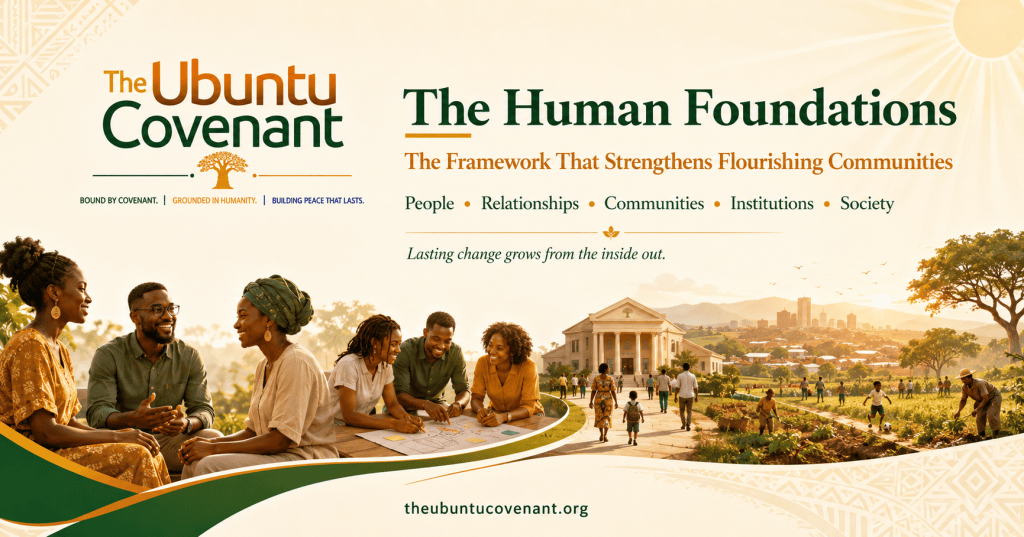
The Human Foundations Framework
Our approach can be understood as a journey from the inside outward.
People
Every institution and community is ultimately shaped by people.
Character, responsibility, integrity, compassion and stewardship influence how people exercise whatever responsibilities are placed in their hands.
Relationships
People do not build communities alone.
Trust, dialogue, mutual respect, cooperation and shared responsibility create the relationships through which collective life becomes possible.
Communities
Strong relationships make belonging, participation, mutual care and collective action possible.
Communities become stronger when people recognise both their place and their responsibility within them.
Institutions
Institutions become stronger when the people and communities surrounding them value integrity, accountability, participation and stewardship.
Institutions therefore require more than good structures.
They require human foundations capable of sustaining those structures.
Society
When people, relationships, communities and institutions strengthen one another, society becomes better equipped to pursue peace, justice, resilience and shared wellbeing.
The movement is not always perfectly linear.
People shape institutions, and institutions also shape people.
Communities influence leadership, and leadership influences communities.
The framework therefore helps us understand interconnection, rather than suggest that transformation happens through one simple sequence.
Rooted in Ubuntu, Expressed Through Harambee, Guided by Stewardship
Ubuntu reminds us that our wellbeing is interconnected.
Harambee reminds us that shared humanity requires shared action.
Stewardship reminds us that whatever we build together must be cared for faithfully.
These principles influence not only what The Ubuntu Covenant does.
They influence how we do it.
Ubuntu shapes how we see people.
Harambee shapes how we work together.
Stewardship shapes how we carry responsibility and think about what remains after us.
Together, they provide the philosophical foundation beneath our approach.
From Approach to Action
An approach only matters if it changes what happens in practice.
The principles explored on this page shape how we enter relationships, understand challenges, design responses, work alongside communities and institutions, learn from experience and think about what should remain after our involvement ends.
The context will differ. The people will differ. And the appropriate response may differ.
What remains constant is the commitment to understand before acting, strengthen rather than replace local capacity, and leave responsibility increasingly where it can continue.
Begin With Understanding
Every meaningful collaboration begins by understanding the people, the context and the challenge before deciding what should happen next.
If your community or institution is exploring how to strengthen local ownership, leadership, dialogue, stewardship, institutional capacity or sustainable community development, the first step does not have to be a programme.
It can simply be a conversation.
