
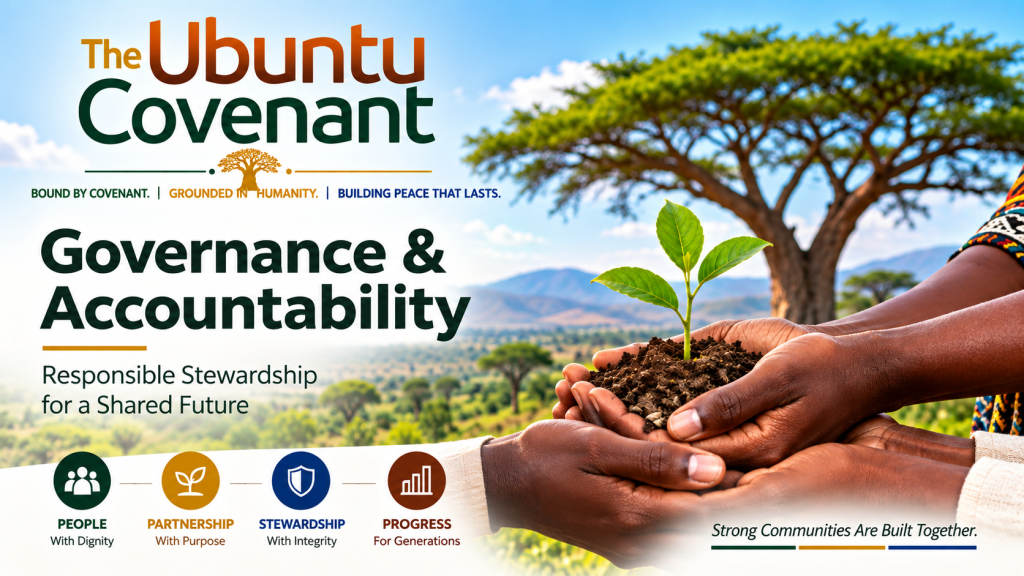
Who Watches Over What Has Been Entrusted?
Imagine a community contributing its time to a project.
A partner contributes resources.
A researcher shares knowledge.
A family shares its story.
A community leader places their trust in an organisation.
Each has given something different.
But each has entrusted something.
And sooner or later, an important question arises:
Who is responsible for what has been entrusted — and how will they account for it?
Good intentions cannot answer that question on their own.
Neither can a compelling vision.
Trust grows when responsibilities are clear, decisions can be questioned, resources are stewarded carefully, commitments are honoured, and people know that those entrusted with responsibility are themselves accountable.
This is why governance matters.
Not simply because organisations need structures, policies and reports, but because responsibility needs somewhere to rest.
For The Ubuntu Covenant, governance and accountability therefore begin with a simple conviction:
What is entrusted to us must be stewarded responsibly.
Stewardship Begins With What Is Entrusted to Us
Every organisation is entrusted with more than money.
There are resources, certainly.
But there are also relationships.
Information.
Stories.
Influence.
Opportunities.
Promises.
And sometimes, the confidence of people who have chosen to trust.
Each carries responsibility.
Stewardship therefore asks:
How are we caring for what has been entrusted to us?
It means seeking to use resources for their intended purpose, making decisions responsibly, recognising conflicts of interest, protecting people’s dignity, honouring commitments and remaining willing to account for the choices we make.
Why Governance Matters
A worthy purpose does not automatically produce responsible action.
Organisations make decisions. They receive resources. They build relationships. They make commitments that affect communities, partners and institutions.
The question is therefore not only:
What good are we trying to do?
It is also:
How will we exercise the responsibility entrusted to us?
Good governance helps ensure that purpose is accompanied by accountability, that resources are stewarded responsibly, and that decisions remain connected to the people and principles an organisation exists to serve.
For us, governance is therefore more than compliance.
It is a practice of stewardship.
How We Understand Accountability
Accountability begins with a simple recognition:
What is entrusted to us is not ours to use carelessly.
Resources are entrusted.
Relationships are entrusted.
Information is entrusted.
The confidence of communities and partners is entrusted.
And when people allow an organisation to work alongside them, something even more important is entrusted — their trust.
That means accountability cannot begin and end with reports, policies or financial records. Those things matter, but they are expressions of something deeper.
Accountability asks whether we can explain our decisions, use resources responsibly, learn when we are wrong, and remain answerable to the people affected by our work.
At The Ubuntu Covenant, we want accountability to move in more than one direction — to communities, to those who support the work, to governing bodies, to partners, and to the purpose for which the organisation exists.
For us, accountability is therefore not merely something we demonstrate.
It is something we practise.
How The Ubuntu Covenant Is Governed
The Ubuntu Covenant is established as a Public Benefit Organization in Kenya and operates within the governance and accountability requirements applicable to public benefit organisations.
Governance responsibility rests with the organisation’s governing body, which provides oversight of purpose, strategy, resources and organisational integrity.
Day-to-day leadership is responsible for translating that direction into practice while remaining accountable to the organisation’s governing structures.
As a young organisation, we recognise that good governance is not something to add later when an organisation becomes larger.
It is part of what must be built correctly from the beginning.
We are therefore committed to developing our governance practices as the organisation grows — strengthening oversight, financial stewardship, safeguarding, learning, transparency and responsible decision-making.
Stewardship of Resources
Resources make good work possible.
But receiving resources also creates responsibility.
Whether resources come through partnerships, grants, contributions or other forms of support, they are entrusted for a purpose.
Responsible stewardship therefore asks more than:
How much was received and spent?
It also asks:
Was it used for the purpose for which it was entrusted?
Were decisions properly authorised and documented?
Did the resources contribute to meaningful work?
Can we account for how they were used?
The Ubuntu Covenant is committed to appropriate financial controls, accurate record-keeping, responsible authorisation of expenditure and transparent reporting consistent with its responsibilities as a Public Benefit Organization.
As the organisation grows, these systems will continue to be strengthened alongside the scale and complexity of the resources entrusted to it.
Good stewardship is not measured by how much an organisation controls, but by how responsibly it cares for what has been placed in its hands.
Learning Is Part of Accountability
An organisation can complete its activities and still fail to ask whether anything meaningful changed.
That is why accountability must include learning.
It requires us to ask:
What happened?
What changed — and what did not?
What are communities and partners telling us?
What assumptions were wrong?
What should we do differently next time?
Not every approach will work as expected. Responsible organisations should be able to recognise that, learn from experience and adjust their practice.
For The Ubuntu Covenant, learning is therefore not separate from accountability.
To learn honestly is also to account honestly for the work we undertake.
Building Responsibly as We Grow
Every organisation begins somewhere.
At the beginning, systems are still being strengthened, experience is still being accumulated, and lessons are still being learned.
Growth can therefore create an important temptation:
to appear more established than we really are.
We believe responsible institution-building requires something different.
It requires honesty about where we are, discipline about what we undertake, and patience to build the structures that responsible service requires.
The Ubuntu Covenant is a young organisation.
As we grow, we are committed to strengthening our governance, financial management, safeguarding, organisational policies, monitoring and learning, and the systems through which people can raise questions or concerns.
We do not expect institutional maturity to happen overnight.
But we believe the foundations of responsible institutions must be laid while they are still small.
Our aim is therefore not simply to become a larger organisation.
It is to become an organisation increasingly worthy of the trust placed in it.
Public Information & Documents
Transparency becomes more meaningful when people can access the information that helps them understand how an organisation is governed and how responsibility is exercised.
As The Ubuntu Covenant develops, this page will become a home for appropriate public governance and accountability information.
This may include:
- Governance and institutional information
- Key organisational policies
- Annual reports
- Financial and audit information
- Safeguarding and accountability information
- Other documents appropriate for public access
Not every internal document belongs in the public domain, and not every document exists at the beginning of an organisation.
We will therefore add information here as it is adopted, verified and appropriate to share.
Transparency should grow alongside institutional responsibility.
Accountability Begins With Openness
Trust does not require people to have no questions.
Often, trust grows because questions can be asked.
Questions about how decisions are made.
Questions about how resources are used.
Questions about what has been learned.
Questions about what could have been done differently.
We welcome those questions because accountability should not create distance between an organisation and the people around it.
It should create greater clarity.
If you would like to understand more about the governance, institutional development or stewardship of The Ubuntu Covenant, we welcome a conversation.
