
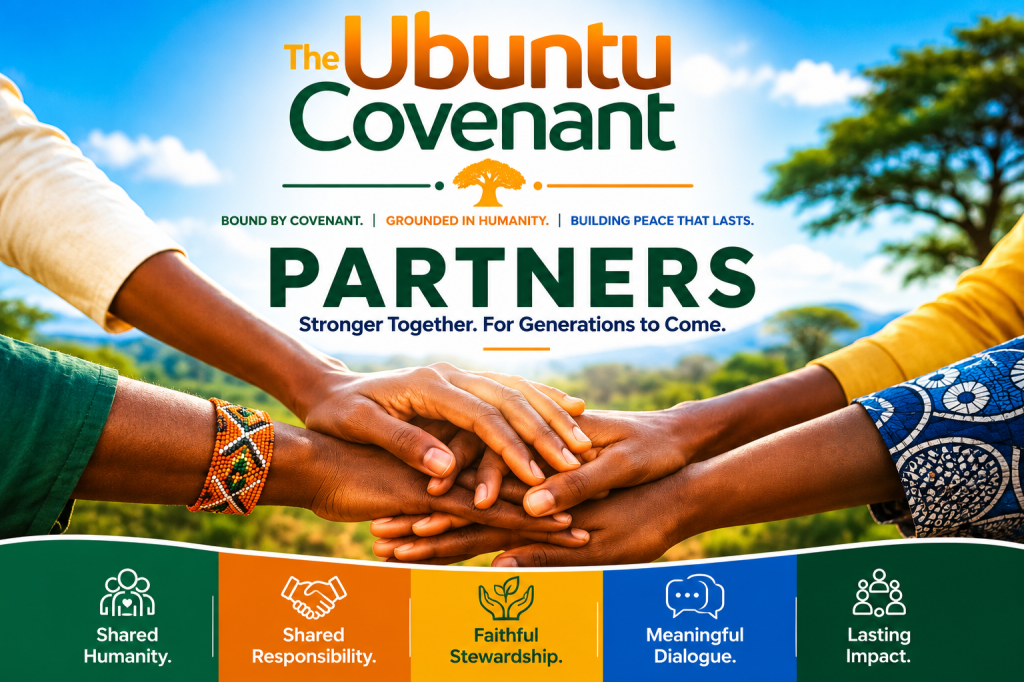
Strong Communities Are Built Together
Think about any lasting achievement in a community.
Rarely was it accomplished by one person or institution alone.
Someone carried knowledge.
Someone brought experience.
Another contributed leadership.
Others offered relationships, resources, time, technical ability or access to institutions.
What made progress possible was not that everyone carried the same thing.
It was that different strengths came together around a shared purpose.
The same is true of many challenges communities face.
Peace cannot be strengthened by peacebuilders alone.
Ethical leadership cannot be strengthened by leaders alone.
Environmental stewardship cannot be left to conservation organisations alone.
Belonging cannot be created by institutions acting without communities.
And lasting development cannot be carried indefinitely by outside organisations.
Different people and institutions carry different parts of the responsibility.
The question is therefore not simply:
“Who can solve this problem?”
It is also:
“Who needs to come together, and what does each one bring?”
Partnership Is More Than Working Together
Not every collaboration becomes a true partnership.
Organisations can share a project without truly trusting one another.
Resources can be exchanged without responsibility being shared.
Communities can be consulted without having meaningful influence.
Partners can pursue the same activity while carrying very different expectations.
This is why partnership must involve more than cooperation.
The quality of the relationship matters.
Can people speak honestly?
Are responsibilities clear?
Is knowledge respected?
Are commitments honoured?
Can disagreement be addressed openly?
Does each partner recognise the contribution of the other?
Does the relationship strengthen those involved rather than create unnecessary dependency?
Meaningful partnership therefore asks not only:
“What will we accomplish together?”
It also asks:
“What kind of relationship will enable us to accomplish it well?”
Different Strengths, Shared Purpose
Every person, community and institution carries something.
A community may understand its own context deeply but need technical expertise.
A research institution may hold valuable knowledge but need relationships through which that knowledge can become useful.
A public institution may possess authority and systems while needing stronger citizen participation.
A philanthropic partner may bring resources while depending upon local institutions to understand context and sustain progress.
A faith community may carry trusted relationships.
A business may contribute innovation, skills or networks.
An elder may carry wisdom that no report contains.
A young person may recognise possibilities established institutions have overlooked.
Partnership becomes powerful when these different forms of contribution are recognised.
No partner needs to possess everything.
But every partner should understand what it brings, what it does not bring, and what it can learn from others.
Our differences do not always have to separate us.
Sometimes they become complementary strengths in service of a shared purpose.
From Shared Humanity to Shared Responsibility
When we recognise that community wellbeing is interconnected, responsibility can no longer belong only to one institution.
This is where the principles that guide The Ubuntu Covenant become practical.
Ubuntu reminds us of our shared humanity.
But recognition alone is not enough.
Shared humanity must move toward shared responsibility.
This is the spirit of Harambee.
People bring what they have.
They contribute what they know.
They carry responsibility together.
And they work toward something that none could achieve as effectively alone.
Yet shared action also requires faithful care.
Relationships must be protected.
Resources must be used responsibly.
Commitments must be honoured.
Local capacity must be strengthened.
And today’s partnership must consider what will remain tomorrow.
This is Stewardship.
Together, Ubuntu, Harambee and Stewardship help us understand partnership not simply as a contractual arrangement, but as a relationship of shared humanity, shared responsibility and faithful contribution.
What Should a Good Partnership Leave Behind?
Every partnership eventually changes.
Funding periods end.
Projects close.
People move into new roles.
Institutions change direction.
External partners leave.
The real character of a partnership may therefore become clearest after the formal relationship has ended.
What remains?
Are local institutions stronger?
Has useful knowledge been shared?
Do communities have greater capacity?
Are relationships stronger?
Has leadership been strengthened?
Can valuable work continue without permanent outside dependence?
Did the partnership create ownership—or merely activity?
A meaningful partnership should leave more than completed outputs.
It should leave stronger people, stronger relationships, stronger institutions and greater capacity to carry progress forward.
This means sustainability cannot be discussed only when a project is ending.
It must shape the relationship from the beginning.
Partnership Should Strengthen Local Ownership
Outside support can be valuable.
Resources matter.
Technical expertise matters.
New ideas and relationships can matter.
But help becomes less helpful when it unintentionally displaces the capacity already present within communities.
A community should not become weaker because others came to strengthen it.
Partnership therefore requires humility.
Before introducing solutions, we should understand what already exists.
Before assuming what people need, we should listen.
Before creating new structures, we should understand existing ones.
And before taking responsibility away from local actors, we should ask whether that responsibility can instead be strengthened.
The strongest partnerships do not seek to make themselves permanently indispensable.
They help strengthen the people and institutions who will remain.
The Partnership We Seek to Practise
These understandings shape how The Ubuntu Covenant approaches partnership.
We see partnership not simply as a way of delivering programmes.
We see it as a way of relating.
Our partnerships seek to be grounded in:
Trust — because meaningful cooperation requires confidence in one another.
Mutual respect — because every person and institution carries dignity, knowledge and experience.
Shared responsibility — because common challenges require meaningful contribution from those involved.
Integrity — because commitments must mean something.
Dialogue — because healthy partnerships must be able to address differences honestly.
Complementary strengths — because no institution carries every capacity.
Accountability — because shared work requires clarity about responsibilities and commitments.
Learning — because no partner enters a relationship knowing everything.
Stewardship — because relationships, resources and responsibilities entrusted to us must be handled faithfully.
Local ownership — because lasting progress should strengthen the people and institutions who will carry the work forward.
These principles shape not only whom we seek to work with.
They shape how we seek to work together.
Who Can Contribute?
Strengthening communities is a responsibility shared across society.
Different actors carry different capacities.
For this reason, The Ubuntu Covenant welcomes opportunities to work alongside:
- communities and community-led organisations;
- civil-society organisations;
- educational and research institutions;
- faith communities;
- national and county governments;
- traditional and cultural leaders;
- development and humanitarian organisations;
- philanthropic institutions and funders;
- businesses and professional associations;
- practitioners, educators and researchers; and
- individuals whose knowledge, experience or service can contribute to the common good.
What matters most is not organisational size or status.
It is whether there is meaningful alignment around human dignity, responsibility, peace, stewardship, local ownership and the strengthening of communities.
How We Work Together
Every partnership has its own context.
The challenge should shape the collaboration rather than forcing every relationship into the same model.
But several disciplines guide how we seek to work.
We Listen Before We Design
Understanding should come before intervention.
We seek to understand the people, context, existing capacities and lessons already present before deciding what a partnership should become.
We Build Upon Existing Strengths
Communities and institutions already carry knowledge, experience, relationships and capacity.
Partnership should strengthen these resources rather than overlook or replace them.
We Share Responsibility
Partnership works best when roles are clear and responsibility is genuinely carried by those involved.
Communities should not simply observe programmes being implemented around them.
They should have meaningful opportunities to help shape and sustain them.
We Learn Together
No partner brings complete knowledge.
We therefore value reflection, honest feedback and the willingness to adapt as circumstances change.
We Strengthen Capacity
Where useful knowledge or skills can be shared, they should be.
Where local institutions can carry greater responsibility, their capacity should be strengthened.
We Think Beyond the Project
From the beginning, we ask:
Who will continue the work?
What knowledge and skills should remain?
Which relationships need strengthening?
What can realistically be sustained?
What responsibilities should increasingly be carried locally?
A partnership becomes stronger when its success does not depend indefinitely upon the continued presence of one partner.
Where Partnership Might Begin
Not every partnership needs to begin with a programme already designed. Sometimes the better starting point is a question, a challenge or an opportunity that different people recognise together.
Depending on the context, conversations might explore areas such as:
Ethical Leadership & Stewardship
Learning, dialogue, mentorship and institutional engagement that strengthen leadership understood as responsibility, integrity and service.
Dialogue, Peacebuilding & Reconciliation
Community dialogue, peacebuilding processes, restorative engagement and initiatives that strengthen relationships across differences.
NTHOME — Dialogue, Wisdom & Dispute-Resolution Pathways
Collaboration around accessible dispute guidance, mediation where appropriate, restorative dialogue, referral pathways, wisdom forums and community conversations.
Community Stewardship & Local Ownership
Initiatives that strengthen participation, shared responsibility, community capacity and people’s ability to sustain progress locally.
Culture, Heritage & Intergenerational Learning
Work that preserves living memory, indigenous wisdom, cultural heritage and meaningful exchange between generations.
Nature-Based Community Action
Locally rooted initiatives that strengthen environmental stewardship, climate resilience, biodiversity and responsible care for land, water and natural resources.
Research, Learning & Knowledge Exchange
Research, reflection, learning programmes, publications and knowledge-sharing that deepen understanding and strengthen practice.
Institutional Strengthening & Capacity Development
Collaboration that strengthens the capacity of organisations, community institutions and leaders to carry their responsibilities more effectively.
These are starting points rather than fixed partnership packages.
Where there is meaningful alignment and a shared purpose, other forms of collaboration may emerge.
No Partner Should Carry Everything
Partnership also requires recognising our limits.
The Ubuntu Covenant does not seek to become every kind of institution.
Some challenges require specialised expertise that others are better equipped to provide.
Some communities carry knowledge of their own circumstances that no outside institution can replace.
Other institutions may possess authority, resources, relationships or technical capacities that we do not.
Healthy partnership allows each participant to contribute faithfully without pretending to carry everything.
Sometimes our contribution may be leadership learning.
Sometimes dialogue.
Sometimes convening.
Sometimes community engagement.
Sometimes knowledge and reflection.
And sometimes the most responsible contribution may be connecting people with institutions better equipped to respond.
Recognising our limits is not weakness.
It is part of the wisdom of working together.
A Shared Invitation
Some partnerships begin with formal proposals.
Others begin much earlier.
With a question.
A shared concern.
A conversation between two institutions.
A community challenge that neither party should carry alone.
An idea that becomes stronger when different experiences are brought together.
The first conversation does not need to begin with certainty about what the partnership will become.
It can begin by asking:
What are we seeing?
What are we learning?
What responsibility might we carry together?
If your community, institution or organisation recognises an area of shared responsibility with The Ubuntu Covenant, we welcome the opportunity to begin that conversation.
Because strong partnerships, like strong communities, rarely begin with everything already decided.
They begin when people recognise that there is something worth building together.
Alone, each of us may carry a part.
Together, we can strengthen what generations will inherit.
