
Knowledge Is Not Yet Wisdom
We live in a time of extraordinary access to information.
Answers can be found quickly.
Reports can be downloaded instantly.
Ideas can travel across the world in seconds.
Yet having more information does not necessarily mean that people, institutions or communities make wiser decisions.
Knowledge tells us something.
Understanding helps us see what it means.
Wisdom helps us know what to do with what we have understood.
This distinction matters.
A community may know that conflict is growing and still not understand what is driving it.
An institution may collect data without learning from the experience behind the numbers.
A leader may know the rules of leadership without understanding the responsibility that leadership carries.
A development programme may produce a detailed report without changing how the next programme is designed.
Learning therefore becomes meaningful when knowledge moves beyond information and begins to shape judgement, relationships and action.
Communities Have Always Learned
Long before formal schools, universities, libraries and digital platforms existed, people were learning.
Children learned by watching.
Young people learned by asking questions.
Elders passed on memory and experience.
Families shared stories.
Communities gathered to discuss difficult matters.
People learned from seasons of abundance and hardship.
They learned from mistakes.
They learned from conflict.
They learned from the land.
They learned from one another.
Much of this knowledge was not written down.
It lived in relationships, practices, conversations and memory.
Learning was not separate from community life.
It was part of how communities understood themselves, adapted to change and prepared the next generation.
Every Generation Receives and Passes Something On
No generation begins with an empty page.
We inherit knowledge.
Language.
Stories.
Institutions.
Cultural memory.
Ways of understanding leadership, family, land, responsibility and community.
Some of what we inherit remains useful.
Some must be questioned.
Some must be adapted.
Some should be left behind.
And some contains wisdom that may disappear if nobody takes responsibility for preserving it.
Every generation therefore has two roles.
It is a learner from those who came before.
And it becomes a teacher to those who come after.
The question is not merely:
“What have we learned?”
It is also:
“What is worth carrying forward?”
Experience Does Not Automatically Become Learning
People can experience the same problem many times without necessarily learning from it.
An organisation may repeat an unsuccessful approach.
A community may return to the same unresolved disagreement.
A leader may repeat the mistakes of those who held responsibility before them.
Experience becomes learning when we stop and reflect.
We ask:
What happened?
Why did it happen?
What were we assuming?
Whose voice did we overlook?
What worked?
What did not?
What surprised us?
What should we preserve?
What should we change?
What would we do differently next time?
Reflection gives experience a second life.
It allows what happened yesterday to become wisdom for tomorrow.
Wisdom Can Come From Many Places
Some knowledge comes through academic research.
Some through professional practice.
Some through cultural memory.
Some through personal experience.
Some through observation.
Some through generations of living with the same land, institutions or community relationships.
A researcher may understand patterns that a community has never formally documented.
A farmer may recognise changes in land or climate that statistics have not yet fully explained.
An elder may remember the origins of a dispute that younger generations only know as present-day tension.
A young person may understand emerging realities that older institutions have not yet recognised.
A practitioner may discover through experience why a theoretically sound intervention struggled in practice.
No single source of knowledge should automatically silence all others.
Learning becomes richer when different forms of knowledge are allowed to meet.
Good Questions Often Come Before Good Answers
Sometimes progress begins not with an answer, but with a better question.
Why do people trust some leaders and distrust others?
Why do certain disagreements continue across generations?
What makes people feel that they genuinely belong?
Why do some community programmes continue after funding ends while others disappear?
How can people preserve valuable cultural wisdom without assuming that everything inherited from the past must remain unchanged?
How can development strengthen local capacity rather than unintentionally create dependency?
What does one generation owe the next?
Questions like these invite us to look beneath the surface.
They slow down easy conclusions.
They create room for reflection.
And sometimes they reveal that the problem we first saw was not the deepest problem at all.
Learning Should Eventually Change Something
Learning is incomplete when it remains only in the mind.
If we learn about dignity but continue treating people as though their voices do not matter, knowledge has not yet become wisdom.
If we understand stewardship but continue exhausting resources without considering those who will inherit them, learning has not reached practice.
If we study dialogue but never listen differently when disagreement comes, information has not changed us.
If organisations repeatedly document lessons but those lessons never influence future decisions, knowledge has not fulfilled its purpose.
Meaningful learning should eventually shape:
how we think,
how we lead,
how we listen,
how we relate,
how we make decisions,
how we use resources,
and how we carry responsibility.
The purpose is not simply to know more.
It is to see more clearly and act more wisely.
Learning Is Stronger When It Is Shared
Some understanding grows in solitude.
But much wisdom grows through conversation.
When people explain what they have learned, others can question it.
When different experiences meet, assumptions can be challenged.
When communities speak with researchers, lived experience can meet formal knowledge.
When generations sit together, memory can encounter new possibility.
When institutions share lessons honestly, others may avoid repeating the same mistakes.
Learning therefore should not flow in only one direction.
Those who teach must also remain willing to learn.
Those who bring expertise must also remain willing to listen.
Those who carry experience should have opportunities to contribute what they know.
Wisdom grows when people approach knowledge with both confidence and humility.
Knowledge Is Also a Stewardship Responsibility
Knowledge can be lost.
Important experience may remain undocumented.
Community memory may disappear when those who carry it are gone.
Research may remain inaccessible.
Lessons learned through costly mistakes may never reach those who need them.
Useful ideas may stay within institutions instead of strengthening wider practice.
What we know therefore creates responsibility.
Knowledge should be examined.
Preserved where valuable.
Shared appropriately.
Applied responsibly.
And passed forward.
In this sense, learning is also an act of stewardship.
We are not merely accumulating information for ourselves.
We are caring for knowledge that may help others live, lead and decide more wisely.
From Learning to the Common Good
The value of knowledge becomes clearest when it contributes to human flourishing.
Learning about leadership should help strengthen leadership.
Learning about peace should improve the way people navigate disagreement.
Learning about culture should help communities understand both what should be preserved and what may need honest examination.
Learning about development should improve the way communities are engaged.
Learning about stewardship should influence how people care for institutions, relationships and natural resources.
Knowledge finds one of its highest purposes when it strengthens the common good.
This understanding leads naturally to the purpose of The Ubuntu Covenant Learning Centre.
The Ubuntu Covenant Learning Centre
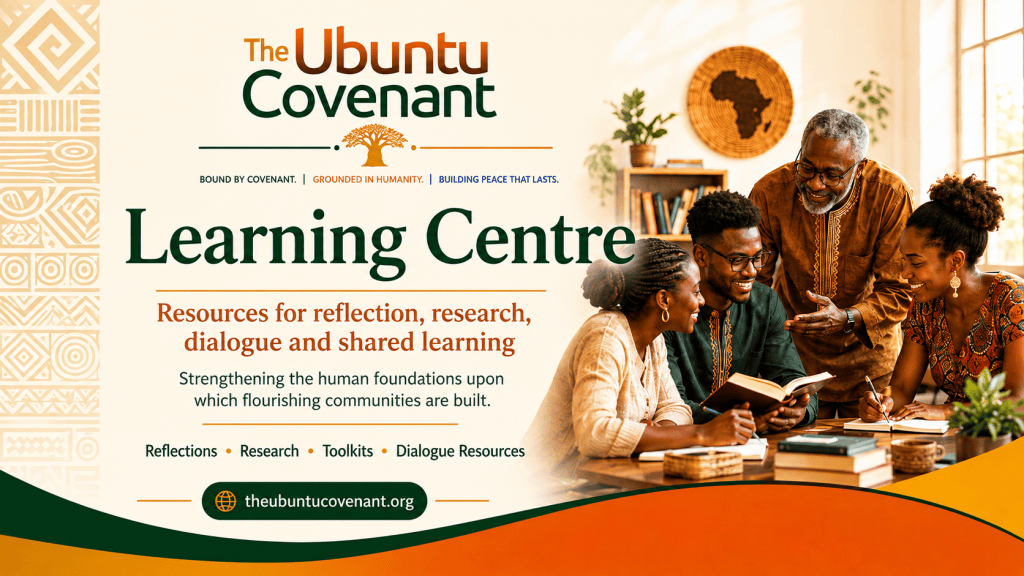
The Ubuntu Covenant Learning Centre is a growing space for reflection, research, knowledge-sharing, practical learning and thoughtful conversation about the human foundations that enable communities to flourish.
It brings together learning around questions of:
Ubuntu and shared humanity
ethical leadership and stewardship
dialogue, peace and reconciliation
belonging and community life
culture, heritage and intergenerational learning
community participation and local ownership
environmental stewardship
institutional strengthening
development and human flourishing
responsibility toward future generations
The purpose is not simply to produce or collect information.
It is to encourage learning that deepens understanding and strengthens practice.
Explore the Learning Centre
The Learning Centre is being built gradually as The Ubuntu Covenant learns, reflects and works alongside others.
Rather than beginning with a large collection of resources, we begin with questions worth exploring and learning worth sharing.
Reflections & Thought Pieces
Short reflections exploring the human foundations of community life — belonging, responsibility, dialogue, leadership, stewardship and the relationships that help communities flourish.
Conversations & Learning
Over time, the Learning Centre will also grow through conversations with communities, practitioners, researchers and institutions whose experience can deepen understanding and challenge assumptions.
These may include interviews, learning conversations, audio and video resources, field insights and shared reflections.
Research, Guides & Practical Resources
As The Ubuntu Covenat’s work develops, learning from research, dialogue and practice will be documented and shared through publications, learning guides, case studies and practical resources.
The purpose will not be simply to produce more information, but to make useful learning available for reflection, adaptation and practice.
Who Is the Learning Centre For?
Learning belongs to everyone.
A community leader can learn from a student.
A policymaker can learn from a farmer.
A researcher can learn from a community elder.
An experienced practitioner can learn from someone encountering a problem for the first time.
Young people can learn from memory.
Older generations can learn from emerging realities.
The Learning Centre is therefore intended for:
- community leaders and community organisations;
- educators and students;
- researchers and policymakers;
- faith leaders and faith communities;
- civil-society practitioners;
- development and humanitarian partners;
- public institutions;
- businesses and professional communities;
- volunteers and community workers; and
- anyone seeking to understand more deeply how people and communities flourish.
The most important qualification is not a title.
It is a willingness to learn, reflect and apply what is understood.
Learning With, Not Merely Teaching To
A learning institution can easily fall into the assumption that its role is always to provide knowledge.
But communities themselves are sources of knowledge.
Practitioners carry experience.
Researchers carry insight.
Institutions carry lessons.
Elders carry memory.
Young people carry emerging perspectives.
The Ubuntu Covenant therefore seeks to learn with people rather than simply speak to them.
We welcome opportunities for communities, researchers, educators, practitioners and institutions to contribute knowledge, challenge assumptions and deepen shared understanding.
The Learning Centre should become stronger because different experiences are allowed to encounter one another.
From Reflection to Action
The final question in learning should often be:
“What will we do differently because of what we now understand?”
Perhaps a leader listens differently.
Perhaps a community approaches disagreement earlier.
Perhaps an organisation redesigns a programme to strengthen local ownership.
Perhaps knowledge that was disappearing is preserved.
Perhaps a young person begins a conversation with an elder.
Perhaps an institution changes the way it measures success.
Perhaps a community begins thinking about what must remain after outside support ends.
Learning becomes meaningful when reflection begins to influence life.
Learn. Reflect. Apply. Share.
Learning is not a destination.
It is a continuing cycle.
Learn from knowledge and experience.
Reflect on what it means.
Apply what strengthens people and communities.
Share what may help others.
Then learn again from what happens next.
In this way, knowledge becomes part of a living inheritance.
Passed from person to person.
Community to community.
Generation to generation.
Wisdom grows when knowledge is examined, lived, shared and faithfully passed on.
