
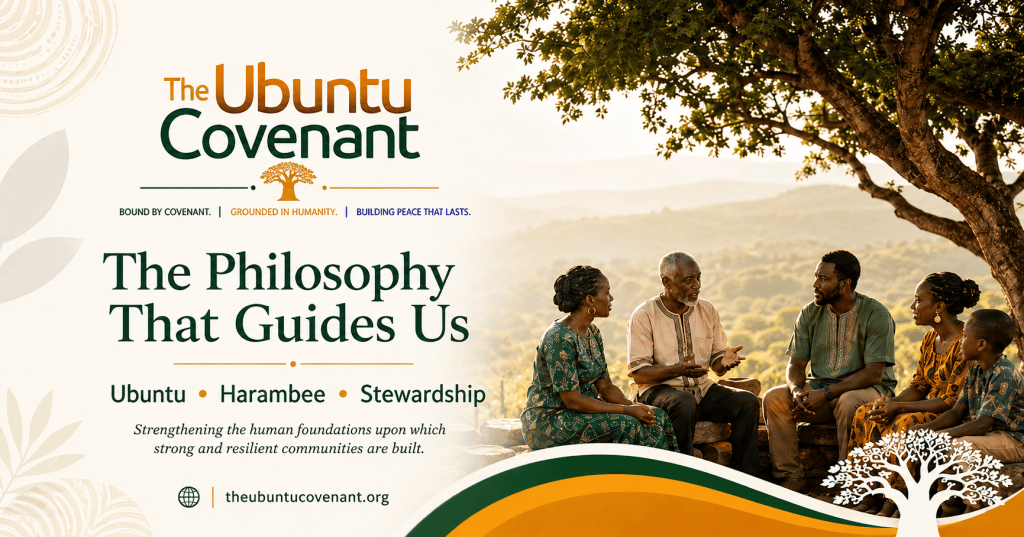
Every Action Begins With a Way of Seeing
Before people decide how to lead, they already carry an understanding of what leadership means.
Before communities decide how to respond to disagreement, they hold assumptions about one another.
Before institutions decide how to use resources, they reveal what they believe those resources are for.
And before one generation decides what to leave behind, it has already formed an understanding of its responsibility toward those who will come after it.
Behind our actions, therefore, there is always a way of seeing.
A way of seeing people.
A way of understanding community.
A way of interpreting responsibility.
A way of thinking about leadership, progress and the future.
This is philosophy in its most practical sense.
It does not remain only in books or ideas.
Eventually, it becomes visible in how people live.
How We See People Shapes What We Build
Consider two different ways of seeing a community.
One begins by asking:
What do these people lack?
What must be provided?
What needs to be fixed?
Another begins with different questions:
What dignity is already present here?
What wisdom has this community accumulated?
What responsibilities do people already carry?
What relationships, abilities and possibilities could be strengthened?
The questions are different because the understanding of people is different.
And different understandings eventually produce different approaches.
If people are regarded mainly as beneficiaries, development may be done for them.
If people are recognised as participants, contributors and stewards, development is more likely to be shaped with them.
The way we understand people ultimately influences the way we treat them.
And the way we treat people eventually shapes the communities and institutions we build.
No Person Flourishes Entirely Alone
Think about an ordinary human life.
A child depends upon family and community.
A farmer depends upon land, water, markets and relationships.
A leader depends upon the trust and cooperation of others.
An institution depends upon people willing to uphold its responsibilities.
Even the most independent person depends upon knowledge, systems, opportunities and relationships created by people they may never meet.
Our lives are distinct.
But they are never completely isolated.
What one person does can strengthen or weaken the wellbeing of another.
What one generation preserves or neglects becomes part of the inheritance of the next.
What leaders decide affects people beyond themselves.
What communities tolerate eventually shapes the kind of community everyone must live within.
This invites an important reflection:
If our lives continually affect one another, then perhaps being human is not only about who I am as an individual.
Perhaps it is also about who I am in relation to others.
African communities across generations have carried a language for this understanding.
That language is Ubuntu.
Ubuntu — Who We Are
Ubuntu begins with a simple but profound recognition:
our humanity is shared.
It reminds us that dignity is not something we reserve for ourselves.
If I recognise my own humanity, I must also recognise yours.
If my wellbeing matters, I must acknowledge that yours matters too.
If I desire respect, fairness, belonging and opportunity, I cannot regard those things as important only when they concern me.
Ubuntu therefore moves us beyond an entirely individual understanding of human life.
It teaches that people become human within relationships of recognition, dignity and responsibility.
This does not mean that individuality disappears into the community.
Nor does it require everyone to agree.
Ubuntu recognises both personhood and relationship.
It reminds us that:
who I am cannot be completely separated from how I relate to others.
And once that is understood, another question follows.
What does our shared humanity require of us?
Shared Humanity Creates Shared Responsibility
Imagine recognising another person’s dignity but taking no responsibility for how they are treated.
Imagine belonging to a community but believing its wellbeing is always someone else’s concern.
Imagine benefiting from institutions while carrying no responsibility for their integrity.
Recognition without responsibility eventually becomes incomplete.
If another person’s dignity matters, then how I treat them matters.
If the wellbeing of a community affects all who belong to it, then responsibility for that community cannot belong only to leaders, government or organisations.
Shared humanity therefore leads naturally toward shared responsibility.
Responsibility toward our families.
Toward neighbours.
Within leadership.
For institutions.
For land and natural resources.
For people whose voices are easily ignored.
And for generations not yet born.
Ubuntu therefore does not simply say:
“We belong to one another.”
It also asks:
“What does belonging require of us?”
At some point, responsibility must become action.
Harambee — How We Act
No meaningful community achievement is ever carried by one person alone.
Think about what happens when a community responds successfully to a shared challenge.
One person may bring knowledge.
Another brings experience.
Someone contributes leadership.
Another provides resources.
Someone brings relationships.
Others contribute time, creativity, labour or practical ability.
No single person carries everything.
But many people carry something.
This is the wisdom expressed through Harambee.
Harambee recognises the strength that becomes possible when people bring their different capacities together around a common purpose.
It is more than cooperation for convenience.
It is shared responsibility becoming shared action.
Ubuntu says:
Our lives are connected.
Harambee asks:
What, then, shall we do together?
Through Harambee, concern becomes contribution.
Belonging becomes participation.
Responsibility becomes cooperation.
And individual ability becomes part of a larger common purpose.
Lasting change is therefore rarely the achievement of one person.
It is strengthened when people recognise that although none of us carries everything, each of us may carry something.
But Working Together Is Not Enough
People can come together and still misuse what they build.
Resources can be mobilised and poorly managed.
Institutions can begin with good intentions and later lose their purpose.
Leadership can begin as service and slowly become entitlement.
Land can sustain one generation and be depleted by another.
Knowledge can be inherited and never passed on.
Collective action therefore requires something more than participation.
It requires faithful care.
It requires the ability to think beyond immediate benefit.
It requires us to ask what condition we will leave behind for others.
This is the responsibility of stewardship.
Stewardship — How We Care
Every generation receives something it did not create entirely for itself.
Relationships.
Families.
Communities.
Institutions.
Knowledge.
Culture.
Land.
Natural resources.
Opportunities.
We receive these things for a season.
Eventually, they pass into other hands.
Stewardship asks us to recognise this temporary responsibility.
It asks:
What has been entrusted to me?
How am I caring for it?
What condition will it be in when it reaches the next person or generation?
This changes the meaning of leadership.
Authority becomes responsibility.
It changes the meaning of resources.
Possession becomes trusteeship.
It changes the meaning of development.
Progress is no longer judged only by what we gain today, but also by what remains possible tomorrow.
Stewardship therefore calls us to care faithfully for people, relationships, institutions, knowledge, culture, creation and the opportunities future generations will inherit.
A steward does not ask only:
“What can I gain from what is in my hands?”
A steward also asks:
“What am I responsible for preserving, strengthening and passing on?”
Ubuntu, Harambee and Stewardship Belong Together
These ideas become clearer when understood together.
Ubuntu — Who we are.
Our humanity is shared, our dignity is mutual and our wellbeing is interconnected.
Harambee — How we act.
Because our lives are connected, we bring our different strengths together around shared responsibility and common purpose.
Stewardship — How we care.
Because something has been entrusted to us, we care for it faithfully and consider those who will inherit the consequences of our choices.
Together, they create a movement:
Shared humanity → Shared responsibility → Shared action → Faithful stewardship.
And this movement reveals something important about flourishing communities.
They are not strengthened merely by accumulating more.
They are strengthened when people learn to:
recognise one another,
carry responsibility together,
act for the common good,
and faithfully care for what they share.
What Happens When These Principles Are Lived?
We often notice the condition of a community through ordinary experiences.
Can people disagree without becoming enemies?
Can a leader be trusted with responsibility?
Do people feel that their voice matters?
Will neighbours cooperate when something threatens the whole community?
Do people care for common resources even when nobody is watching?
Are young people receiving wisdom from those who came before them?
Can institutions keep their commitments?
Do people still feel that they belong?
The answers reveal things that cannot always be seen in buildings, budgets or statistics.
Where people recognise one another’s dignity, belonging becomes possible.
Where commitments are honoured, trust grows.
Where people can listen across differences, dialogue becomes possible.
Where authority is carried faithfully, integrity becomes visible.
Where people contribute rather than wait passively, participation deepens.
Where today’s decisions consider tomorrow’s consequences, stewardship takes root.
Where people recognise that community wellbeing belongs to everyone, shared responsibility grows.
These qualities are not separate from community strength.
They are among the human foundations beneath it.
We often notice them most clearly when they are missing.
What This Means for Leadership
Leadership reveals how a society understands power.
If authority is regarded mainly as privilege, leadership becomes something to possess.
If authority is understood as stewardship, leadership becomes something to carry faithfully.
A philosophy rooted in shared humanity asks leaders to remember that authority affects the dignity, opportunities and wellbeing of others.
The question therefore changes.
Not only:
“What authority do I have?”
But:
“What has been entrusted to me?”
And:
“Will it be stronger because I carried responsibility for it?”
Leadership, in this understanding, becomes service, responsibility and stewardship.
What This Means for Peace
Peace cannot be measured only by the absence of visible conflict.
A family may stop arguing while resentment remains.
A community may appear calm while people no longer trust one another.
A dispute may formally end while relationships remain broken.
Silence can sometimes resemble peace without producing reconciliation.
A philosophy rooted in shared humanity asks deeper questions.
Can people recognise one another’s dignity even when they disagree?
Can they listen?
Can they seek understanding?
Can they pursue justice without dehumanising one another?
Can relationships be repaired where repair remains possible?
Peace therefore grows not only through the settlement of disputes.
It also grows through the human foundations that enable people to continue living together.
What This Means for Development
A project may be completed successfully and still leave people dependent.
Infrastructure may be built without community ownership.
Resources may be distributed without strengthening responsibility.
Outside expertise may solve today’s problem while leaving little local capacity to address tomorrow’s.
This does not mean resources, infrastructure or expertise are unimportant.
They matter greatly.
But another question must accompany them:
What is becoming stronger within people and communities as a result?
Are people more capable?
Has knowledge been transferred?
Has local ownership deepened?
Are institutions better equipped?
Can the progress continue when external support ends?
Development becomes more sustainable when people are not merely recipients of change.
They become participants and stewards of it.
What This Means for Future Generations
Many people who will experience the consequences of today’s decisions are not present to speak for themselves.
They cannot attend our meetings.
They cannot object when resources are exhausted.
They cannot ask us to preserve the knowledge we are allowing to disappear.
They cannot challenge decisions whose consequences they will inherit.
Yet one day they will live with what remains.
This gives the present generation a special responsibility.
What condition will they inherit our institutions in?
Our communities?
Our land?
Our environment?
Our knowledge?
Our relationships?
Our culture?
Stewardship asks us to include tomorrow in the decisions we make today.
A flourishing society is not one that succeeds only for the present generation.
It leaves possibilities open for those who come after it.
A Philosophy for Our Time
The circumstances in which African communities live have changed considerably.
Urbanisation.
Technology.
Climate change.
Migration.
Globalisation.
Economic pressure.
Changing family structures.
New forms of leadership and governance.
Yet underneath these changes, enduring human questions remain.
How should we live together?
What does dignity require?
How should power be exercised?
How do communities navigate disagreement?
What responsibility do we carry for one another?
How should common resources be cared for?
What does one generation owe the next?
Ubuntu, Harambee and stewardship do not offer simplistic answers to every modern challenge.
They offer something more foundational.
They provide a way of thinking about the human relationships and responsibilities within which those answers must be sought.
The Philosophy That Guides The Ubuntu Covenant
These understandings form the philosophical foundation of The Ubuntu Covenant.
Ubuntu shapes how we understand people.
Harambee shapes how we understand shared action.
Stewardship shapes how we understand responsibility.
Together, they guide how we approach leadership, peace, development, community, partnership and responsibility toward future generations.
They also shape the question beneath our work:
What human foundations must be strengthened so that communities are better able to flourish?
For us, philosophy is not decoration around the work.
It is the way of seeing that shapes the work itself.
A Philosophy Must Be Lived
The true test of a philosophy is not how beautifully it can be explained.
It is what happens when people live by it.
Ubuntu becomes visible when dignity is honoured.
Harambee becomes visible when responsibility is shared.
Stewardship becomes visible when people care faithfully for what has been placed in their hands.
The philosophy becomes real when:
people listen before judging,
leaders serve rather than merely occupy positions,
communities participate rather than wait passively,
resources are cared for rather than consumed without thought,
wisdom is shared rather than allowed to disappear,
and one generation considers the wellbeing of the next.
This is where philosophy becomes practice.
Not merely something we understand.
Something we live.
We inherit communities from those who came before us.
We shape them through the choices we make today.
We strengthen them for the generations yet to come.
