
What Makes Change Last?
Communities everywhere are working toward better futures.
Schools are built. Institutions are strengthened. Livelihoods are supported. Programmes are developed. Roads, services and opportunities are created.
All of these matter.
Yet experience raises another question:
What enables progress to endure after the programme ends, leadership changes or outside support is no longer present?
A good initiative can lose momentum when people do not feel ownership of it.
An institution can have strong policies and still struggle when trust has been lost.
A disagreement that might have been resolved early can deepen when people no longer know how to listen to one another.
Natural resources can support generations and still become depleted when stewardship gives way to short-term interests.
Knowledge carried for generations can disappear when nobody takes responsibility for passing it forward.
These realities remind us that sustainable change depends upon more than what is built.
It also depends upon what becomes stronger within people, relationships, communities and institutions.
Trust.
Belonging.
Responsible leadership.
Dialogue.
Participation.
Shared responsibility.
Stewardship.
The capacity to learn and act together.
These are among the human foundations that help communities sustain progress.
The question therefore becomes:
How can these foundations be strengthened in everyday community and institutional life?
From Understanding to Practice
A community project can have funding, technical expertise and a clear plan—and still struggle to endure.
Sometimes the difficulty is visible. A committee stops meeting. Participation declines. Conflict emerges. Maintenance is neglected.
But what is visible may not be the whole problem.
Behind a stalled project may be a question of ownership.
Behind low participation may be a question of voice or belonging.
Behind conflict may be relationships in which trust has weakened.
Behind weak institutions may be uncertainty about leadership, responsibility or accountability.
So before asking “What should be done?”, another question matters:
“What is really happening here?”
Understanding begins by listening—to people’s experiences, relationships, knowledge, disagreements, hopes and the capacities that already exist within the community.
Only then can people begin to recognise what needs strengthening, what they can take responsibility for together and what must be cared for if change is to endure.
This is where The Ubuntu Covenant seeks to contribute.
We listen, convene, facilitate and accompany—creating space for people and institutions to strengthen trust, navigate differences, exercise shared responsibility and develop locally owned ways forward.
The measure of that work is not how long The Ubuntu Covenant remains.
It is what becomes possible without our continued presence: people better able to work together, take responsibility, steward what they share and continue learning and acting after an engagement has ended.
Where Human Foundations Matter
The same challenge can appear differently from one community to another.
In one place, the visible concern may be conflict. In another, leadership. Elsewhere, it may be the stewardship of shared resources, the loss of cultural memory, or difficulty bringing people together around a common responsibility.
Yet beneath these different situations, similar human questions often emerge:
Do people trust one another?
Do they feel that they belong and that their voice matters?
Can differences be navigated without destroying relationships?
Is leadership exercised with responsibility?
Can people work together around what they share?
Will what is built today be cared for tomorrow?
These questions are where the work of The Ubuntu Covenant finds practical expression.
Rather than treating leadership, peace, culture, stewardship and community action as separate concerns, we explore the human foundations that connect them—and work alongside people and institutions to strengthen those foundations in practice.
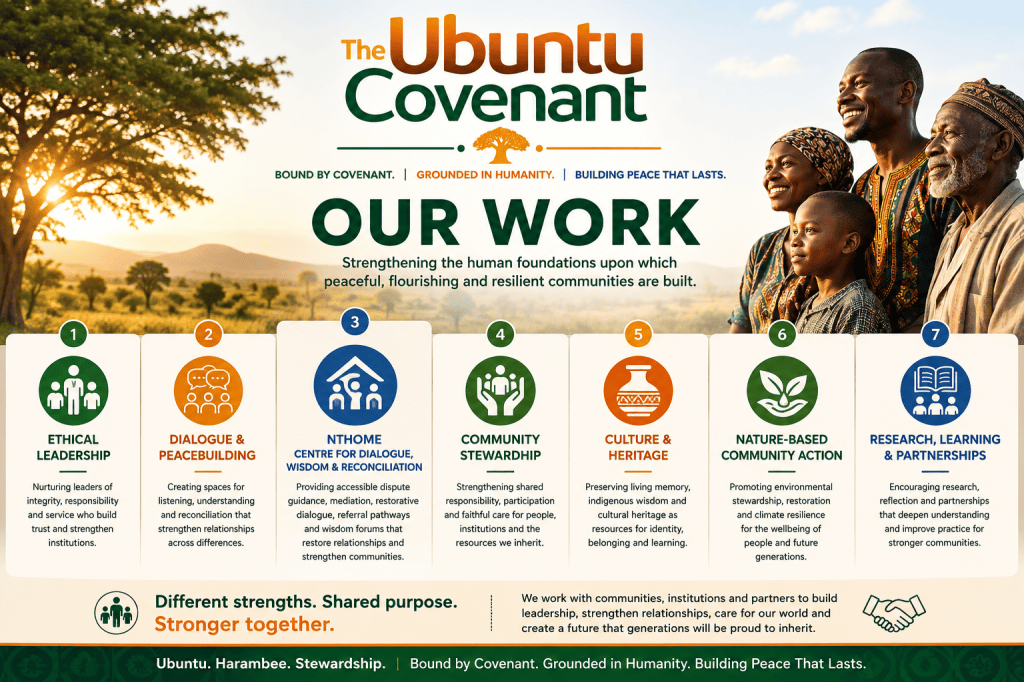
Ethical Leadership
Almost everyone has experienced the difference between a person who holds a position and a person who carries responsibility.
The title may be the same. The difference is often revealed in how power is exercised, how people are treated, how decisions are made and whether responsibility is carried beyond personal interest.
Leadership therefore shapes more than decisions. It shapes trust, belonging, institutional culture and people’s willingness to participate.
When leadership is experienced as responsible and accountable, people are more likely to believe that their contribution matters. When it is not, even well-designed institutions can become difficult to trust.
The question is not only who leads, but what kind of relationships and institutions their leadership is helping to create.
The Ubuntu Covenant works with leaders, institutions and communities to explore leadership as stewardship—strengthening reflection, responsibility, ethical decision-making and forms of leadership that protect dignity and contribute to the common good.
Dialogue & Peacebuilding
Almost every disagreement begins with something people see differently.
But conflict rarely remains only about the issue itself. Words are exchanged. Positions harden. People stop listening. Trust weakens. Sometimes the original disagreement becomes less important than what has happened to the relationship.
Peace therefore requires more than ending an argument.
It requires spaces where people can speak honestly, listen across differences, recognise one another’s dignity and begin rebuilding the relationships that make living and working together possible.
The question is not simply how conflict can be stopped, but what must be restored so that people can move forward together.
The Ubuntu Covenant creates and supports spaces for dialogue, reflection and reconciliation—helping communities and institutions navigate differences, strengthen trust and develop the capacity to address disagreement without allowing it to destroy belonging.
NTHOME — Centre for Dialogue, Wisdom & Reconciliation
Sometimes people do not need another institution telling them what should happen.
They need a trusted space in which they can be heard.
A disagreement within a family, tension over land, conflict between neighbours or a breakdown in community relationships can carry more than the issue that first brought people together. Beneath it may be memory, identity, dignity, mistrust, hurt or relationships that have weakened over time.
Not every disagreement requires the same response. Some need careful listening. Some need dialogue. Some may benefit from mediation or restorative processes. Others require professional, legal or specialised support beyond what a community process should attempt to provide.
The important question is not simply, “How do we settle this dispute?” but, “What will help people move forward without further damaging dignity, relationship and belonging?”
NTHOME — Centre for Dialogue, Wisdom & Reconciliation is a practical expression of this understanding within The Ubuntu Covenant.
It creates space for listening, dialogue and appropriate pathways toward reconciliation, drawing on community wisdom while recognising when referral to other forms of support is necessary.
Its work includes:
Listening and assessment — understanding the concern, the people and relationships involved, and the wider context before considering an appropriate pathway.
Dispute guidance — helping people understand the options available and consider what form of response may be appropriate.
Mediation and restorative dialogue — creating facilitated spaces for people to listen, speak honestly, navigate differences and, where possible, begin restoring relationships.
Referral — recognising when legal, administrative, counselling or other specialised support is needed beyond what NTHOME should provide.
Follow-up — returning to what has happened, what has been learned and what may help relationships and agreements endure.
But NTHOME is not concerned only with disputes.
Through wisdom forums, intergenerational conversations, leadership dialogues and community gatherings, it also creates space for reflection, belonging, living memory and responsible stewardship.
Because communities become stronger when people are heard before they are judged, guided when systems are difficult to navigate, and invited into dialogue before division becomes permanent.
Community Stewardship
A community may receive something valuable—a water system, a shared facility, restored land, new knowledge or an institution intended to serve people for many years.
But receiving something and sustaining it are not the same thing.
Over time, another set of questions begins to matter:
Who takes responsibility when something needs attention?
Who participates in decisions about what is shared?
How are benefits and responsibilities distributed?
What happens when disagreements arise?
And who is thinking about those who will inherit what exists today?
Stewardship begins when people see what they share not simply as something to benefit from, but as something entrusted to their care.
The Ubuntu Covenant works alongside communities and institutions to strengthen shared responsibility, local ownership and the capacity to care for common resources, relationships and institutions over time.
The goal is not simply to create something valuable. It is to strengthen the human capacity to care for what must endure.
Culture & Heritage
A community does not begin with the present generation.
Long before today’s institutions, programmes and development plans, people carried ways of understanding family, responsibility, land, identity, belonging and life together. Some of that wisdom remains alive. Some has weakened. Some deserves careful examination rather than automatic preservation.
When communities lose connection with their memory, they can also lose part of the language through which belonging, responsibility and identity have been understood.
But preserving culture is not simply about protecting the past.
The deeper question is:
What wisdom should be carried forward, what should be questioned, and what can help present and future generations live together with greater dignity and responsibility?
The Ubuntu Covenant creates spaces for intergenerational learning, storytelling, reflection and the exploration of cultural knowledge—helping communities engage their heritage not as something frozen in the past, but as a living resource that can contribute to belonging, responsibility and the common good.
Nature-Based Community Action
Land, water, forests and other shared natural resources are never only environmental concerns.
They are also connected to livelihoods, memory, relationships, responsibility and the choices one generation makes for another.
A degraded landscape may therefore raise a deeper human question:
What happens when something everyone depends upon becomes nobody’s responsibility?
Restoring the natural environment requires technical knowledge. But sustaining that restoration also depends on people—whether communities can cooperate, make decisions together, share responsibility and care for what has been restored after a project or outside partner has left.
This is where stewardship becomes practical.
The Ubuntu Covenant works alongside communities and partners to explore how shared responsibility, local knowledge and collective action can strengthen the care of natural resources and the places people depend upon.
The aim is not simply to restore a place, but to strengthen the human relationships and responsibility that can help care for it over time.
Research, Learning & Partnerships
Communities rarely face entirely new questions.
Somewhere, another community may already have wrestled with a similar challenge. A practitioner may have learned something through experience. Research may have uncovered an important insight. Local knowledge may hold an understanding that has never been formally documented.
The challenge is often not the absence of knowledge, but whether people are able to find it, question it, adapt it and learn from one another.
No single organisation, institution or community holds all the answers.
This is why learning becomes stronger when different forms of knowledge meet—community experience, research, professional practice and wisdom carried across generations.
The Ubuntu Covenant seeks to create connections between communities, practitioners, researchers and institutions so that useful knowledge can be exchanged, examined and translated into practice.
We also document what we learn from our own work— including what does not work—so that experience can contribute to better understanding and more responsible practice over time.
Why These Questions Belong Together
A conversation about leadership may uncover a question of trust.
A disagreement over land may reveal something deeper about belonging, memory or responsibility.
An environmental concern may eventually become a question about whether people can cooperate around something they all depend upon.
These connections matter because communities do not experience life in separate programme categories.
Relationships, leadership, belonging, responsibility and stewardship continually shape one another.
This is why the different areas of our work belong together.
The Ubuntu Covenant seeks to understand these connections and strengthen the human foundations beneath them—so that people and institutions are better able to work together, navigate differences, take responsibility for what they share and sustain what they build.
What Remains When the Programme Ends?
A programme can end on schedule.
The reports can be submitted. The funding can close. The facilitators can leave. The equipment can remain behind.
But those things do not necessarily tell us whether meaningful change will continue.
A more difficult question comes afterwards:
What are people and institutions now able to carry forward for themselves?
Perhaps people are better able to work across differences. Perhaps leadership is exercised with greater responsibility. Perhaps knowledge that once belonged to a few is more widely shared. Perhaps communities have greater confidence to make decisions together, care for shared resources or continue learning without waiting for another outside intervention.
These are not always the easiest changes to count. But they matter because lasting development ultimately depends on what people can continue to understand, practise, adapt and steward.
For The Ubuntu Covenant, this means paying attention to what becomes stronger through an engagement:
Trust and relationships — are people better able to listen, cooperate and navigate differences?
Belonging and participation — do people experience greater voice, dignity and responsibility within what they share?
Leadership — is responsibility being exercised in ways that strengthen trust and the common good?
Shared responsibility and local ownership — are people increasingly able to act together rather than depend on continued outside direction?
Stewardship — are communities and institutions better able to care for relationships, knowledge, resources and what they have built?
Capacity to continue — can learning, adaptation and collective action continue after an engagement has ended?
The measure of meaningful work is therefore not simply what was delivered while a programme was present, but what people are increasingly able to carry forward when it is gone.
Sometimes the First Step Is a Conversation
Not every meaningful relationship begins with a programme or proposal.
Sometimes it begins with a question that has not been fully understood.
A relationship that has become difficult.
A responsibility people are struggling to carry together.
Or the recognition that something important could become stronger if people had the space to listen, reflect and work through it together.
There may not always be an immediate answer.
But there can be value in beginning with understanding.
The Ubuntu Covenant welcomes conversations with communities, institutions and partners who are exploring how stronger human foundations can contribute to change that is locally owned and able to endure.
Because sometimes the beginning of lasting change is simply creating the space for people to see what they can understand, strengthen and carry forward together.
