
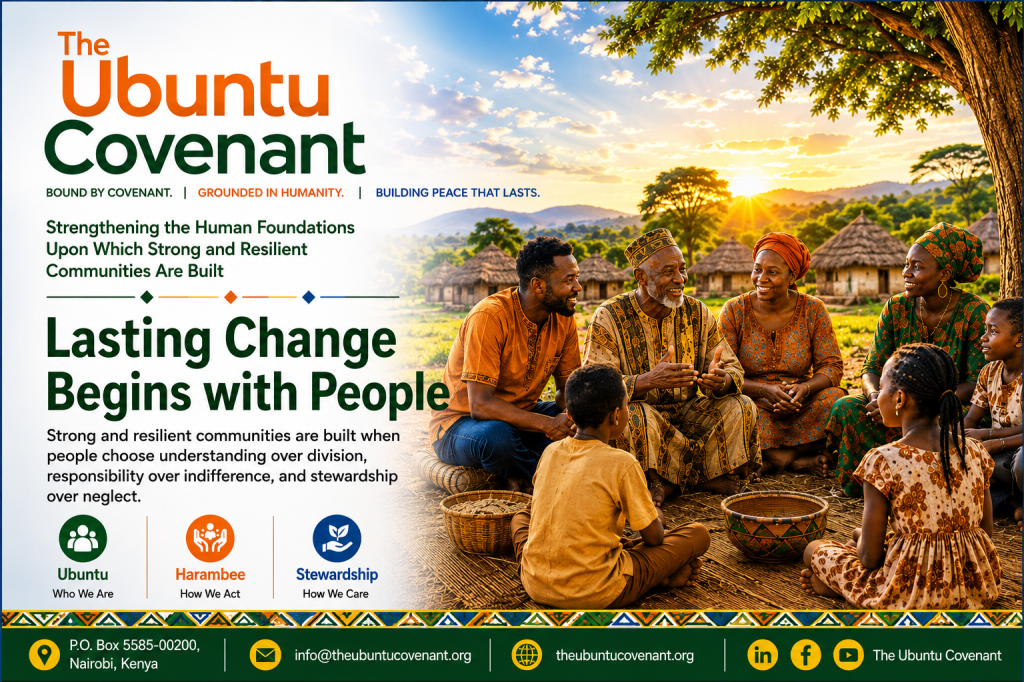
Why Does Progress Last in Some Communities and Not in Others?
Communities everywhere invest in development.
Roads are built. Schools are opened. Policies are written. Programmes are launched.
Yet some communities are able to sustain progress across generations while others struggle to do so.
Why?
The difference is not always found in infrastructure, funding or technical expertise.
Often, it lies in something less visible.
The quality of relationships between people.
The level of trust within institutions.
The way leadership is understood.
The strength of belonging.
The willingness of people to carry responsibility for one another and for the future.
These are the human foundations upon which lasting development is built.
Before There Were Institutions, There Were People
Before there were governments, organisations, development programmes or formal institutions, there were people.
People lived in families.
They formed communities.
They learned to depend upon one another.
They developed ways of resolving differences, sharing knowledge, caring for resources and protecting what mattered to them.
Over time, institutions emerged to organise and strengthen these responsibilities.
But institutions do not replace the human relationships beneath them.
A school may have buildings, teachers and policies.
A community may have leadership structures.
A country may have laws and public institutions.
Yet whether these structures flourish often depends upon something deeper:
Trust.
Responsibility.
Belonging.
Participation.
Dialogue.
Leadership.
Stewardship.
These are not secondary concerns.
They are part of the foundation upon which institutions and communities endure.
When the Human Foundations Weaken
The weakening of a community rarely happens all at once.
It often begins quietly.
People stop listening to one another.
Leadership becomes associated with position rather than responsibility.
Young people become disconnected from community wisdom.
Citizens begin to withdraw from public life.
Differences become harder to navigate, and shared responsibilities gradually give way to individual interests.
Development may continue on the surface while the relationships beneath it become increasingly fragile.
Eventually, what appears to be a technical problem may reveal something deeper.
A governance challenge may also be a trust challenge.
A conflict may also be a relationship challenge.
A struggling community initiative may also be an ownership challenge.
A leadership problem may also be a stewardship challenge.
This changes the questions we ask.
It is no longer enough to ask:
“What should we build?”
We must also ask:
“What kind of people, relationships and institutions are needed to sustain what we build?”
The Human Foundations of Flourishing Communities
If strong communities depend upon more than structures, what are the human foundations beneath them?
Experience points us toward several.
Belonging — People are more likely to contribute to communities in which they know they matter and have a place.
Human Dignity — How people are seen and treated shapes whether they can participate, contribute and flourish.
Trust — Cooperation becomes possible when people can rely on one another, their leaders and the institutions they share.
Dialogue — Communities need ways to listen across differences, address disagreement and continue living together.
Responsible Leadership — Leadership strengthens communities when authority is exercised as responsibility rather than privilege.
Participation — People are more likely to take responsibility for what they have genuinely helped to understand and shape.
Stewardship — What communities inherit, build and share must be cared for with both the present and future in mind.
The question is not simply what we inherit.
It is:
Will we consume what has been entrusted to us, or strengthen it for those who come after us?
From Understanding to Responsibility
Recognising these human foundations leads to another question:
How are they strengthened?
Trust cannot simply be announced.
Belonging cannot be imposed.
Dialogue cannot be reduced to a meeting.
Responsible leadership cannot be created by giving someone a title.
And genuine participation cannot grow where people are never entrusted with meaningful responsibility.
These qualities are cultivated over time.
They grow when people have opportunities to listen to one another, learn together, carry responsibility, resolve differences, participate in decisions and act around shared concerns.
This means that strengthening a community is not only about changing structures.
It is also about cultivating the relationships, values and responsibilities that allow those structures to endure.
And this leads us to a deeper question:
Is there a way of understanding human life that can help us think about these responsibilities?
The Wisdom of Ubuntu
Long before these questions were expressed through modern institutions or development language, African communities carried ways of understanding what it means to live well with others.
One of the deepest expressions of this wisdom is Ubuntu.
Ubuntu begins with a simple recognition:
Our humanity is deeply connected.
We become who we are through relationships—with families, neighbours, communities and generations before us. Our choices affect others, and our dignity calls us to recognise the dignity of those around us.
Ubuntu therefore asks:
Who are we to one another?
But recognising our shared humanity is only the beginning.
A community may care deeply about a shared concern and still wait for someone else to act.
This is where Harambee becomes important.
Rooted strongly in Kenya’s experience of collective effort, Harambee asks:
What can we do together—and what responsibility belongs to each of us?
It moves belonging toward contribution and shared humanity toward shared action.
Yet even collective action raises another question:
What happens to what we build after the moment of action has passed?
A school must be cared for. An institution must be led responsibly. Knowledge must be preserved and passed forward. Resources must be used with those who come after us in mind.
This is the responsibility of Stewardship.
It asks:
What has been entrusted to us—and what will we leave stronger for those who come after us?
Together, these ideas describe a movement:
Ubuntu — Who we are.
Harambee — How we act.
Stewardship — How we care.
Or more simply:
Shared humanity → Shared responsibility → Faithful care.
These ideas matter not because they sound compelling, but because of what they ask of people, communities and institutions in practice.
That is where the work of The Ubuntu Covenant begins.
The Ubuntu Covenant
The questions we have explored are not abstract.
They shape whether communities can live together peacefully, whether leadership serves responsibly, whether people participate meaningfully, and whether development leaves behind stronger communities.
It is within these realities that The Ubuntu Covenant finds its purpose.
The Ubuntu Covenant is a Kenyan Public Benefit Organization working to strengthen the human foundations upon which peaceful, flourishing and resilient communities and institutions depend.
Rooted in Ubuntu, expressed through Harambee and guided by Stewardship, we work with people, communities and institutions to strengthen the relationships, values, capacities and responsibilities that enable communities to flourish.
But this work does not begin with the assumption that communities are empty spaces waiting for outside solutions.
Communities already possess knowledge.
They carry experience.
They hold relationships, memory, traditions, leadership and capacity.
Our starting point is therefore to recognise what is already present.
We create spaces where people can reflect upon that knowledge and experience, strengthen what already works, confront what needs to change, and build the capacity to respond to the challenges and opportunities before them.
Our purpose is not simply to do things for communities.
It is to help strengthen the human foundations through which communities can increasingly think, participate, lead and act for themselves.
What This Means in Practice
The human foundations of community life are strengthened through practice, not ideas alone.
For The Ubuntu Covenant, this means working alongside communities and institutions in areas where relationships, responsibility, leadership, participation and stewardship shape what becomes possible.
Our work includes:
Dialogue, Peace & Reconciliation — creating constructive pathways for understanding, disagreement, mediation and restoration.
Ethical Leadership & Stewardship — strengthening leadership that understands authority as responsibility and service.
Community, Belonging & Human Dignity — strengthening the relationships and conditions through which people experience dignity, belonging and shared responsibility.
Governance, Citizenship & Participation — helping strengthen meaningful participation, accountability and people’s ability to shape what affects their lives.
Community Learning & Heritage — creating spaces for knowledge, memory, experience and intergenerational wisdom to be shared and carried forward.
Collaboration & Local Ownership — working in ways that strengthen local capacity, shared responsibility and the ability of communities and institutions to carry work forward.
No single response will be appropriate everywhere. What matters is understanding the context first and determining what kind of engagement can genuinely strengthen what is already present.
Development Should Leave Communities Stronger
Every development effort eventually reaches a moment when the programme ends, the funding cycle closes or outside partners leave.
That moment reveals something important:
What remains when the project ends?
Lasting development should leave behind more than completed activities.
It should strengthen knowledge, relationships, local ownership and institutional capacity. It should leave people better able to make decisions, respond to challenges and carry useful work forward.
This changes how we think about success.
The question is not only:
“What did the project accomplish?”
We must also ask:
“What became stronger because the work took place?”
Because perhaps one of the clearest signs of lasting development is what people and institutions are increasingly able to continue, adapt and strengthen for themselves.
Learning as Part of the Work
No community, institution or programme can be fully understood from the beginning.
Assumptions are tested by experience. Circumstances change. People reveal perspectives that were not visible at first. What works in one setting may need to be adapted in another.
That is why learning should not happen only at the end of the work.
We seek to reflect while the work is unfolding—listening to experience, noticing what is changing, documenting what matters and allowing what we learn to shape what happens next.
Good practice does not simply apply what is already known. It remains willing to learn.
Partnership as Shared Responsibility
Some challenges are too interconnected for any one organisation, institution or community to address alone.
Partnership becomes meaningful when it brings together different forms of knowledge, experience, capacity and responsibility around something that matters to all involved.
For The Ubuntu Covenant, partnership is therefore not simply about what one party can provide to another.
It asks a deeper question:
What can we understand, contribute and steward together that none of us could carry as well alone?
We seek relationships with communities, institutions, practitioners, researchers, funders and others who share an interest in strengthening the human foundations that help people and institutions flourish.
Partnership is strongest when responsibility is shared, learning moves in more than one direction, and each participant brings something of value.
Every Relationship Begins with a Conversation
Much of what strengthens a community begins before a programme is designed or a partnership is formed.
It begins when people are willing to listen.
To ask questions.
To understand one another’s experiences.
To discover where concerns, responsibilities and possibilities are shared.
This is true within communities.
It is also true between people and institutions seeking to work together.
Not every conversation needs to begin with a proposal.
Sometimes it begins with a question.
Sometimes with an idea worth exploring.
Sometimes with a challenge that cannot be understood from one perspective alone.
And sometimes with the recognition that something meaningful might become possible if people begin talking.
For The Ubuntu Covenant, conversation is therefore not simply a step toward partnership.
It is part of how relationship begins.
If the questions and ideas explored here connect with your community, institution or work, we welcome the opportunity to begin that conversation.
