
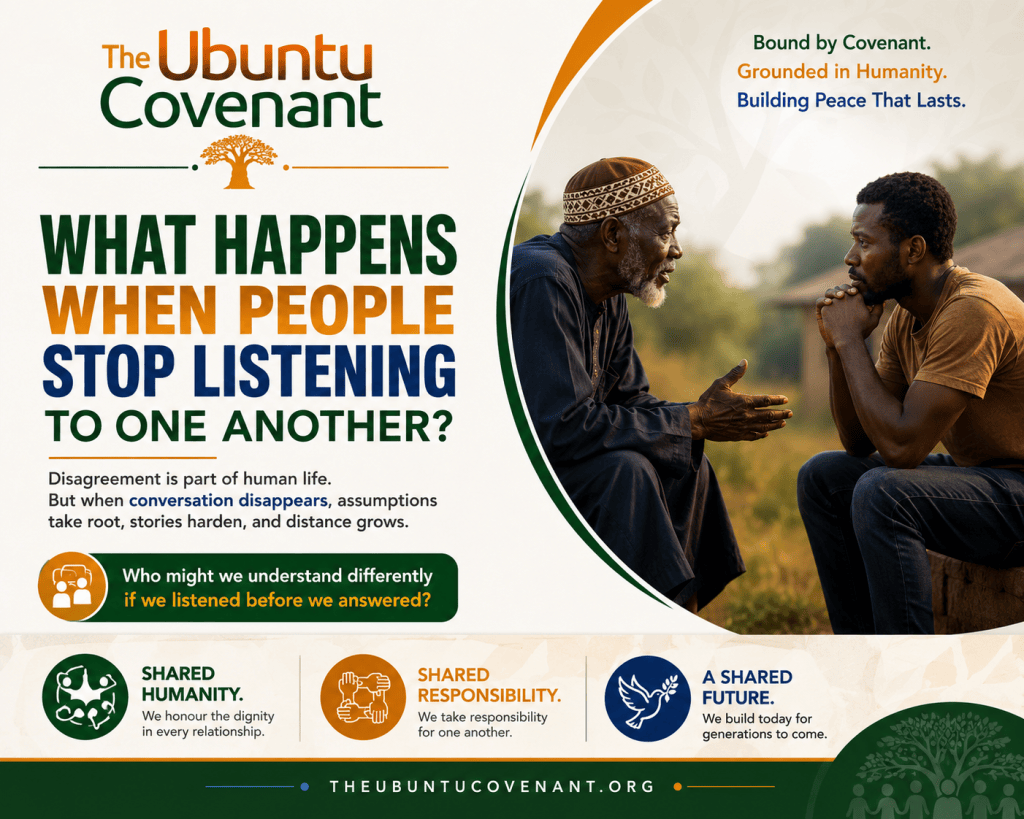
Two neighbours had lived beside each other for many years.
Their children played together. They borrowed tools from one another. When one household celebrated, the other often joined them.
Then came a disagreement.
It began with something relatively small—a boundary, a misunderstanding, a few words spoken in frustration.
Neither neighbour thought the matter was serious enough to require a real conversation.
So they stopped talking.
Days became weeks.
Each continued speaking about what had happened, but mostly to other people.
And something interesting began to happen.
With every retelling, the other neighbour seemed a little more unreasonable.
A little more difficult.
A little more responsible for what had gone wrong.
The original disagreement had hardly changed.
But the distance between them had.
When Conversation Disappears
We often assume that relationships break because people disagree.
But disagreement is part of human life.
Families disagree.
Neighbours disagree.
Colleagues disagree.
Communities disagree.
Institutions disagree.
Even people who care deeply about one another will sometimes understand the same situation differently.
The greater danger may not always be disagreement itself.
Sometimes it is what happens after disagreement, when conversation disappears.
Silence leaves space.
And that space rarely remains empty.
We fill it with assumptions.
We begin imagining why the other person acted as they did.
We interpret their silence.
We remember previous disappointments.
We discuss the situation with people who already understand our side.
Slowly, our assumptions can become explanations.
Our explanations become stories.
And our stories become convictions.
Eventually, we may become completely certain about someone we have stopped speaking to.
Every Conflict Has More Than One Story
Ask two people to describe the same disagreement and you may hear two remarkably different accounts.
This does not necessarily mean one of them is lying.
Human beings experience events from different positions.
We notice different things.
We remember different words.
We interpret intentions differently.
We carry histories the other person may not fully understand.
That is why listening matters.
Listening does not immediately tell us who is right.
It does something that may need to happen first.
It helps us understand what the situation looks like from somewhere other than where we are standing.
Sometimes that changes our judgement.
Sometimes it does not.
But understanding another person’s experience can change the way we carry our disagreement.
Listening Is Not Agreement
One reason people sometimes resist dialogue is because they fear that listening means surrendering their position.
But listening and agreement are not the same thing.
We can listen carefully and still disagree.
We can understand someone’s pain without accepting every conclusion they draw from it.
We can acknowledge harm without pretending that only one person has a story.
We can hold convictions while remaining curious about how another person arrived at theirs.
Good dialogue does not ask people to abandon truth.
It asks something more difficult:
Can we pursue truth without abandoning one another’s humanity?
That requires patience.
It requires humility.
And sometimes it requires the courage to hear something we would rather not hear.
When Silence Becomes Inheritance
Unresolved conflict rarely belongs only to the people who began it.
A disagreement between siblings can become distance between their children.
A dispute over land can shape relationships for generations.
A grievance within a community can slowly become a story about another family, clan, group or generation.
People who were not present when the original disagreement occurred may eventually inherit its consequences.
They may even inherit its anger.
This is why reconciliation is not only about repairing yesterday.
It can also be an act of responsibility toward tomorrow.
Someone eventually has to ask:
Must the next generation inherit this too?
That question can change a conflict.
It moves us beyond proving who was right and asks what kind of future our present choices are creating.
The Courage to Meet Again
Not every broken relationship can be restored easily.
Some conflicts involve deep harm.
Some require accountability.
Some need mediation, protection, professional guidance or time.
Reconciliation should never mean pretending that harm did not happen.
But many relationships remain broken not because reconciliation is impossible, but because nobody knows how to begin.
Sometimes the beginning is remarkably small.
A willingness to meet.
A question asked without accusation.
An opportunity for each person to speak without interruption.
An acknowledgement of pain.
An apology.
A willingness to hear the story we have spent years avoiding.
None of these guarantees reconciliation.
But they reopen something conflict often closes:
the possibility of seeing a human being where we had begun to see only an opponent.
From Ubuntu to Harambee
There is an old African understanding captured in the idea of Ubuntu:
Our humanity is deeply connected to the humanity of others.
This does not mean relationships will always be easy.
Ubuntu does not remove disagreement.
It asks what happens to our shared humanity inside disagreement.
Can I oppose your position without denying your dignity?
Can I seek justice without becoming indifferent to your humanity?
Can we disagree without making coexistence impossible?
And when repairing a relationship requires more than individual willingness, another principle becomes important: Harambee—shared responsibility in action.
Sometimes peace requires others to help hold the space.
Families.
Elders.
Community leaders.
Mediators.
Institutions.
People willing to help those in conflict speak, listen and search for a way forward.
Peace is rarely sustained by spectators.
It requires participation.
Perhaps Peace Begins Before Agreement
We sometimes imagine peace as the moment when everyone finally agrees.
Human communities rarely work that way.
Perhaps a more durable understanding is possible.
Peace is not the absence of disagreement.
It is the presence of relationships, practices and institutions strong enough to help us live through disagreement without destroying one another.
That is why dialogue and reconciliation matter to The Ubuntu Covenant.
Our interest is not simply in ending arguments.
It is in strengthening the human foundations that make peaceful communities possible: dignity, trust, listening, shared responsibility and the capacity to remain in relationship even when differences are difficult.
But before any programme, framework or institution enters the picture, something much simpler must happen.
Someone has to become willing to listen.
Someone has to become willing to speak.
And sometimes someone has to find the courage to say:
Can we talk again?
Perhaps that is where reconciliation begins.
Not when every disagreement has disappeared.
But when people decide that disagreement will no longer have the final word.
Who might we understand differently if we listened before we answered?
Shared Humanity. Shared Responsibility. A Shared Future

Leave a comment