
There is a remarkable sentence written about David.
It does not begin by describing the size of his kingdom.
It does not mention the battles he won.
It does not count the wealth accumulated during his reign.
It does not even begin with the title by which history remembers him.
Instead, Acts 13:36 records:
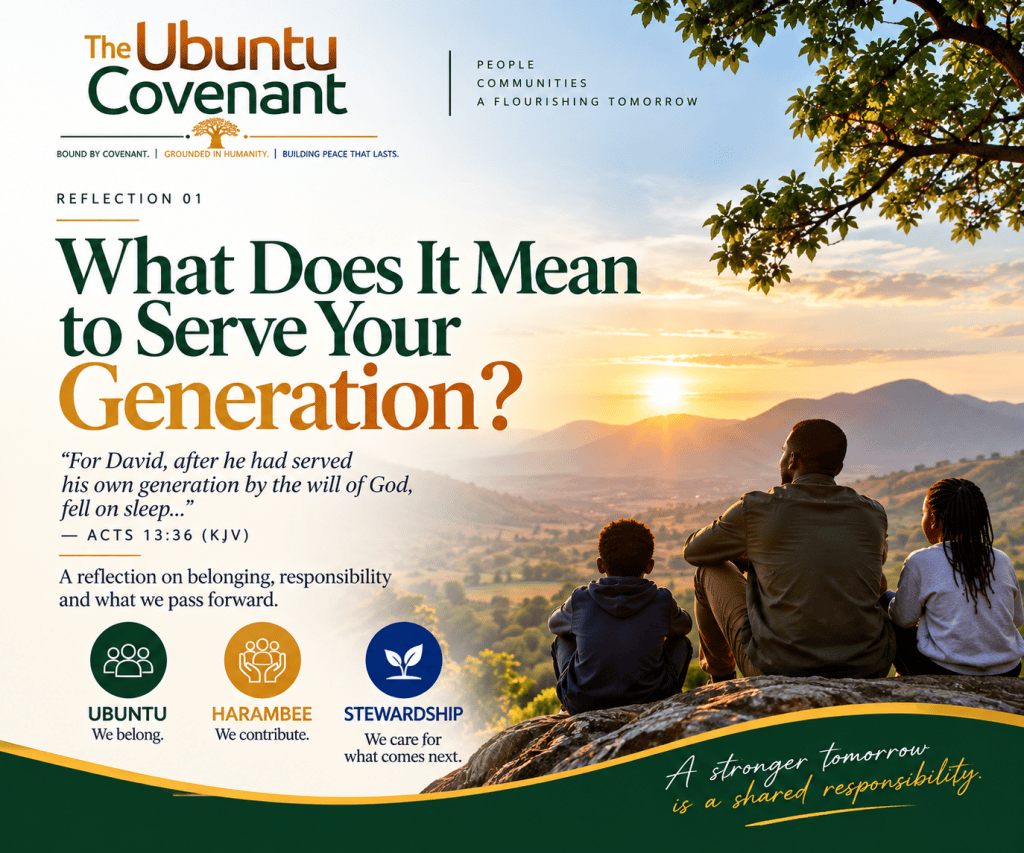
“For David, after he had served his own generation by the will of God, fell on sleep…”
— Acts 13:36, KJV
He served his generation.
There is something worth considering in those words.
Every generation arrives in a world it did not create.
We inherit families we did not begin.
Communities whose stories started before us.
Land we did not make.
Institutions built through the labour of others.
Knowledge discovered before we were born.
Cultures, traditions, relationships and natural resources that existed before they reached our hands.
We inherit achievements.
We also inherit unfinished problems.
And for a relatively brief period in history, all these things become part of our responsibility.
Then another generation comes.
Perhaps the question of a meaningful life, therefore, is not only:
What can I achieve during my lifetime?
There may be another question:
What has been entrusted to my generation — and what condition will it be in when we hand it to the next?
Every Generation Receives an Inheritance
None of us begins from nothing.
Someone taught before we became teachers.
Someone cultivated before we inherited the land.
Someone built the institution in which we now work.
Someone preserved knowledge that we now possess.
Someone struggled for opportunities we may now take for granted.
Someone planted trees beneath whose shade they knew they might never sit.
Our generation receives the benefit of decisions made by people we may never meet.
But inheritance is rarely perfect.
We also receive problems previous generations could not resolve.
Broken relationships.
Environmental degradation.
Weak institutions.
Inequality.
Conflict.
Distrust.
Systems that no longer serve people as they should.
Communities in which people may live increasingly close to one another while feeling less responsible for one another.
Some of these challenges began long before us.
We may not be responsible for creating everything we inherited.
But once something reaches our hands, another question arises:
What will we do with it?
That is where inheritance begins becoming stewardship.
Perhaps Leadership Is Really Stewardship
Leadership is often described through position.
Who occupies the office?
Who has authority?
Who makes decisions?
Who controls resources?
Who has influence?
But Acts 13:36 invites another measure.
Did this person serve their generation?
That changes the question.
Instead of asking only:
What position did I occupy?
we might ask:
What became stronger because responsibility passed through my hands?
Did people become stronger?
Did relationships become more trustworthy?
Did institutions become more responsible?
Did communities become more capable of working together?
Did those with less power retain their dignity?
Did we care for resources entrusted to us?
Did we preserve what deserved to be preserved?
Did we repair what needed repairing?
Did we leave something upon which another generation could build?
Leadership viewed this way is not primarily possession.
It is entrustment.
Authority is entrusted.
Knowledge is entrusted.
Resources are entrusted.
Opportunity is entrusted.
Influence is entrusted.
And stewardship asks what we do while those things are temporarily in our care.
Nobody Serves a Generation Alone
There is another important word in Acts 13:36.
Generation.
David’s life was lived among other people.
So is ours.
Whatever responsibility we carry exists within relationships.
A teacher’s work is connected to learners.
A leader’s decisions affect people they may never personally meet.
A farmer’s stewardship of land can affect another generation.
A parent’s choices can shape a family long after childhood has ended.
The strength of an institution depends upon many people fulfilling responsibilities that cannot be carried by one individual alone.
Human beings are profoundly interconnected.
African thought gives us a powerful language through which to consider this reality:
Ubuntu.
Ubuntu reminds us that a human being does not become fully human in isolation.
Our lives are formed in relationship.
Who I become affects others.
What happens to others eventually affects the community to which I belong.
My wellbeing cannot be understood entirely apart from yours.
But recognising our interconnectedness raises another question.
If we belong to one another, what responsibility does that belonging create?
From Ubuntu to Harambee
Belonging that never becomes responsibility can remain merely an attractive idea.
If my wellbeing is connected to yours, there will eventually be moments when recognising that connection requires something from me.
Participation.
Contribution.
Listening.
Sacrifice.
Cooperation.
Responsibility.
This brings us to another idea deeply familiar within Kenya:
Harambee.
To pull together.
There are things no individual can build alone.
A peaceful community.
A trustworthy institution.
A healthy environment.
A flourishing school.
A resilient family.
A society in which dignity is protected.
These require people willing to contribute toward something larger than themselves.
Ubuntu therefore asks:
Who are we to one another?
Harambee asks:
What must we do together?
But even working together is not the end of the responsibility.
Because eventually we must ask what happens to what we build.
What Happens After We Build?
A community may build a water system.
Who maintains it?
An organisation may establish an institution.
Who protects its purpose when the founding generation is gone?
A society may develop public resources.
Who ensures they are used for the common good?
A family may inherit land.
Who considers what another generation will receive?
People may work together to create something valuable.
But if nobody accepts responsibility for preserving it, today’s achievement can become tomorrow’s loss.
This is where stewardship completes the movement.
Stewardship asks:
What has been entrusted to us?
How will we care for it?
Who else has a legitimate interest in it?
And what condition will it be in when it leaves our hands?
This gives us a simple progression:
Ubuntu → Harambee → Stewardship
We belong.
We contribute.
We care for what has been entrusted to us.
And ultimately:
We pass something forward.
Development Also Has a Human Foundation
This way of thinking has implications beyond individual leadership.
Consider a community that receives significant investment.
A road is constructed.
A water system is installed.
A school is built.
An organisation is established.
Training is provided.
Resources are made available.
These things matter.
Communities need infrastructure, finance, institutions, technology, knowledge and effective public systems.
But something else eventually determines what happens to many of these investments.
People.
A water system requires people willing to maintain it.
A cooperative requires trust.
An institution requires people willing to exercise authority responsibly.
Public resources require stewardship.
Peace requires people capable of addressing disagreement without destroying relationship.
Community initiatives require participation.
Development therefore rests partly upon an infrastructure that is much harder to photograph.
Trust.
Belonging.
Responsibility.
Cooperation.
Character.
Stewardship.
When these human foundations are strong, material and institutional investments have something upon which to stand.
When they weaken, even substantial investment may struggle to endure.
This leads to a question worth exploring:
What are the human conditions without which development, institutions, peace and community life eventually weaken?
A Question That Gave Birth to The Ubuntu Covenant
Questions like these sit at the heart of The Ubuntu Covenant.
We are interested not only in what communities build, but in the human relationships, responsibilities and practices that help what is built to endure.
We are exploring how the enduring principles of Ubuntu, Harambee and Stewardship might be translated from ideas we admire into practices we can live.
Our starting point is not the assumption that we already possess all the answers.
It is a willingness to ask.
To listen.
To learn from communities.
To learn from African wisdom and lived experience.
To engage practitioners, researchers and institutions.
To test ideas in practice.
To reflect on what works and what does not.
And to share what we learn so that others can question, adapt and improve it.
Because perhaps serving our generation does not begin by assuming that we already know everything our generation needs.
Perhaps it begins by listening carefully enough to understand what has been entrusted to us.
Service Is Larger Than Position
Acts 13:36 is also liberating because service to one’s generation is not reserved for presidents, chief executives, religious leaders or people with public titles.
A generation is served in classrooms.
In homes.
On farms.
Inside businesses.
In hospitals.
Within public institutions.
Through research.
Through art.
Through honest work.
Through caring for children.
Through preserving memory.
Through protecting land.
Through building trustworthy organisations.
Through resolving conflicts.
Through creating opportunities for someone who otherwise might never receive them.
Most people who strengthen a generation will never become famous.
But significance and visibility are not the same thing.
A person may have enormous influence upon the future while remaining largely unknown beyond the people whose lives they touched.
Perhaps the better question is therefore not:
How important will I become?
But:
What responsibility is already within my reach?
We Are Also Someone Else’s Ancestors
There is another way of looking at our generation.
One day, we will be the previous generation.
People who have not yet been born may live with consequences of decisions being made today.
They may inherit institutions we currently lead.
Land we currently use.
Environmental conditions we currently influence.
Public systems we currently strengthen or weaken.
Family stories we choose either to preserve or forget.
Cultures we either carry responsibly or allow to disappear.
Debts we create.
Opportunities we open.
Relationships we repair.
And problems we decide to leave unresolved.
They may never know our names.
But they may live inside the consequences of our stewardship.
Perhaps this is one of the deepest meanings of serving a generation:
to live responsibly toward people we may never meet.
A Reflection to Carry With You
Acts 13:36 eventually says that David “fell on sleep.”
His opportunity to serve his generation had an ending.
So will ours.
That makes this question personal.
What has been entrusted to you in this generation?
Perhaps it is a family.
A classroom.
A business.
A farm.
A community.
A public office.
A church.
An organisation.
A profession.
A piece of land.
Knowledge.
Influence.
Resources.
Or simply a few people whose lives regularly intersect with yours.
Whatever it is, consider another question:
Will it be stronger because it passed through my hands?
Not perfect.
Not necessarily larger.
Not necessarily famous.
But stronger.
More trustworthy.
More humane.
More capable of serving others.
Better prepared for whoever comes next.
Perhaps that is one measure of a life well lived.
Not simply that we were present in our generation.
Not simply that we succeeded within it.
But that while we were here,
we served it.
The Ubuntu Covenant
Ubuntu • Harambee • Stewardship
Belonging. Shared Responsibility. Faithful Care for What Comes Next.

Leave a comment