
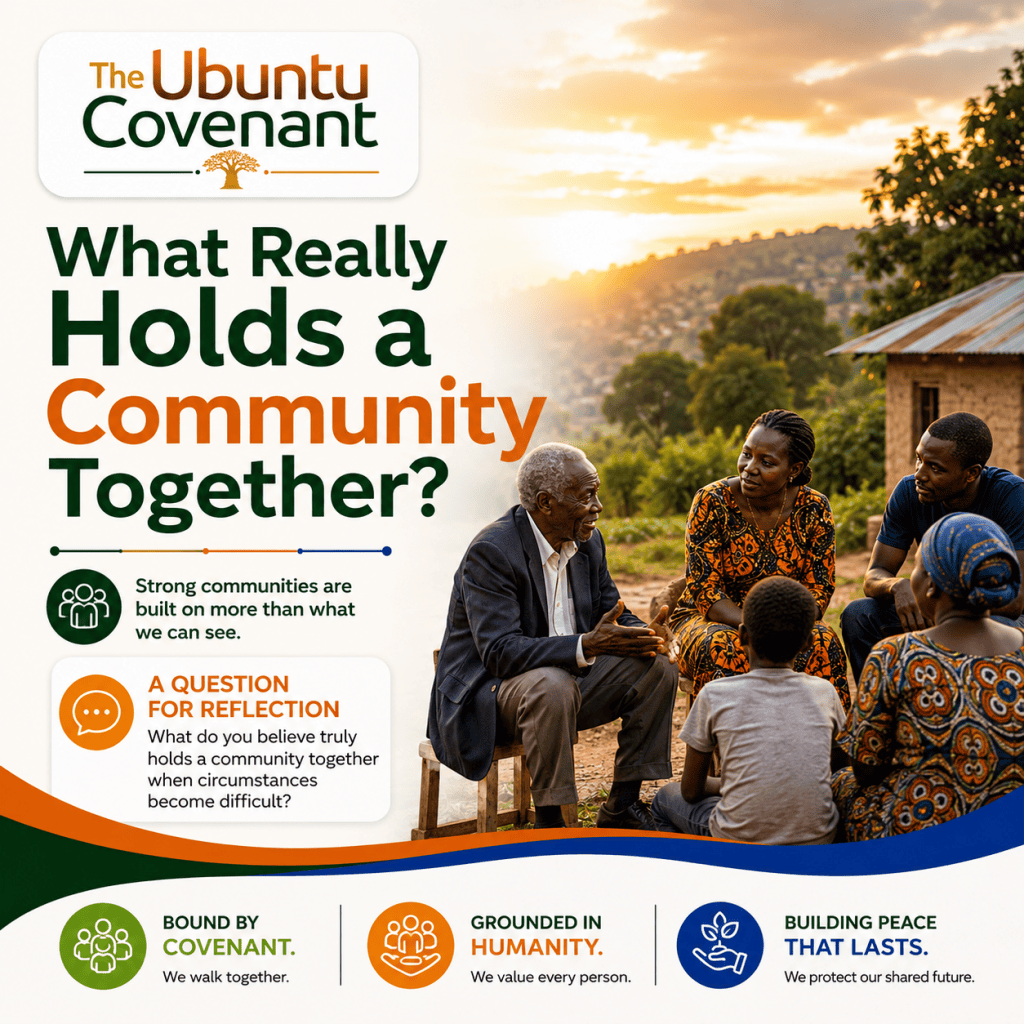
Why do some communities flourish across generations, while others struggle to sustain progress?
At first, the answer may seem straightforward.
Communities need schools. Roads. Healthcare. Functioning institutions. Economic opportunity. Technology. Safe public spaces.
All of these matter.
They expand opportunity, strengthen systems and improve everyday life.
But they do not tell the whole story.
Two communities may have similar infrastructure, similar institutions and access to similar resources—and yet experience very different outcomes over time.
So perhaps another question is necessary:
What lies beneath the things we can see?
The foundations we do not always see
Every visible system rests upon relationships between people.
A school may have classrooms, books and trained teachers. But its strength also depends on trust between families and educators, responsibility among those entrusted with leadership, and a shared commitment to the wellbeing of learners.
An institution may have policies and structures. But those structures still depend on people choosing integrity over self-interest, dialogue over division and responsibility over indifference.
A community may have resources. But sustaining those resources requires people willing to care for what they share.
This suggests that strong communities are sustained not only by what they build, but also by the human foundations beneath what they build.
Foundations such as:
Dignity. Trust. Belonging. Responsibility. Integrity. Dialogue. Stewardship. Shared purpose.
They are less visible than a road or a building.
Yet they influence whether what is built can be trusted, protected, strengthened and passed forward.
Ubuntu — Who are we?
African thought has long carried a language for understanding this relational dimension of human life.
Ubuntu begins with the recognition that our humanity is bound together.
We do not become fully human in isolation. We become human through relationship—with families, neighbours, communities and those whose lives intersect with our own.
Ubuntu therefore invites a fundamental question:
Who are we to one another?
But recognising our shared humanity cannot end as an idea.
If our lives are connected, that connection carries responsibility.
Harambee — How do we act together?
A community cannot be sustained indefinitely if responsibility always belongs to somebody else.
Government has responsibilities.
Institutions have responsibilities.
Leaders have responsibilities.
But communities themselves also carry knowledge, relationships, capabilities and responsibilities.
Harambee gives practical expression to this idea.
It is the movement from recognising our shared humanity to accepting our shared responsibility.
Not simply gathering together, but learning to build together, solve together, deliberate together and care for what is held in common.
Harambee therefore asks:
How do we act together?
And even that question is incomplete unless we consider those who are not yet here.
Stewardship — What will we leave behind?
Every generation inherits something.
We inherit institutions.
We inherit land and natural resources.
We inherit knowledge and culture.
We inherit relationships.
We may inherit trust painstakingly built by those before us—or the consequences of trust that was broken.
The question is not simply what we inherit.
It is what condition we leave it in.
Stewardship extends responsibility beyond ourselves and beyond the present.
It asks us to care for what has been entrusted to us, strengthen what we can, and remember that others will one day inherit the consequences of the choices we make today.
Its question is:
What will we leave behind?
Three questions. One human journey.
The movement is simple:
Ubuntu — Shared Humanity
Who are we?
Harambee — Shared Responsibility
How do we act together?
Stewardship — Shared Future
What will we leave behind?
These are not alternatives to infrastructure, institutions or economic development.
They point to something that must grow alongside them.
Because a road still requires stewardship.
An institution still requires integrity.
A democracy still requires dialogue.
A school still requires trust.
And a community still requires people who recognise some responsibility for one another and for what they share.
Perhaps, then, the question is not whether communities need development or human formation.
They need both.
A reflection to watch
The short film below explores this question further:
Why do some communities flourish across generations, while others struggle to sustain progress?
After watching, consider this:
What do you believe enables a community not only to make progress, but to sustain that progress across generations?
And perhaps an even more personal question:
What responsibility do each of us carry for strengthening the human foundations of the communities to which we belong?

Leave a comment