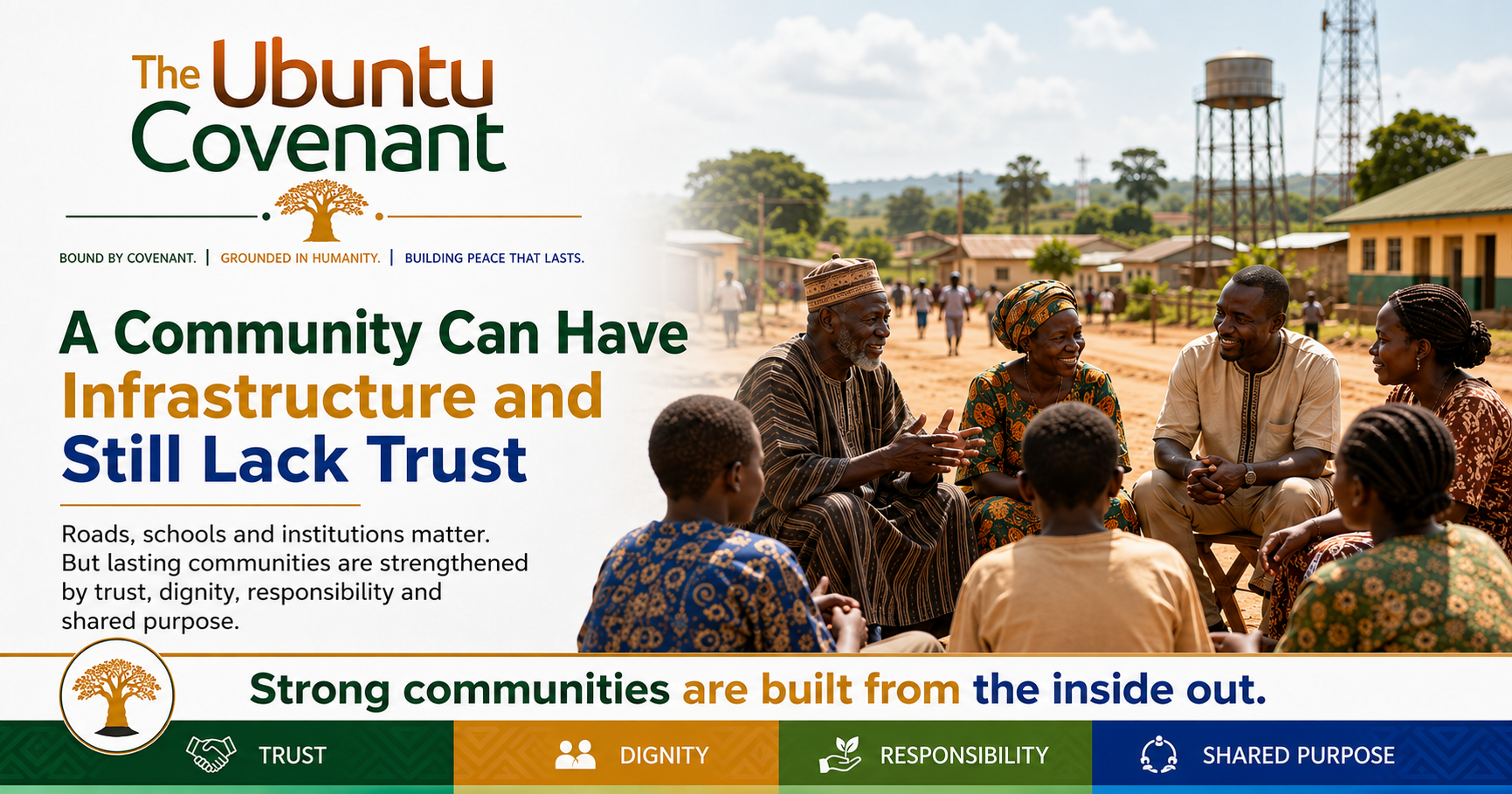
A Community Rarely Falls Apart in a Day
Imagine a community where people once believed that what belonged to everyone should be cared for by everyone.
The school mattered because every child mattered.
The health centre mattered because anyone could become sick.
Public resources were understood as belonging not to those temporarily entrusted with them, but to the community itself.
People disagreed, sometimes deeply, but there remained a sense that they belonged to something larger than themselves.
Then, slowly, things began to change.
A public resource disappeared and nobody was held responsible.
A qualified young person watched an opportunity go to someone with better connections.
A public servant discovered that doing the right thing could be more costly than remaining silent.
A community raised concerns, but eventually stopped because nobody seemed to be listening.
People did not wake up one morning and announce that they had stopped trusting their institutions.
Trust simply weakened.
Quietly.
One disappointment at a time.
And eventually, people who still lived together no longer necessarily believed they were building something together.
This is how a centre can begin to weaken.
What Actually Holds a Society Together?
We often think of a nation’s centre as its government.
Its presidency.
Its parliament.
Its constitution.
Its courts and institutions.
These matter enormously.
But institutions alone cannot hold a society together.
Beneath them must exist something less visible: a shared understanding of responsibility.
That power is entrusted rather than possessed.
That public resources are held in trust.
That institutions exist to serve people.
That citizenship carries obligations as well as rights.
And that decisions made today should not diminish the possibilities available to those who come tomorrow.
This is a moral centre.
When that centre is strong, people may disagree politically, culturally or economically while still recognising responsibilities toward one another.
When it weakens, something deeper than administrative failure begins to happen.
Relationships begin to fracture.
When the Falcon Can No Longer Hear
More than a century ago, W. B. Yeats captured an unsettling image:
“The falcon cannot hear the falconer;
Things fall apart; the centre cannot hold.”
A falcon circles outward until it can no longer hear the one guiding it.
The relationship between direction and movement has been broken.
Perhaps this image gives us a useful way of thinking about leadership.
What happens when power becomes increasingly separated from responsibility?
What happens when institutions become distant from the people they exist to serve?
What happens when citizens cease believing that public systems will treat them fairly?
The problem is no longer simply that something has gone wrong.
The relationship holding things together has weakened.
The Centre Can Weaken Quietly
Societies do not always unravel through dramatic events.
Sometimes the warning signs appear ordinary.
A neglected school.
A hospital struggling without essential resources.
A graduate who begins to believe that competence alone will never be enough.
A public servant who learns that integrity may carry a personal cost.
A citizen who stops reporting wrongdoing because nothing seems to change.
A community that gradually retreats into ethnic, regional, religious or political identity because the larger national identity no longer feels capable of holding everyone together.
Seen separately, these appear to be different problems.
But they may share something beneath the surface:
A weakening of trust.
Corruption, therefore, is not only about money that disappears.
Its deeper cost is what disappears with the money.
Confidence.
Fairness.
Belonging.
The belief that institutions can be trusted.
The belief that sacrifice for the common good is worthwhile.
The belief that tomorrow can be better than today.
Leadership Is More Than Holding Office
This brings us to a difficult question for Africa.
The question is not simply whether our countries have leaders.
They do.
Nor whether we have constitutions, governments and institutions.
We do.
The deeper question is:
What understanding of leadership holds these things together?
If leadership becomes primarily about acquiring, protecting and retaining power, public responsibility can gradually become separated from public office.
But leadership can be understood differently.
Leadership as responsibility.
Leadership as service.
Leadership as stewardship.
Stewardship begins with a simple recognition:
What has been entrusted to us does not belong to us alone.
A nation is not the possession of the generation currently governing it.
Its institutions, land, resources, relationships and possibilities have been inherited from those who came before.
And they are being held, temporarily, for people who have not yet been born.
Leadership therefore asks more than:
What can we achieve while we are here?
It must also ask:
What will remain because we were here?
But Leadership Is Not Only About Leaders
It would be easy to place the entire burden on presidents, ministers, parliamentarians and public officials.
That would also be incomplete.
A society’s moral centre is maintained—or weakened—through many relationships.
Businesses decide whether profit will be pursued responsibly.
Professionals decide whether competence and integrity still matter.
Religious institutions decide whether they will speak about responsibility while practising it themselves.
Families teach children what success, honesty and service mean.
Communities decide whether disagreement must become hostility.
Citizens decide whether wrongdoing is unacceptable only when committed by people outside their own political, ethnic or social group.
Institutions matter.
Leadership matters.
But culture matters too.
The centre holds when responsibility becomes shared.
Perhaps Africa’s Question Is Bigger Than “Who Will Lead Us?”
Africa has enormous human capacity.
Young populations.
Natural resources.
Entrepreneurship.
Knowledge.
Culture.
Faith.
Creativity.
Communities that have repeatedly demonstrated remarkable resilience.
Yet resources and potential alone cannot guarantee flourishing.
Something must hold them together.
Perhaps this is why our leadership conversation needs to move beyond asking only:
Who should lead?
There is another question beneath it:
What kind of people must we become?
What kind of public institutions must we build?
What kind of citizens must we form?
What kind of relationships must exist between power and responsibility?
What must we preserve for people we will never meet?
These are not questions for governments alone.
They belong to all of us.
When Shared Humanity Becomes Shared Responsibility
Ubuntu reminds us that our humanity is bound together.
Harambee reminds us that belonging must eventually become shared responsibility.
Stewardship asks us to consider what our choices will leave behind.
Together, they offer a different way of thinking about the centre.
Perhaps the centre is not one institution, one leader or one political system.
Perhaps it is the network of responsibilities that allows people to continue recognising one another as belonging to a shared future.
And perhaps rebuilding that centre begins long before another policy is written.
It begins wherever people choose responsibility over entitlement, service over self-interest, integrity over convenience, and stewardship over possession.
W. B. Yeats gave us the haunting warning:
“Things fall apart; the centre cannot hold.”
Our generation must wrestle with the question that follows:
What kind of leaders, citizens, institutions and communities must we become so that the centre can hold—and what will we faithfully leave for those who come after us?