Tag: Collective Action

  • What Changes When People Begin to Say “Ours”?

    What Changes When People Begin to Say “Ours”?

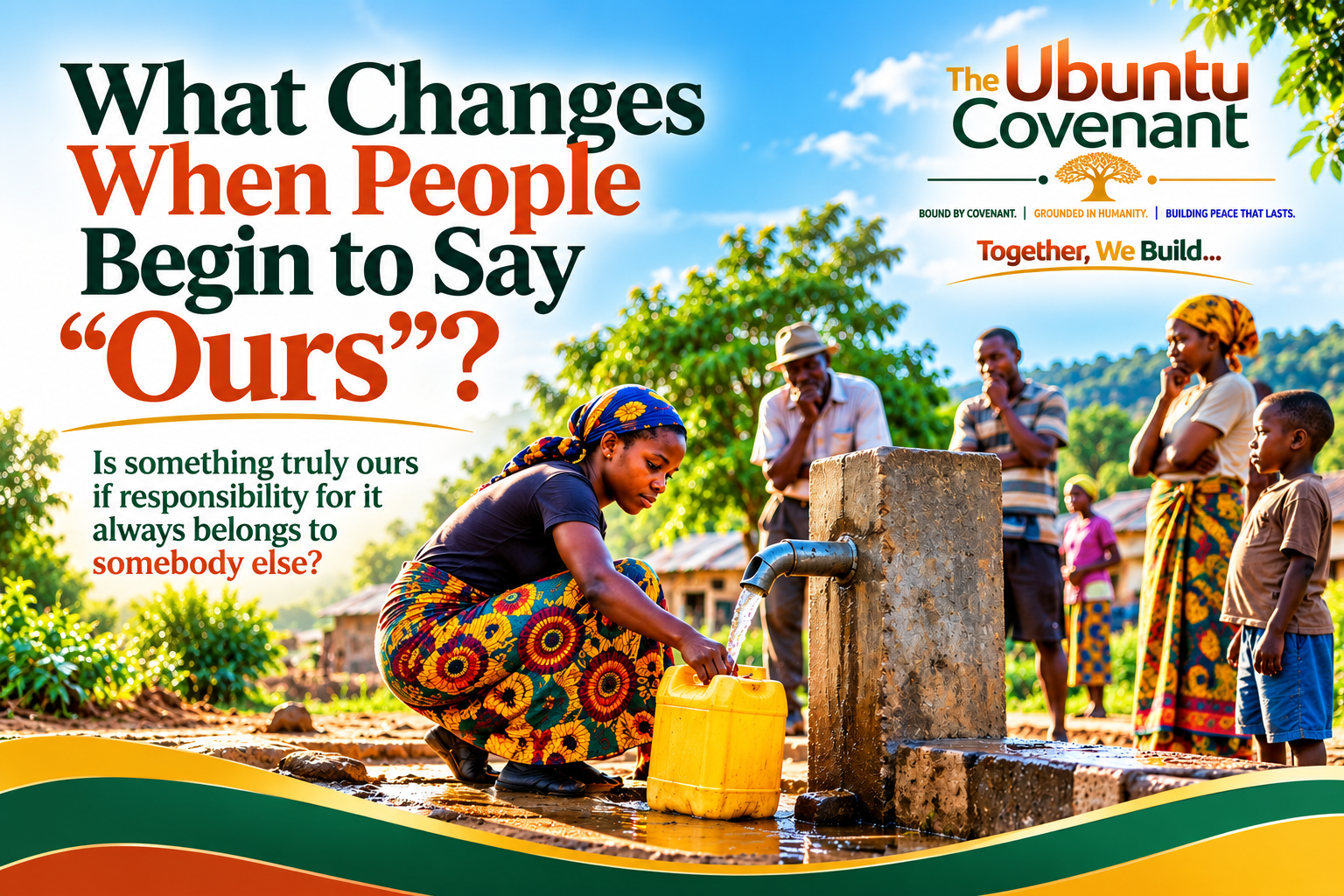
    The water stopped flowing on a Tuesday morning.

    At first, nobody was particularly worried.

    The community water point had failed before. Usually someone reported it, somebody came to look at it, and within a few days the problem was resolved.

    But this time, nobody came.

    By Thursday, families were walking farther to collect water.

    By Saturday, the conversations had begun.

    Some said the local authorities should have repaired it already.

    Others remembered the organisation that had helped install the water point years earlier.

    “They should come back,” someone said.

    Another person blamed the committee that had once been responsible for managing it.

    Everyone seemed to know who should do something.

    The difficulty was that all the people being discussed were somewhere else.

    Meanwhile, the water point remained broken.

    Then, during one of the conversations, an older woman who had been listening quietly asked a simple question:

    “Whose water point is this?”

    There was a brief silence.

    “It’s ours,” someone eventually replied.

    She nodded.

    Then she asked another question.

    “If it is ours, why is responsibility for it always somebody else’s?”

    The conversation changed.

    Not because the community suddenly had all the money, skills or authority needed to repair the water point.

    They did not.

    Some problems genuinely require government.

    Some require technical expertise.

    Some require resources that communities do not possess.

    But the woman’s question had exposed something deeper.

    They had been speaking about something that belonged to them as though responsibility for its future belonged entirely to somebody else.

    And that raises a question far beyond one broken water point.

    When Does Something Become Ours?

    We use the word our easily.

    Our school.

    Our road.

    Our neighbourhood.

    Our institution.

    Our community.

    Our country.

    But belonging is more demanding than language.

    Something may be located among us without truly being carried by us.

    A school may stand in a community while families believe that everything concerning its future belongs to teachers or government.

    A road may serve everyone while each person waits for somebody else to protect it.

    A public space may belong to everyone and, for that very reason, feel as though it belongs to no one.

    An institution may exist for the public while citizens relate to it only as people waiting to receive something from it.

    Perhaps one of the quietest challenges facing communities is not simply the absence of resources.

    Sometimes it is the gradual separation of belonging from responsibility.

    We want to say:

    This is ours.

    But when something goes wrong, our language changes:

    They should fix it.

    There Are Things We Cannot Carry Alone

    Shared responsibility does not mean pretending communities can solve every problem themselves.

    That would ignore reality.

    Governments have responsibilities.

    Institutions have responsibilities.

    Leaders have responsibilities.

    Development organisations, businesses and professionals may possess resources, authority and expertise that communities genuinely need.

    A broken bridge cannot always be repaired by neighbours.

    A health facility cannot operate on goodwill alone.

    A school cannot function without trained educators, public investment and appropriate systems.

    Recognising shared responsibility therefore does not mean transferring institutional obligations onto communities.

    It means asking a different question:

    Even where others have responsibilities, what responsibility still belongs to us?

    That question changes the conversation.

    Instead of asking only:

    Who should do something for us?

    We also begin asking:

    What can we do?

    What should we protect?

    Whose voice has not been heard?

    What knowledge already exists among us?

    What can we carry together?

    Where do we genuinely need help?

    These are very different questions.

    They do not remove responsibility from institutions.

    They make responsibility visible at every level.

    Something Changes When the Language Changes

    There is a difference between saying:

    “The school.”

    and saying:

    “Our school.”

    But there is an even greater difference between saying our school and behaving as though its future concerns us.

    The word ours becomes meaningful when it changes what we are willing to notice, protect, contribute to and pass forward.

    When people begin to think this way, participation changes.

    People are no longer present only because they were invited to a meeting.

    They begin bringing knowledge.

    They ask questions.

    They notice problems earlier.

    They challenge decisions when necessary.

    They contribute where they can.

    They expect accountability from those entrusted with responsibility.

    And they begin recognising that accountability runs in more than one direction.

    The community asks something of its leaders.

    But it also begins asking something of itself.

    Perhaps This Is Where Ubuntu Begins

    There is an old African understanding captured in the idea of Ubuntu:

    I am because we are.

    It reminds us that human beings do not flourish alone.

    Our lives are carried through relationships—with family, neighbours, institutions, communities and generations we may never meet.

    But recognising our interconnectedness leads naturally to another question:

    If our lives are bound together, what do we owe one another?

    This is where Ubuntu begins moving from an understanding of humanity toward responsibility.

    And responsibility eventually requires action.

    From “Mine” and “Theirs” to “Ours”

    Across African societies, the spirit expressed through Harambee has long recognised that there are burdens individuals cannot carry alone.

    There are moments when people must pull together.

    Not because everyone contributes equally.

    Not because everyone possesses the same resources.

    But because the outcome concerns everyone.

    One person may bring knowledge.

    Another may bring time.

    Another may have influence.

    Another may contribute resources.

    Another may simply be willing to begin.

    Shared responsibility does not require identical contribution.

    It requires the recognition that we each have some relationship to what happens next.

    That may be one of the most important transitions a community can make:

    from somebody should do something

    to

    what can we carry together?

    And Then Comes Stewardship

    There is another dimension to the word ours.

    Very little of what we call ours belongs only to those who are here today.

    The school will educate children who have not yet been born.

    The land will be inherited.

    The institutions we strengthen—or weaken—will outlive many of us.

    The trust we build between people can become an inheritance.

    So can the mistrust we leave unresolved.

    This is where responsibility becomes stewardship.

    Stewardship asks us to care not only about what something provides for us now, but about the condition in which we leave it.

    It asks:

    What have we received?

    How are we caring for it?

    What will those who come after us inherit because of the choices we make today?

    The word ours therefore stretches in two directions.

    It connects us to one another.

    And it connects the present generation to the next.

    Perhaps the First Change Is a Question

    The broken water point may eventually require a technician.

    The road may still require government investment.

    The school may need more resources.

    The institution may need reform.

    Shared responsibility does not make these realities disappear.

    But something important happens when people stop seeing themselves only as recipients of decisions, services and development.

    They begin seeing themselves as participants in what their community becomes.

    And perhaps that transformation begins long before the project, the funding or the meeting.

    Perhaps it begins when somebody looks at something everyone has been walking past and asks:

    “Whose is this?”

    And someone answers:

    “Ours.”

    Then comes the harder question:

    What does “ours” require of us?
  • A Community Can Have Infrastructure and Still Lack Trust

    A Community Can Have Infrastructure and Still Lack Trust

    What Holds a Community Together After the Buildings Are Built?

    Roads connect people to markets, schools and essential services.

    Hospitals protect life.

    Water systems improve health and dignity.

    Schools create opportunities for future generations.

    Public institutions help communities organise responsibilities and respond to common needs.

    These visible forms of development matter. They can transform everyday life and open possibilities that were previously beyond reach.

    Yet experience also shows that infrastructure alone cannot make a community flourish.

    A community may have new buildings while trust continues to weaken.

    It may have policies while people feel unheard.

    It may have leadership structures while responsibility is avoided.

    It may have development programmes while relationships remain divided.

    This invites an important question:

    What holds a community together after the buildings have been completed?

    Every visible system rests upon invisible foundations

    A school is more than classrooms, books and desks.

    It also depends upon teachers who serve responsibly, parents who remain involved, learners who value the opportunity before them and leaders who protect the purpose of education.

    A hospital is more than equipment and medicine.

    It also depends upon compassion, professional integrity, public confidence and respect for every person’s dignity.

    A public institution is more than offices, policies and procedures.

    It also depends upon leaders who understand authority as service, citizens who believe participation matters and systems that treat people fairly.

    A peace agreement is more than signatures on a document.

    It also depends upon listening, truth, restraint and the willingness to rebuild relationships after disagreement.

    These foundations are not always visible.

    They cannot be photographed as easily as a road or a building.

    They may not appear prominently in project reports.

    Yet they often determine whether visible progress will be trusted, protected and sustained.

    Trust cannot be built according to a construction plan

    A building can be completed within a scheduled period.

    Trust usually cannot.

    Trust grows slowly through repeated experiences of honesty, fairness, consistency and respect.

    It grows when leaders keep their word.

    It grows when people are consulted before decisions are made on their behalf.

    It grows when institutions listen rather than merely announce.

    It grows when disagreement is handled without humiliating those involved.

    It grows when responsibility is shared instead of being transferred entirely to government, donors or outside organisations.

    Once trust is weakened, even a well-designed programme may be received with suspicion.

    People may question motives, resist participation or protect themselves from disappointment.

    This is why development must pay attention not only to what is being built, but also to how people are treated while it is being built.

    Progress must reach beneath the surface

    Visible development can improve conditions.

    Human development strengthens the relationships and responsibilities required to sustain those improvements.

    Communities become more resilient when people can work across differences, care for shared resources and recognise that their well-being is connected to the well-being of others.

    They become stronger when leadership is understood as stewardship rather than status.

    They become safer when dialogue begins before disagreement becomes hostility.

    They become more hopeful when people see themselves not only as recipients of assistance, but also as participants in shaping their shared future.

    The deeper question is therefore not only:

    What resources does this community need?

    It is also:

    What human foundations must be strengthened so that those resources can serve the common good?

    Infrastructure and human foundations belong together

    This is not a choice between physical development and human development.

    Communities need roads, schools, healthcare facilities, markets, water systems and effective public institutions.

    But visible progress becomes more durable when it rests upon invisible foundations such as:

    Trust.

    Dignity.

    Integrity.

    Dialogue.

    Shared responsibility.

    Stewardship.

    A common sense of purpose.

    These foundations help people care for what has been built, use it responsibly and preserve its benefits for those who will come after them.

    Without them, infrastructure may remain standing while the community around it becomes increasingly divided.

    From shared humanity to shared responsibility

    Ubuntu reminds us that human beings do not flourish in isolation.

    Our lives are shaped by relationships, responsibilities and the way we treat one another.

    But recognising our shared humanity is only the beginning.

    That recognition must become practical.

    People must learn to listen together, decide together, serve together and take responsibility for what they hold in common.

    This is where Ubuntu finds expression through Harambee—shared humanity becoming shared responsibility and collective action.

    Stewardship then asks a further question:

    How faithfully are we caring for the people, relationships, institutions and resources entrusted to us?

    Together, these ideas help us see that strong communities are not formed only through what is constructed around people.

    They are also formed through what is cultivated within people and between them.

    The work beneath lasting progress

    The Ubuntu Covenant strengthens the human foundations upon which strong and resilient communities are built.

    Our concern is not only whether communities have institutions, programmes and resources.

    It is also whether dignity is protected, trust is nurtured, responsibility is shared and leadership serves the common good.

    Because lasting development is not only about constructing what people can see.

    It is also about cultivating what communities must carry within themselves.

    An invitation to reflect

    Look at your own community.

    What visible progress has taken place?

    And beneath that progress, which human foundation still needs attention?

    Is it trust?

    Dialogue?

    Integrity?

    Responsibility?

    Stewardship?

    Perhaps the next important step is not another structure.

    Perhaps it is a conversation that helps people recognise what they are responsible for together.

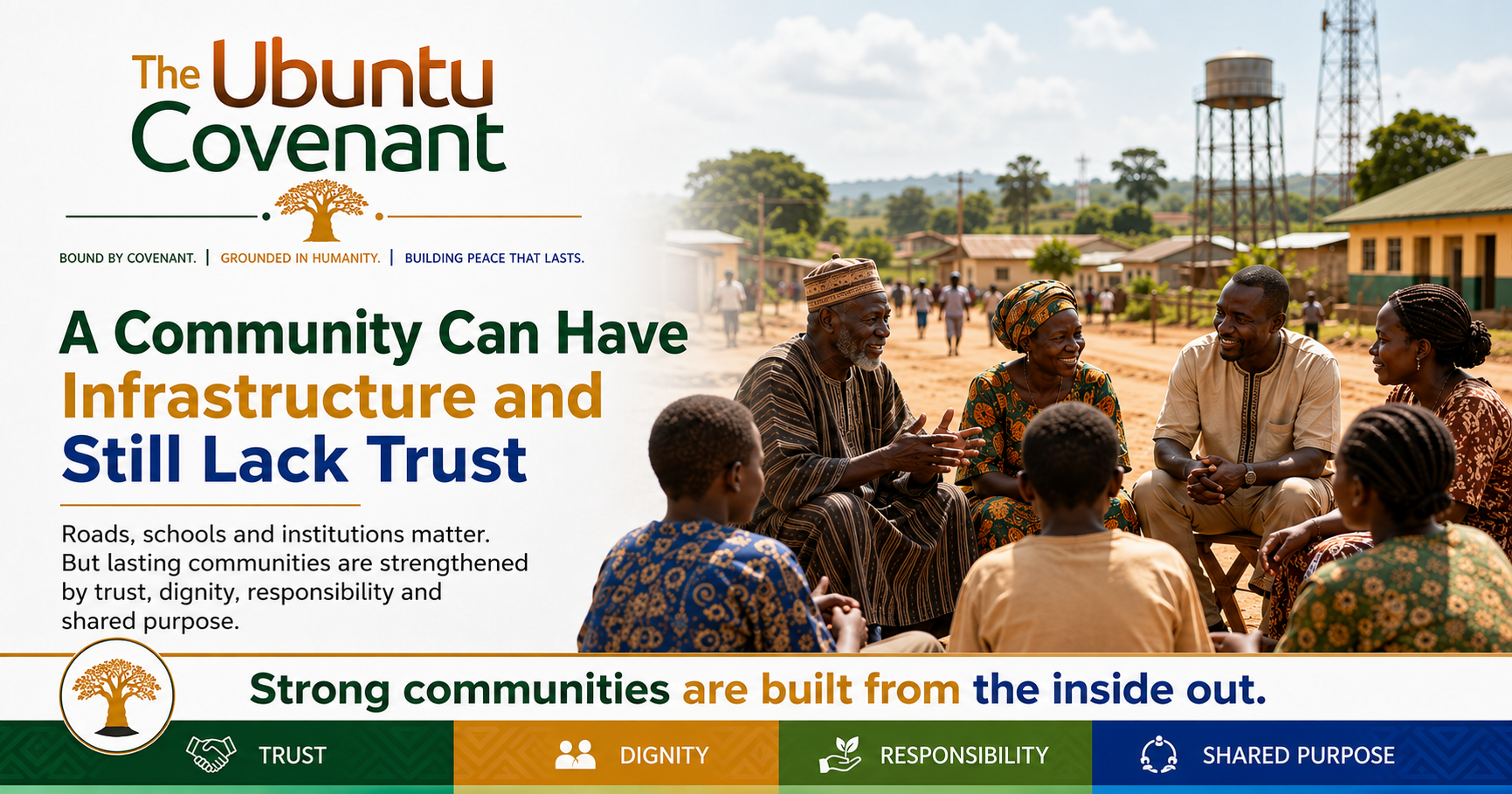
    Strong communities are built from the inside out.

    Rooted in Ubuntu. Expressed through Harambee. Guided by Stewardship.

  • From Ubuntu to Harambee: When Shared Humanity Becomes Shared Responsibility

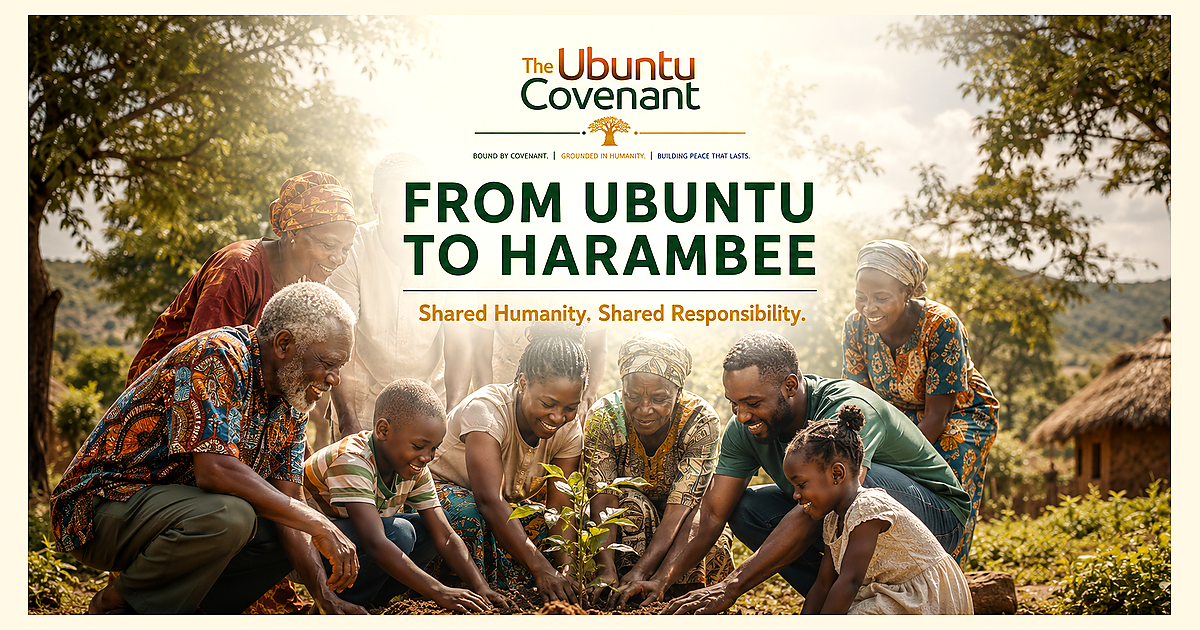
    From Ubuntu to Harambee: When Shared Humanity Becomes Shared Responsibility

    Knowing what is right is not the same as living it.

    Communities are not transformed by the values they admire, but by the values they practice consistently.

    People may affirm dignity while ignoring exclusion. We may speak of unity while leaving responsibility to others. We may recognize our shared humanity while continuing to live as though another person’s well-being has nothing to do with our own.

    Wisdom becomes transformative only when it shapes action.

    Ubuntu teaches that our humanity is bound together. But this understanding naturally leads to a practical question:

    If we belong to one another, how should we act together?

    This is where Harambee begins.

    When Understanding Becomes Practice

    Ubuntu is not only a description of human connection. It is an invitation to live in ways that honor that connection.

    If our humanity is bound together, then dignity must shape how we treat others. Compassion must influence our choices. Responsibility must extend beyond personal interest, and the common good must become more than an admirable idea.

    A philosophy that remains only in words may be respected without ever transforming the way people live.

    Every enduring principle eventually asks something of us. It asks whether our beliefs can be seen in our relationships, our leadership, our decisions, and our willingness to contribute to the well-being of others.

    Ubuntu therefore prepares the heart and mind. Harambee gives that understanding practical expression.

    What Harambee Means

    Across Kenya, Harambee is commonly understood as “all pull together.”

    It reflects the recognition that some responsibilities cannot be carried by one person alone. Families, communities, and institutions become stronger when people willingly contribute their time, abilities, wisdom, resources, and effort toward the common good.

    Harambee is sometimes associated mainly with fundraising or public campaigns. But its meaning reaches deeper than collecting money or completing a single activity.

    It is a practice of shared responsibility.

    One person may contribute knowledge. Another may offer time. Another may create relationships, provide encouragement, protect trust, or make room for voices that are often overlooked.

    The value of Harambee is not found in every person contributing the same thing. It is found in people recognizing that each has something meaningful to contribute.

    Ubuntu and Harambee

    Ubuntu and Harambee belong together.

    Ubuntu answers the question: Who are we?

    Our humanity is bound together.

    Harambee answers the question: How should we act?

    We pull together for the common good.

    Ubuntu speaks to identity. Harambee speaks to responsibility. Ubuntu helps us recognize that we belong to one another. Harambee asks us to live in a way that reflects that belonging.

    Ubuntu without Harambee risks becoming an idea that is admired but not practiced.

    Harambee without Ubuntu risks becoming collective effort without a shared moral foundation.

    Together, they remind us that shared humanity finds its fullest expression in shared responsibility.

    More Than Working Together

    Not every form of collective action reflects Ubuntu.

    People can work together while excluding others. Communities can pursue a shared goal while placing an unfair burden on those with less power. Calls for unity can sometimes silence honest disagreement or pressure people into participation.

    True Harambee cannot be built on fear, coercion, exclusion, or harm.

    It must preserve dignity, encourage willing participation, and recognize that the common good includes those whose voices are easiest to overlook.

    Ethical Harambee therefore asks:

    Who has been included in the conversation?

    Who carries the cost of our decisions?

    Whose contribution has not been recognized?

    Who benefits from the action we are taking?

    What will future generations inherit from our choices?

    Harambee is strongest when people do more than work beside one another. They listen, share responsibility, protect dignity, and ensure that collective action truly serves the common good.

    Harambee in Everyday Life

    Harambee is not reserved for national campaigns, public ceremonies, or moments of crisis. It begins in ordinary life.

    It is practiced when family members share responsibility rather than leaving every burden to one person.

    It is present when elders share wisdom, adults create room for participation, and young people contribute their energy, questions, and ideas.

    It is practiced when neighbors address disagreement through conversation before division becomes permanent.

    It is present when leaders invite participation, institutions build trust, and communities care faithfully for their shared environment and resources.

    Harambee can be seen whenever people ask not only, “What do I need?” but also, “What can I contribute?”

    These everyday choices may appear small, but communities are shaped by what people practice repeatedly.

    Collective responsibility becomes a culture one decision, one relationship, and one contribution at a time.


    Leadership That Convenes

    Harambee also changes how leadership is practiced.

    A leader shaped by Harambee does not treat people merely as recipients of instructions. The leader recognizes that communities possess knowledge, experience, relationships, and abilities that must be invited into the work.

    Such leadership convenes before it commands.

    It listens before deciding. It creates room for participation, distributes responsibility, and helps people recognize the contribution they can make.

    This does not remove the need for direction or accountability. It strengthens both by building trust, ownership, and shared purpose.

    The strongest leader is not always the person carrying every responsibility. It is often the person who helps others carry responsibility faithfully together.

    The Ubuntu Covenant

    The Ubuntu Covenant does not claim ownership of Harambee.

    Harambee belongs to Kenya’s living tradition of collective effort and shared responsibility. It has been practiced across generations in families, communities, institutions, and national life.

    The Ubuntu Covenant exists as one faithful institutional expression of this wisdom.

    We seek to translate the shared humanity revealed by Ubuntu into responsible action through Harambee—strengthening trust, belonging, ethical leadership, dialogue, stewardship, and collaboration.

    Our work begins where principles meet practice.

    We ask how people can recognize their shared responsibility, contribute their distinct strengths, and work together in ways that preserve dignity and strengthen the human foundations of community life.

    We do not believe that one institution can build the future alone.

    The future is strengthened when people, communities, and institutions recognize that each has a responsibility—and that every responsible contribution matters.

    An Invitation to Shared Responsibility

    Harambee invites each of us to consider the responsibility we may be waiting for someone else to carry.

    What knowledge can we share?

    What relationship can we strengthen?

    What conversation can we help begin?

    What responsibility can we accept?

    Who should be included before we move forward?

    How can our contribution strengthen the common good rather than personal recognition?

    Harambee does not require everyone to possess the same resources, hold the same position, or make the same contribution.

    It asks each person to recognize that they have something meaningful to offer—and that the future is strengthened when those contributions are brought together responsibly.

    Ubuntu reminds us who we are.

    Harambee asks how we should act.

    Shared humanity becomes visible through shared responsibility.

    But whenever people build something together, another question follows:

    How will we care for what has been entrusted to us and preserve it for those who will come after us?

    This is the question of stewardship.

    Ubuntu is our covenant. Harambee is our practice.