
Foundational Reflection 001
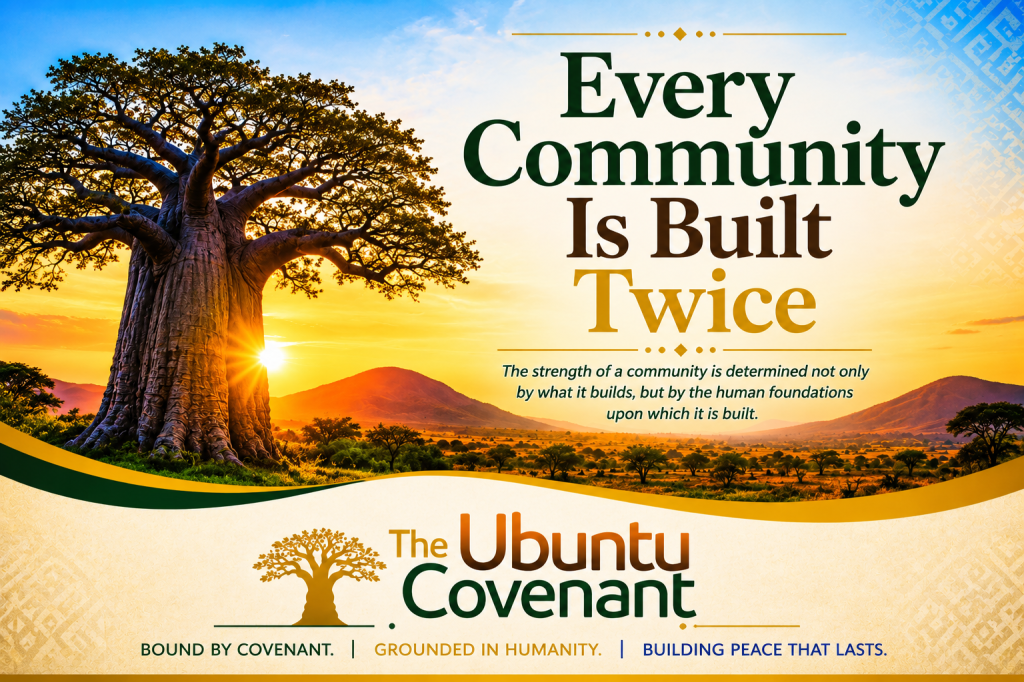
“The strength of a community is determined not only by what it builds, but by the human foundations upon which it is built.”
Yet much of our attention today is directed toward strengthening systems while giving too little attention to strengthening the people who create, sustain, and inherit those systems.
We invest in institutions, policies, infrastructure, and programmes—all of which are important. But lasting change depends upon something even more fundamental: the quality of our relationships, the character of our leadership, the strength of our shared responsibility, and the values that shape how we live together.
History reminds us that no institution is stronger than the people who sustain it.
Strong laws require people of integrity.
Thriving economies depend upon trust.
Peace agreements endure only where reconciliation takes root.
Even the finest schools cannot fulfil their purpose without homes and communities that nurture character, responsibility, and hope.
When the human foundations are neglected, systems eventually begin to weaken. But when people are strengthened, communities gain the capacity to renew themselves from within.
Long before modern institutions, development frameworks, or public policies existed, communities had already understood a timeless truth.
They understood that people come before programmes.
Relationships come before regulations.
Character comes before competence.
Trust comes before transactions.
Communities did not flourish simply because they possessed wealth or power. They flourished because they cultivated mutual care, shared responsibility, wise leadership, and a commitment to the common good.
These were more than cultural practices.
They were the human foundations upon which healthy communities were built.
Across generations, African communities gave expression to this enduring understanding through the philosophy of Ubuntu.
Ubuntu is one of Africa’s enduring philosophical traditions. It recognises that our humanity is not formed in isolation but in relationship with others.
It reminds us that the wellbeing of each person is inseparable from the wellbeing of the community…, and that dignity grows where people live with compassion, responsibility, mutual respect, and care for one another.
Ubuntu does not ask us to lose our individuality. Rather, it teaches that our individual gifts find their fullest meaning when they contribute to the common good.
In this way, Ubuntu is not merely an idea to admire. It is a way of seeing people, shaping relationships, and strengthening the human foundations upon which communities flourish.
Today’s world has achieved remarkable advances in science, technology, governance, and economic development. Yet many communities continue to struggle with division, mistrust, loneliness, conflict, and weakening social bonds.
These challenges remind us that material progress alone cannot guarantee human flourishing.
Communities need more than infrastructure.
They need trust.
More than policies.
They need shared responsibility.
More than economic growth.
They need relationships rooted in dignity, compassion, and stewardship.
For this reason, Ubuntu is not simply part of Africa’s past. It remains a living philosophy that continues to strengthen… the human foundations upon which strong and resilient communities continue to be built.
It is from this understanding that The Ubuntu Covenant draws its purpose.
The Ubuntu Covenant is an African institution rooted in the enduring philosophy of Ubuntu and expressed through the spirit of Harambee—the conviction that we pull together for the common good.
We believe that lasting peace, ethical leadership, resilient families, and thriving communities are built upon strong human foundations.
For this reason, our work is not centred on replacing the important work of governments, schools, faith communities, or development organisations. Rather, we seek to strengthen the values, relationships, and shared responsibility that enable these institutions and the communities they serve to flourish.
By teaching, convening, conducting research, and fostering dialogue…, we seek to preserve and apply the enduring wisdom of Ubuntu in ways that respond to today’s opportunities and challenges while preparing future generations to inherit stronger communities.
Perhaps the greatest investment any generation can make is not only in what it builds, but in the kind of people it is becoming.
Every conversation that restores understanding.
Every act of stewardship that protects what has been entrusted to us.
Every leader who chooses integrity over self-interest.
Every family that strengthens its bonds.
Every neighbour who extends compassion.
Each contributes to building the invisible foundations upon which future generations will stand.
Strong communities are not inherited by chance.
They are cultivated intentionally, one relationship, one decision, and one generation at a time.
As we face the opportunities and challenges of our time, perhaps the most important question is not only what kind of institutions we are building, but what kind of people and communities we are becoming.
This is the conversation to which The Ubuntu Covenant invites every person, family, institution, and community.
Because when we strengthen our shared humanity, we strengthen everything built upon it.
Continue the Conversation
What are the human foundations that have strengthened your family, community, or workplace?
Share your reflections in the comments, continue the conversation with those around you, and journey with us as we explore the enduring wisdom of Ubuntu and its relevance for our world today.
Together, let us strengthen the human foundations upon which strong and resilient communities are built.
The Ubuntu Covenant
Rooted in Ubuntu. Expressed through Harambee. Guided by Stewardship.
Strengthening the Human Foundations Upon Which Strong and Resilient Communities Are Built.

Leave a comment