
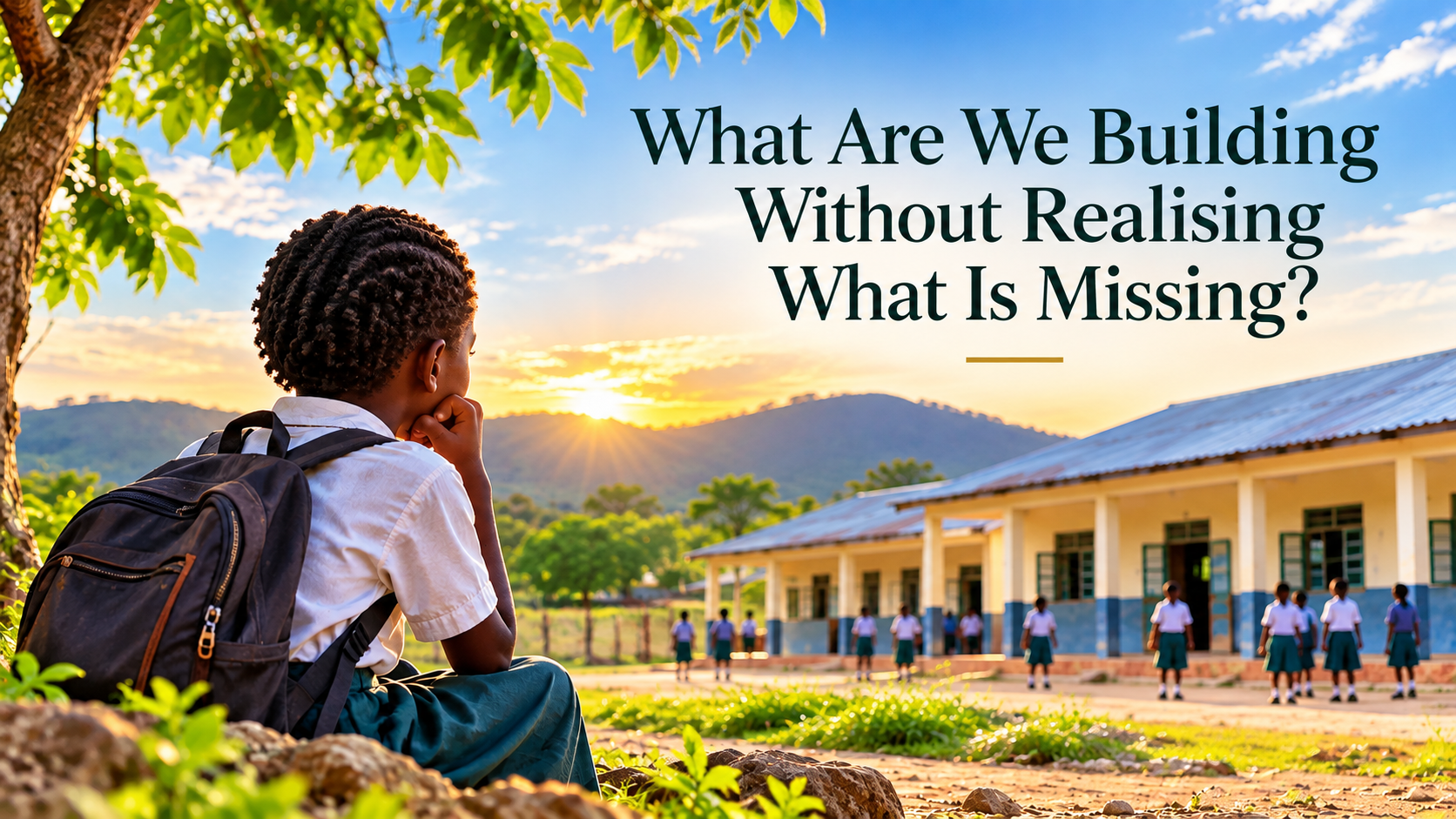
The school had finally been built.
For years, parents had hoped their children would no longer have to walk long distances to attend classes.
Now there were classrooms, desks, a staffroom, and a playground.
The community gathered for the opening ceremony.
There were speeches, photographs, and expressions of gratitude.
It was a moment worth celebrating.
The following is an illustrative story, but the questions it raises are familiar in many communities.
Some years later, the excitement had faded.
The classrooms were still there. Children still attended. Teachers still reported for duty.
Yet something was troubling.
Parents rarely attended school meetings. Teachers felt unsupported. Concerns raised by families often went unanswered. Decisions were increasingly made without meaningful conversation between those responsible for the school and those whose children depended on it.
Gradually, the relationship between the school and the community weakened.
The buildings had not disappeared.
The institution had not closed.
But something important was missing.
What was it?
When Having Something Is Not the Same as Making It Work
Across our societies, we invest considerable effort in building what we believe will improve people’s lives.
We construct schools, hospitals, roads, and water systems.
We establish committees, associations, public institutions, and development programmes.
We develop policies, allocate budgets, and create structures to manage shared concerns.
These are necessary and often valuable investments.
But their existence does not automatically mean they are fulfilling their intended purpose.
A community may have a meeting hall without meaningful cooperation.
An institution may have accountability procedures without people feeling able to question those in authority.
A peace committee may hold regular meetings while mistrust continues to grow between neighbours.
A development project may reach completion while the arrangements needed to sustain its benefits remain uncertain.
What, then, makes the difference between something that has been established and something that genuinely works?
The Things We Cannot Simply Construct
Imagine two communities facing a similar challenge.
Both have access to resources.
Both have recognised leadership structures.
Both receive support for a development initiative.
Yet their experiences may be very different.
In one community, people struggle to agree on priorities. Meetings are poorly attended. Decisions are questioned because trust has weakened. Responsibilities are unclear, and disagreements remain unresolved.
In the other, people may still disagree, but they have ways of listening to one another, addressing concerns, sharing responsibilities, and holding those entrusted with decisions accountable.
The difference is not necessarily that one community has better people than the other.
Their histories, resources, opportunities, and institutional environments may be very different.
But the comparison invites us to consider something that is often overlooked.
What happens between people can be as important as what is built around them.
Trust cannot simply be delivered as equipment.
Belonging cannot be established by opening an office.
Shared responsibility cannot be guaranteed by appointing a committee.
And a commitment to the future cannot be secured through a project completion report alone.
These conditions develop through relationships, experiences, practices, and the ways people exercise responsibility towards one another.
They can be strengthened.
They can also be weakened.
When Institutions Exist but Their Purpose Is Not Experienced
An institution may be legally established, adequately structured, and formally recognised.
But how do the people it serves experience it?
Do they feel respected?
Can they raise concerns without fear?
Are decisions explained?
Are responsibilities exercised fairly?
Does the institution respond when something goes wrong?
These questions matter because institutions do not operate outside human relationships.
They are shaped by the people within them, the communities around them, and the wider conditions in which they function.
At the same time, we must recognise that trust and goodwill alone cannot compensate for inadequate resources, poor institutional design, corruption, or the failure of public authorities to fulfil their obligations.
Communities should not be expected to carry responsibilities that properly belong to institutions.
Nor should people be asked to trust institutions that have not demonstrated trustworthiness.
The human foundations of society and the quality of its institutions must strengthen one another.
Before We Decide What to Do, What Have We Understood?
When a community faces a difficulty, our instinct is often to search for a solution.
We identify a problem.
We design an intervention.
We mobilise resources.
We begin implementation.
But what if we have not yet understood the relationships, experiences, and circumstances surrounding that problem?
Consider a community where neighbours who once cooperated now struggle to live peacefully together.
Would establishing another committee necessarily restore trust?
Would organising a workshop address the experiences that created the division?
Would providing resources resolve disagreements that people have never had an opportunity to discuss?
Perhaps some of these interventions would help.
Perhaps others would not.
We cannot know simply by looking at the problem from outside.
We must first understand the people living with it.
When did relationships begin to change?
What experiences have shaped people’s perceptions of one another?
What responsibilities have been neglected?
What forms of cooperation still exist?
What would make it possible for people to begin rebuilding confidence in one another?
These are not questions we ask merely to prepare people to accept a solution already chosen for them.
They are questions that help us understand whether an intervention is needed, what form it might take, and who should determine the way forward.
Sometimes the most responsible beginning is not an activity.
It is listening.
Shared Humanity. Shared Responsibility. A Shared Future.
At The Ubuntu Covenant, we are exploring the human conditions that make community life, institutions, peace, and development possible.
Our starting point is a simple recognition: what we build together depends, in part, on how we understand and relate to one another.
Shared Humanity invites us to recognise the dignity, belonging, and lived realities of every person.
Shared Responsibility challenges us to consider how individuals, communities, leaders, and institutions fulfil their different obligations towards the common good.
A Shared Future asks whether our decisions today protect and strengthen what others will depend upon tomorrow.
These commitments guide how we think about listening, dialogue, cooperation, and stewardship.
They do not provide ready-made answers to every community challenge.
Instead, they invite us to begin with the people concerned, understand their realities, and support the possibility of meaningful, locally owned action.
Because a community is not simply a collection of people living in the same place.
And an institution is not simply a structure established to perform a function.
Both depend on relationships, responsibilities, practices, and conditions that require continuing care.
What Might We Be Overlooking?
Perhaps we need to look again at how we understand development.
Not because buildings, infrastructure, policies, and institutions are unimportant.
They are essential.
But because what we construct and establish must ultimately serve human lives.
Before celebrating another completed project, perhaps we should ask whether the conditions needed to sustain it are present.
Before establishing another institution, perhaps we should ask what will enable people to trust it, participate in it, and hold it accountable.
Before introducing another community intervention, perhaps we should ask what we have genuinely understood about the people and relationships involved.
And before deciding what society needs next, perhaps we should examine what is already weakening beneath the surface.
We may be building many of the things a society needs while overlooking some of the human conditions that allow those things to work.
The question is not whether we should continue building.
It is whether we are paying enough attention to what makes what we build meaningful, trustworthy, and lasting.
What are we building without realising what is missing?
The Ubuntu Covenant
Shared Humanity. Shared Responsibility. A Shared Future.
Leave a Reply