
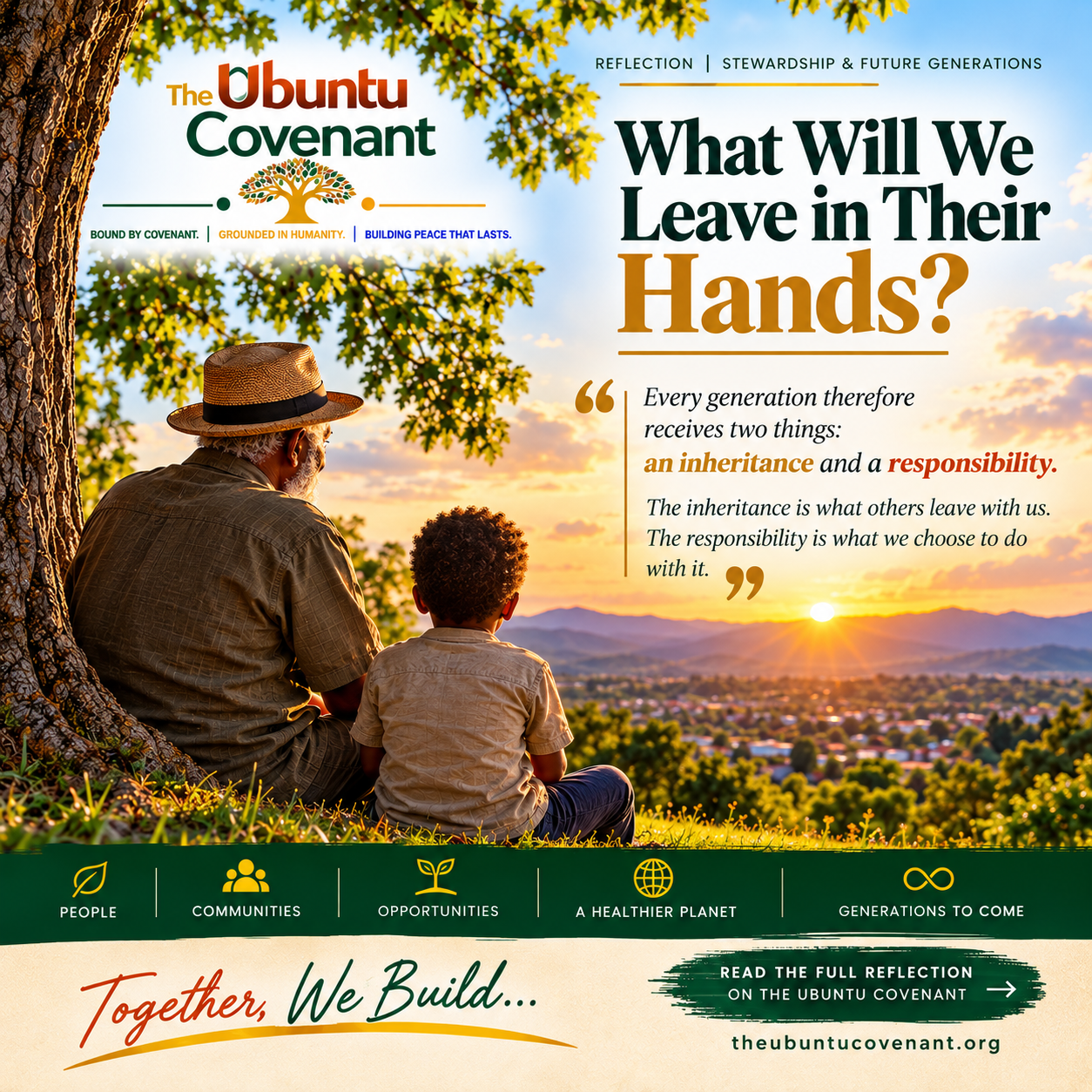
Many years ago, a man planted a tree beside his home.
He watered it when it was small.
Protected it from animals.
Pruned it when necessary.
And waited.
Years passed.
The tree grew, but slowly.
By the time its branches had become large enough to offer generous shade, the man was already growing old.
One afternoon, someone asked him a simple question:
“Why did you spend so much time caring for a tree whose shade you may hardly enjoy?”
The question made sense.
There were other things he could have planted that would have benefited him sooner.
But the old man looked at the tree differently.
Throughout his own life, he had rested beneath trees he had never planted.
He had eaten fruit from trees cared for by people who were gone before he was old enough to know their names.
He had walked paths others had cleared.
Drawn water from places others had protected.
Learned things others had taken time to discover.
His life had been made easier by work for which he could never personally thank those responsible.
So perhaps the tree was never only about him.
One day, another person would sit beneath it.
Perhaps a grandchild.
Perhaps a traveller.
Perhaps someone whose name he would never know.
The old man was simply caring for something today that another person might need tomorrow.
How Much of Our Lives Began Before Us?
Consider your own life for a moment.
How much of what you depend upon did you actually begin?
You did not invent the language through which you first learned to speak.
You did not begin your family’s story.
You did not create the land.
You probably did not establish the first school in which you learned.
You did not discover most of the knowledge you use.
Many of the roads you travel were built by people you will never meet.
Institutions you depend upon were established before you entered them.
Someone preserved a story.
Someone defended something worth keeping.
Someone taught another person who eventually taught you.
Someone planted a tree.
Our lives are surrounded by the work of people who came before us.
But that is only one side of inheritance.
We Do Not Inherit Only What Is Good
Sometimes what travels between generations is painful.
A family can inherit a disagreement nobody resolved.
Children can inherit land without understanding the history attached to it.
A community can inherit mistrust created decades earlier.
A country can inherit institutions carrying both wisdom and weakness.
A generation can inherit depleted soil, polluted rivers or disappearing forests.
We can inherit prejudices.
Silences.
Debts.
Unanswered questions.
Ways of treating one another that nobody stopped to examine.
So inheritance is not simply something to celebrate.
It is something to discern.
Some things we receive should be protected.
Some should be strengthened.
Some should be repaired.
Some should be questioned.
And some should end with us.
Between What We Receive and What We Leave
This is where responsibility enters the story.
Every generation therefore receives two things:
an inheritance and a responsibility.
The inheritance is what others leave with us.
The responsibility is what we choose to do with it.
We cannot choose everything that reaches us.
But we participate in determining what happens next.
A generation may inherit a strong institution and weaken it.
Another may inherit a struggling institution and patiently rebuild it.
A family may inherit land and care for it so that another generation can depend upon it.
Another may exhaust the same inheritance within a few years.
A community may inherit an old disagreement and carry it for another fifty years.
Or somebody may finally have the courage to say:
This has travelled far enough.
Between inheritance and legacy lies responsibility.
One Day, We Will Be the People Who Came Before
We often speak about future generations as though they are far away.
But every day brings them closer.
Children alive today will one day make decisions about institutions we currently lead.
They will live with environmental choices we are making now.
They may inherit relationships we strengthened.
Or conflicts we avoided resolving.
They may receive knowledge we preserved.
Or discover that something valuable disappeared because nobody considered it worth passing forward.
And eventually, when they tell their own stories, we will be the people who came before them.
Perhaps they will ask:
What did they protect?
What did they repair?
What did they waste?
What did they know was wrong but continue anyway?
What did they begin even though they knew they might never personally enjoy its results?
Those are uncomfortable questions.
But they are also necessary ones.
Only Now Do We Give It a Name
There is a word for caring faithfully for something that is in our hands but does not exist only for us.
Stewardship.
Stewardship changes the question from:
“What belongs to me?”
to:
“What has been entrusted to us?”
And then:
“What condition should it be in when we hand it forward?”
That question applies to more than money or natural resources.
We steward relationships.
We steward institutions.
We steward knowledge.
We steward authority.
We steward land.
We steward culture and memory.
We steward opportunities.
We even steward peace.
Something may be in our hands today while still carrying consequences for people we may never meet.
What Are We Building Together?
This is also why the unfinished sentence matters:
Together, We Build…
We are building with materials others left behind.
With knowledge accumulated before us.
Within communities whose stories began before we arrived.
Through institutions others helped establish.
But we are not building only for ourselves.
Eventually, we too will step away.
And something will remain.
The question is not whether we will leave an inheritance.
Every generation does.
The question is:
What kind of inheritance will ours be?
Will people inherit stronger relationships?
More trustworthy institutions?
Communities more capable of carrying responsibility together?
Land cared for wisely?
Knowledge preserved and expanded?
A greater ability to disagree without destroying one another?
Or will another generation spend its time repairing what we could have addressed?
Perhaps this is one of the deepest meanings behind:
Together, We Build…
We build something today that somebody else will eventually inherit.
Before We Move On
Perhaps there are four questions worth sitting with:
What have we inherited that deserves to be protected?
What have we inherited that needs to be repaired?
What should not travel beyond our generation?
And what can we begin today whose shade may one day be enjoyed by people we will never meet?
The Ubuntu Covenant
Together, We Build…
Leave a Reply