
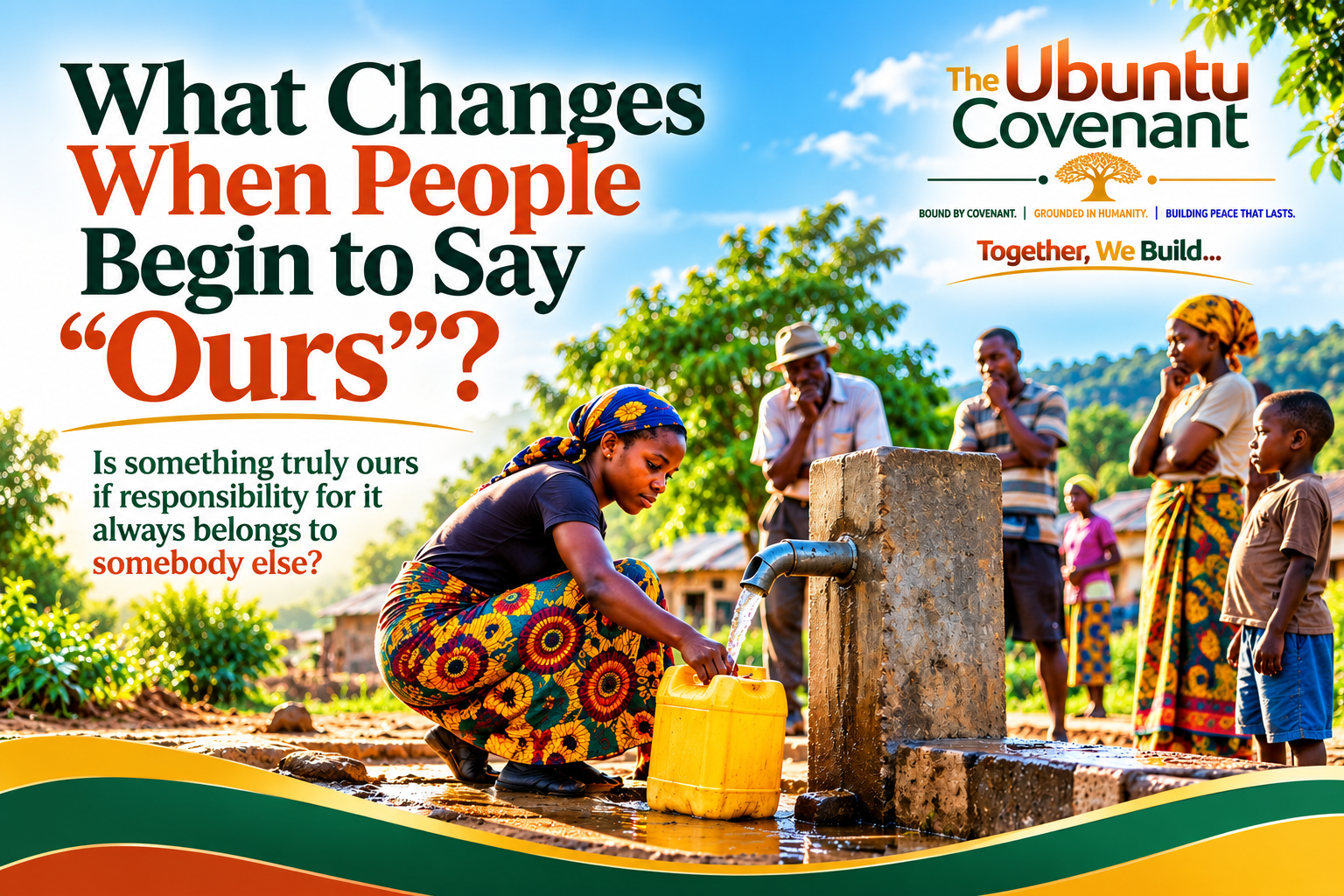
The water stopped flowing on a Tuesday morning.
At first, nobody was particularly worried.
The community water point had failed before. Usually someone reported it, somebody came to look at it, and within a few days the problem was resolved.
But this time, nobody came.
By Thursday, families were walking farther to collect water.
By Saturday, the conversations had begun.
Some said the local authorities should have repaired it already.
Others remembered the organisation that had helped install the water point years earlier.
“They should come back,” someone said.
Another person blamed the committee that had once been responsible for managing it.
Everyone seemed to know who should do something.
The difficulty was that all the people being discussed were somewhere else.
Meanwhile, the water point remained broken.
Then, during one of the conversations, an older woman who had been listening quietly asked a simple question:
“Whose water point is this?”
There was a brief silence.
“It’s ours,” someone eventually replied.
She nodded.
Then she asked another question.
“If it is ours, why is responsibility for it always somebody else’s?”
The conversation changed.
Not because the community suddenly had all the money, skills or authority needed to repair the water point.
They did not.
Some problems genuinely require government.
Some require technical expertise.
Some require resources that communities do not possess.
But the woman’s question had exposed something deeper.
They had been speaking about something that belonged to them as though responsibility for its future belonged entirely to somebody else.
And that raises a question far beyond one broken water point.
When Does Something Become Ours?
We use the word our easily.
Our school.
Our road.
Our neighbourhood.
Our institution.
Our community.
Our country.
But belonging is more demanding than language.
Something may be located among us without truly being carried by us.
A school may stand in a community while families believe that everything concerning its future belongs to teachers or government.
A road may serve everyone while each person waits for somebody else to protect it.
A public space may belong to everyone and, for that very reason, feel as though it belongs to no one.
An institution may exist for the public while citizens relate to it only as people waiting to receive something from it.
Perhaps one of the quietest challenges facing communities is not simply the absence of resources.
Sometimes it is the gradual separation of belonging from responsibility.
We want to say:
This is ours.
But when something goes wrong, our language changes:
They should fix it.
There Are Things We Cannot Carry Alone
Shared responsibility does not mean pretending communities can solve every problem themselves.
That would ignore reality.
Governments have responsibilities.
Institutions have responsibilities.
Leaders have responsibilities.
Development organisations, businesses and professionals may possess resources, authority and expertise that communities genuinely need.
A broken bridge cannot always be repaired by neighbours.
A health facility cannot operate on goodwill alone.
A school cannot function without trained educators, public investment and appropriate systems.
Recognising shared responsibility therefore does not mean transferring institutional obligations onto communities.
It means asking a different question:
Even where others have responsibilities, what responsibility still belongs to us?
That question changes the conversation.
Instead of asking only:
Who should do something for us?
We also begin asking:
What can we do?
What should we protect?
Whose voice has not been heard?
What knowledge already exists among us?
What can we carry together?
Where do we genuinely need help?
These are very different questions.
They do not remove responsibility from institutions.
They make responsibility visible at every level.
Something Changes When the Language Changes
There is a difference between saying:
“The school.”
and saying:
“Our school.”
But there is an even greater difference between saying our school and behaving as though its future concerns us.
The word ours becomes meaningful when it changes what we are willing to notice, protect, contribute to and pass forward.
When people begin to think this way, participation changes.
People are no longer present only because they were invited to a meeting.
They begin bringing knowledge.
They ask questions.
They notice problems earlier.
They challenge decisions when necessary.
They contribute where they can.
They expect accountability from those entrusted with responsibility.
And they begin recognising that accountability runs in more than one direction.
The community asks something of its leaders.
But it also begins asking something of itself.
Perhaps This Is Where Ubuntu Begins
There is an old African understanding captured in the idea of Ubuntu:
I am because we are.
It reminds us that human beings do not flourish alone.
Our lives are carried through relationships—with family, neighbours, institutions, communities and generations we may never meet.
But recognising our interconnectedness leads naturally to another question:
If our lives are bound together, what do we owe one another?
This is where Ubuntu begins moving from an understanding of humanity toward responsibility.
And responsibility eventually requires action.
From “Mine” and “Theirs” to “Ours”
Across African societies, the spirit expressed through Harambee has long recognised that there are burdens individuals cannot carry alone.
There are moments when people must pull together.
Not because everyone contributes equally.
Not because everyone possesses the same resources.
But because the outcome concerns everyone.
One person may bring knowledge.
Another may bring time.
Another may have influence.
Another may contribute resources.
Another may simply be willing to begin.
Shared responsibility does not require identical contribution.
It requires the recognition that we each have some relationship to what happens next.
That may be one of the most important transitions a community can make:
from somebody should do something
to
what can we carry together?
And Then Comes Stewardship
There is another dimension to the word ours.
Very little of what we call ours belongs only to those who are here today.
The school will educate children who have not yet been born.
The land will be inherited.
The institutions we strengthen—or weaken—will outlive many of us.
The trust we build between people can become an inheritance.
So can the mistrust we leave unresolved.
This is where responsibility becomes stewardship.
Stewardship asks us to care not only about what something provides for us now, but about the condition in which we leave it.
It asks:
What have we received?
How are we caring for it?
What will those who come after us inherit because of the choices we make today?
The word ours therefore stretches in two directions.
It connects us to one another.
And it connects the present generation to the next.
Perhaps the First Change Is a Question
The broken water point may eventually require a technician.
The road may still require government investment.
The school may need more resources.
The institution may need reform.
Shared responsibility does not make these realities disappear.
But something important happens when people stop seeing themselves only as recipients of decisions, services and development.
They begin seeing themselves as participants in what their community becomes.
And perhaps that transformation begins long before the project, the funding or the meeting.
Perhaps it begins when somebody looks at something everyone has been walking past and asks:
“Whose is this?”
And someone answers:
“Ours.”
Then comes the harder question:
What does “ours” require of us?