
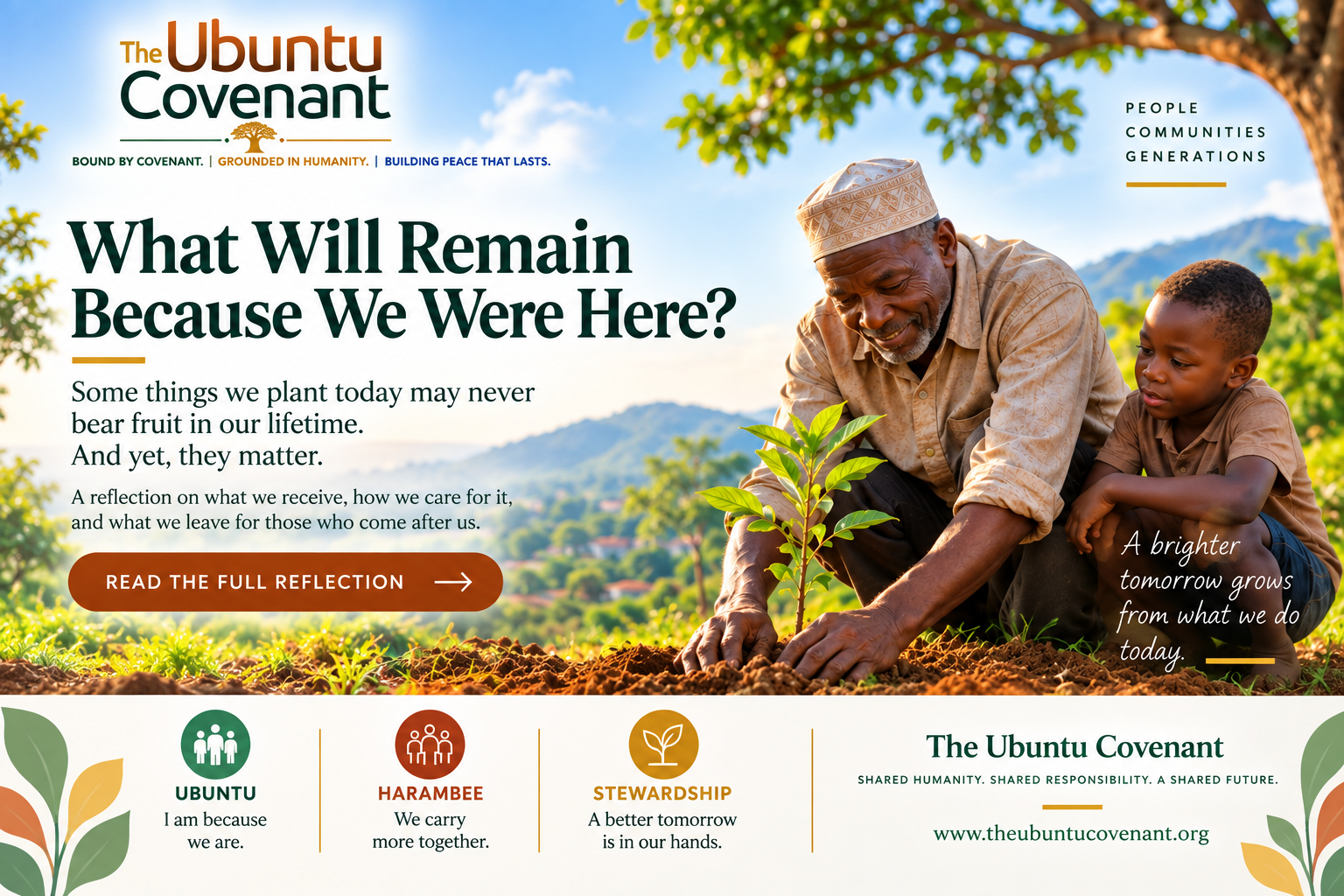
An old man planted a tree beside a path he had walked for most of his life.
The seedling was small.
Its stem was thin enough to bend with the wind.
After placing it in the soil, he pressed the earth carefully around its roots and poured a little water at its base.
A younger man passing nearby stopped to watch.
He smiled and asked:
“How long before that tree gives good shade?”
The old man looked at the seedling.
“Many years,” he replied.
The younger man laughed.
“Will you even be here to sit beneath it?”
The old man smiled.
Then he looked toward several large trees further along the path.
For years, travellers had rested beneath them.
Children played around their trunks.
People sheltered there when the afternoon sun became too strong.
The old man pointed towards them.
“I did not plant those either.”
Then he returned to covering the roots of the young tree.
Perhaps nothing more needed to be said.
Someone had planted what he had enjoyed.
Now he was planting something he might never enjoy himself.
And perhaps somewhere between those two trees lies one of the most important questions any generation can ask:
What will remain because we were here?
How Much of Our Lives Began Before Us?
We often think about what we are building.
Our families.
Our careers.
Our organisations.
Our communities.
Our institutions.
Our nations.
But perhaps we think less often about how much of what makes those things possible was already here when we arrived.
We did not invent the languages through which we first learned to speak.
We did not begin the families whose names we carry.
We did not create the cultures that gave meaning to many of our earliest experiences.
We did not build every road we use.
We did not establish every school in which we learned.
We did not discover every piece of knowledge from which we benefit.
We did not plant every tree whose shade we enjoy.
Much of life begins with receiving.
Someone came before us.
Someone built.
Someone taught.
Someone protected.
Someone sacrificed.
Someone preserved something long enough for it to reach us.
And perhaps receiving something places a question before us:
What will we do with what has been placed in our hands?
Not Everything We Receive Belongs Only to Us
Imagine inheriting a piece of family land.
Legally, it may now belong to you.
You may cultivate it.
Build on it.
Lease it.
Perhaps even sell it.
But that land may carry more than economic value.
It may carry memory.
Family history.
Livelihood.
Identity.
The labour of people who came before you.
And possibilities for people who have not yet been born.
The same may be true of many things we inherit.
An institution.
A business.
A public office.
A community resource.
A forest.
A river.
A tradition.
A reputation.
Even trust.
We may possess something today without being the only people who have a claim upon how it is treated.
Perhaps ownership and responsibility are not always the same thing.
Some Things Take Years to Build and Moments to Lose
Trust may take years to establish.
A careless decision can damage it quickly.
Land may remain productive across generations.
Poor stewardship can exhaust it.
An institution may take decades to earn public confidence.
A few years of neglect can weaken it.
Families may carry relationships across generations.
Unresolved conflict can pass from parents to children.
Communities may inherit traditions of cooperation.
Those traditions can disappear when people stop practising them.
This means every generation stands in an unusual place.
We receive consequences from people who came before us.
And we create consequences for people who will come after us.
We are neither the beginning nor the end.
We are somewhere in the middle.
What If Progress Is Not Only About What We Gain?
Much of modern life encourages us to measure progress through accumulation.
What did we build?
How much did we earn?
How large did we become?
How quickly did we grow?
What did we achieve?
These questions matter.
But perhaps another set of questions deserves equal attention.
What did we preserve?
What did we strengthen?
What did we repair?
What did we refuse to destroy?
What became healthier because it passed through our hands?
And perhaps most importantly:
What will still be useful when we are no longer here?
A generation can become wealthier while leaving exhausted land behind.
An organisation can become larger while weakening the relationships that once gave it meaning.
A leader can achieve visible results while leaving institutions more fragile.
A community can develop physically while becoming less capable of cooperation.
Perhaps progress should therefore be measured not only by what we acquire.
Perhaps it should also be measured by what remains capable of serving others after us.
Some People We Serve Will Never Know Our Names
The person who planted the large tree may never meet the traveller who eventually rests beneath it.
The teacher may never know what becomes of every child they encouraged.
The person who protects a water source today may never meet the family that depends upon it decades later.
Someone who strengthens an institution may never know the people who benefit from its integrity years afterwards.
Someone who helps reconcile a family may never meet the grandchildren who inherit relationships rather than bitterness.
Perhaps this is one of the quietest forms of responsibility:
doing something well for people who may never be able to thank us.
It asks us to think beyond immediate reward.
Beyond recognition.
Beyond our own lifetime.
There Is a Word for This Kind of Care
When something valuable has been entrusted to us, there is an old idea that helps describe our relationship to it:
Stewardship.
A steward understands that having something in one’s hands does not necessarily mean having the right to exhaust it.
Some things are held in trust.
Land.
Resources.
Institutions.
Relationships.
Knowledge.
Leadership.
Opportunities.
Even the influence we have over other people.
Stewardship asks us to receive these things with gratitude, use them responsibly, strengthen them where possible, and consider those who will encounter them after us.
It changes the question from:
“What can I get from this?”
to:
“What has been entrusted to me here?”
And then:
“What condition will it be in when it leaves my hands?”
Shared Responsibility Must Eventually Include the Future
Ubuntu reminds us that our humanity is bound together.
Harambee reminds us that some responsibilities must be carried together.
But there is another dimension.
The community does not consist only of the people we can see today.
There are people who will live with decisions being made now.
Children who will inherit the land.
Citizens who will inherit institutions.
Families who will inherit either reconciled relationships or unresolved wounds.
Communities that will inherit the consequences of how resources were used.
People who may never know our names.
They cannot sit at today’s table.
They cannot vote in today’s meeting.
They cannot object to today’s decisions.
Yet they may live with them.
Perhaps stewardship asks us to make room for them anyway.
Returning to the Tree
Years from now, the old man may no longer walk that path.
The young man who questioned him may have grown old himself.
The small seedling may have become a large tree.
Someone travelling beneath the afternoon sun may stop there.
Perhaps a mother and her children.
Perhaps a farmer carrying something home.
Perhaps an elderly person needing to rest.
They may sit beneath its branches without knowing who planted it.
They may never ask.
And perhaps that is alright.
Because the purpose of planting was never to make the planter remembered.
It was to leave something useful behind.
Perhaps each of us is planting something, whether we realise it or not.
Through the way we raise children.
Through the institutions we build.
Through the land we use.
Through the relationships we repair—or leave broken.
Through the resources entrusted to us.
Through the decisions we make when nobody from the next generation is present to question them.
One day, these things will leave our hands.
And when they do, perhaps the most important question will not be:
How much did we possess while we were here?
Perhaps it will be:
What remained because we were here?