Tag: Community

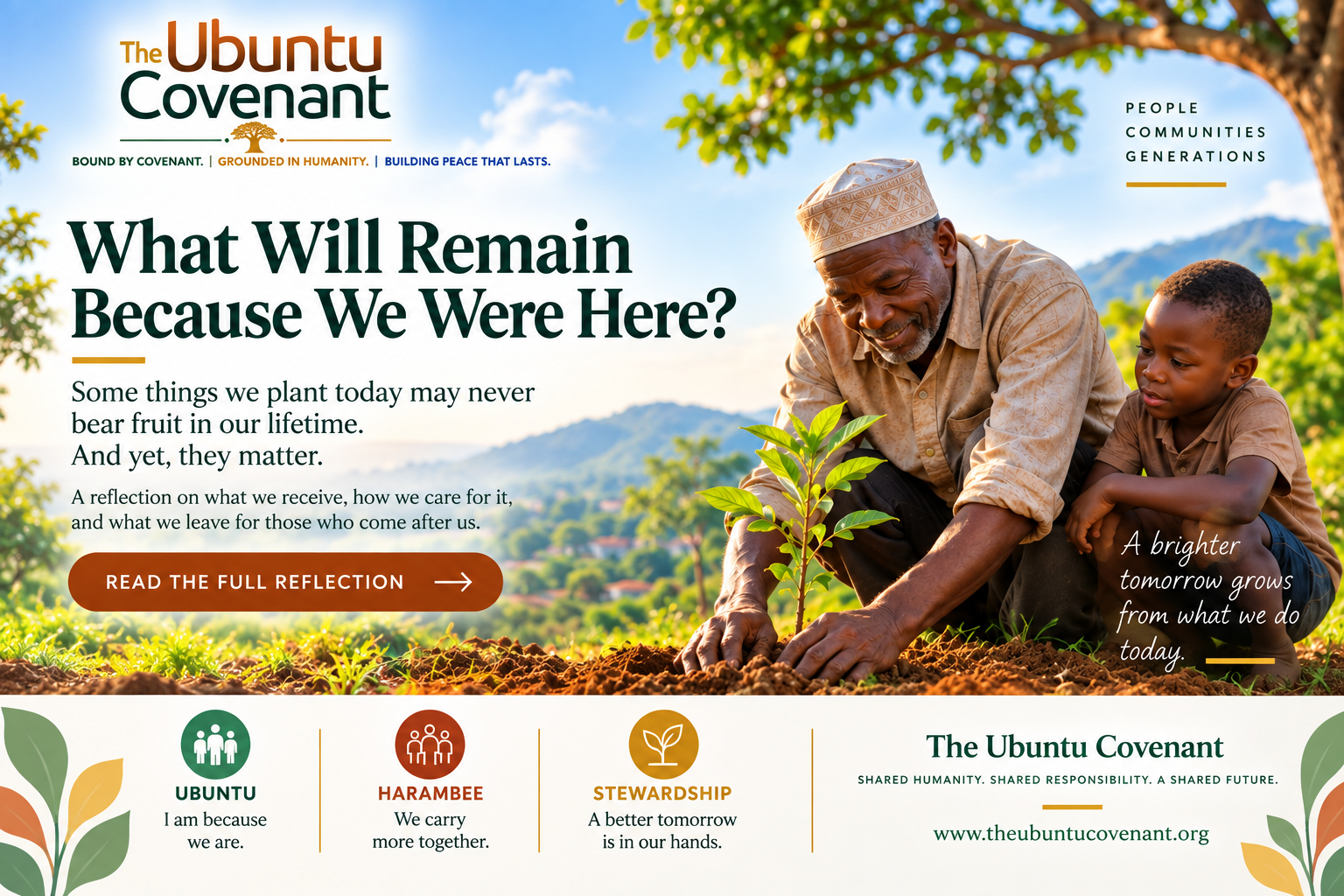
  • What Will Remain Because We Were Here?

    What Will Remain Because We Were Here?

    An old man planted a tree beside a path he had walked for most of his life.

    The seedling was small.

    Its stem was thin enough to bend with the wind.

    After placing it in the soil, he pressed the earth carefully around its roots and poured a little water at its base.

    A younger man passing nearby stopped to watch.

    He smiled and asked:

    “How long before that tree gives good shade?”

    The old man looked at the seedling.

    “Many years,” he replied.

    The younger man laughed.

    “Will you even be here to sit beneath it?”

    The old man smiled.

    Then he looked toward several large trees further along the path.

    For years, travellers had rested beneath them.

    Children played around their trunks.

    People sheltered there when the afternoon sun became too strong.

    The old man pointed towards them.

    “I did not plant those either.”

    Then he returned to covering the roots of the young tree.

    Perhaps nothing more needed to be said.

    Someone had planted what he had enjoyed.

    Now he was planting something he might never enjoy himself.

    And perhaps somewhere between those two trees lies one of the most important questions any generation can ask:

    What will remain because we were here?

    How Much of Our Lives Began Before Us?

    We often think about what we are building.

    Our families.

    Our careers.

    Our organisations.

    Our communities.

    Our institutions.

    Our nations.

    But perhaps we think less often about how much of what makes those things possible was already here when we arrived.

    We did not invent the languages through which we first learned to speak.

    We did not begin the families whose names we carry.

    We did not create the cultures that gave meaning to many of our earliest experiences.

    We did not build every road we use.

    We did not establish every school in which we learned.

    We did not discover every piece of knowledge from which we benefit.

    We did not plant every tree whose shade we enjoy.

    Much of life begins with receiving.

    Someone came before us.

    Someone built.

    Someone taught.

    Someone protected.

    Someone sacrificed.

    Someone preserved something long enough for it to reach us.

    And perhaps receiving something places a question before us:

    What will we do with what has been placed in our hands?

    Not Everything We Receive Belongs Only to Us

    Imagine inheriting a piece of family land.

    Legally, it may now belong to you.

    You may cultivate it.

    Build on it.

    Lease it.

    Perhaps even sell it.

    But that land may carry more than economic value.

    It may carry memory.

    Family history.

    Livelihood.

    Identity.

    The labour of people who came before you.

    And possibilities for people who have not yet been born.

    The same may be true of many things we inherit.

    An institution.

    A business.

    A public office.

    A community resource.

    A forest.

    A river.

    A tradition.

    A reputation.

    Even trust.

    We may possess something today without being the only people who have a claim upon how it is treated.

    Perhaps ownership and responsibility are not always the same thing.

    Some Things Take Years to Build and Moments to Lose

    Trust may take years to establish.

    A careless decision can damage it quickly.

    Land may remain productive across generations.

    Poor stewardship can exhaust it.

    An institution may take decades to earn public confidence.

    A few years of neglect can weaken it.

    Families may carry relationships across generations.

    Unresolved conflict can pass from parents to children.

    Communities may inherit traditions of cooperation.

    Those traditions can disappear when people stop practising them.

    This means every generation stands in an unusual place.

    We receive consequences from people who came before us.

    And we create consequences for people who will come after us.

    We are neither the beginning nor the end.

    We are somewhere in the middle.

    What If Progress Is Not Only About What We Gain?

    Much of modern life encourages us to measure progress through accumulation.

    What did we build?

    How much did we earn?

    How large did we become?

    How quickly did we grow?

    What did we achieve?

    These questions matter.

    But perhaps another set of questions deserves equal attention.

    What did we preserve?

    What did we strengthen?

    What did we repair?

    What did we refuse to destroy?

    What became healthier because it passed through our hands?

    And perhaps most importantly:

    What will still be useful when we are no longer here?

    A generation can become wealthier while leaving exhausted land behind.

    An organisation can become larger while weakening the relationships that once gave it meaning.

    A leader can achieve visible results while leaving institutions more fragile.

    A community can develop physically while becoming less capable of cooperation.

    Perhaps progress should therefore be measured not only by what we acquire.

    Perhaps it should also be measured by what remains capable of serving others after us.

    Some People We Serve Will Never Know Our Names

    The person who planted the large tree may never meet the traveller who eventually rests beneath it.

    The teacher may never know what becomes of every child they encouraged.

    The person who protects a water source today may never meet the family that depends upon it decades later.

    Someone who strengthens an institution may never know the people who benefit from its integrity years afterwards.

    Someone who helps reconcile a family may never meet the grandchildren who inherit relationships rather than bitterness.

    Perhaps this is one of the quietest forms of responsibility:

    doing something well for people who may never be able to thank us.

    It asks us to think beyond immediate reward.

    Beyond recognition.

    Beyond our own lifetime.

    There Is a Word for This Kind of Care

    When something valuable has been entrusted to us, there is an old idea that helps describe our relationship to it:

    Stewardship.

    A steward understands that having something in one’s hands does not necessarily mean having the right to exhaust it.

    Some things are held in trust.

    Land.

    Resources.

    Institutions.

    Relationships.

    Knowledge.

    Leadership.

    Opportunities.

    Even the influence we have over other people.

    Stewardship asks us to receive these things with gratitude, use them responsibly, strengthen them where possible, and consider those who will encounter them after us.

    It changes the question from:

    “What can I get from this?”

    to:

    “What has been entrusted to me here?”

    And then:

    “What condition will it be in when it leaves my hands?”

    Shared Responsibility Must Eventually Include the Future

    Ubuntu reminds us that our humanity is bound together.

    Harambee reminds us that some responsibilities must be carried together.

    But there is another dimension.

    The community does not consist only of the people we can see today.

    There are people who will live with decisions being made now.

    Children who will inherit the land.

    Citizens who will inherit institutions.

    Families who will inherit either reconciled relationships or unresolved wounds.

    Communities that will inherit the consequences of how resources were used.

    People who may never know our names.

    They cannot sit at today’s table.

    They cannot vote in today’s meeting.

    They cannot object to today’s decisions.

    Yet they may live with them.

    Perhaps stewardship asks us to make room for them anyway.

    Returning to the Tree

    Years from now, the old man may no longer walk that path.

    The young man who questioned him may have grown old himself.

    The small seedling may have become a large tree.

    Someone travelling beneath the afternoon sun may stop there.

    Perhaps a mother and her children.

    Perhaps a farmer carrying something home.

    Perhaps an elderly person needing to rest.

    They may sit beneath its branches without knowing who planted it.

    They may never ask.

    And perhaps that is alright.

    Because the purpose of planting was never to make the planter remembered.

    It was to leave something useful behind.

    Perhaps each of us is planting something, whether we realise it or not.

    Through the way we raise children.

    Through the institutions we build.

    Through the land we use.

    Through the relationships we repair—or leave broken.

    Through the resources entrusted to us.

    Through the decisions we make when nobody from the next generation is present to question them.

    One day, these things will leave our hands.

    And when they do, perhaps the most important question will not be:

    How much did we possess while we were here?

    Perhaps it will be:

    What remained because we were here?
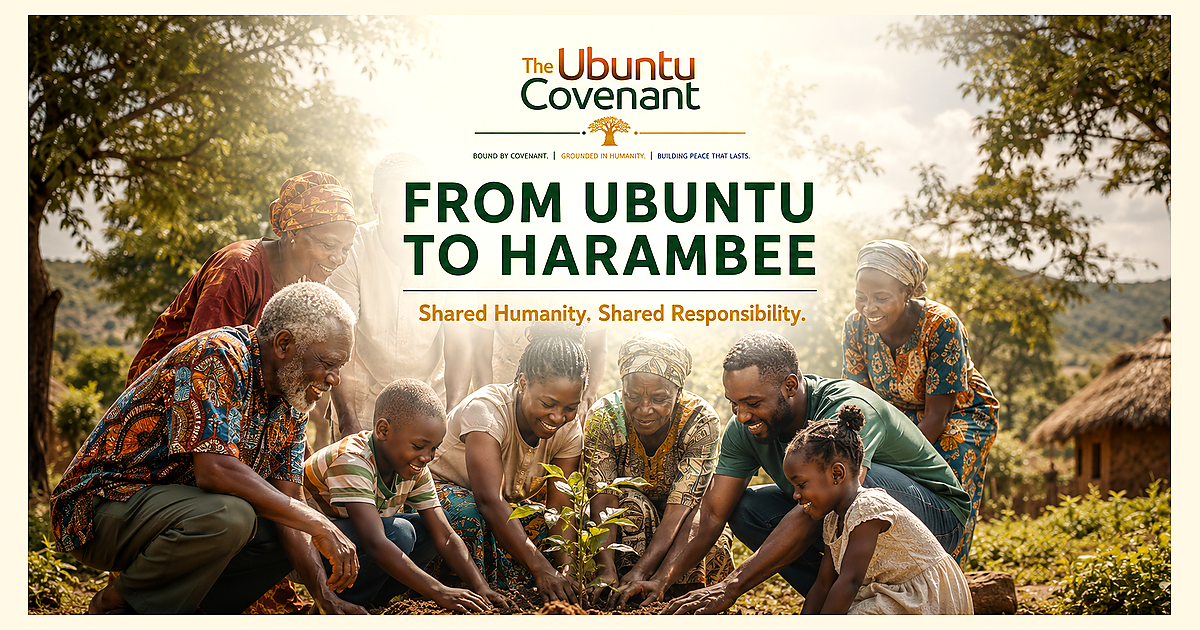
  • From Ubuntu to Harambee: When Shared Humanity Becomes Shared Responsibility

    From Ubuntu to Harambee: When Shared Humanity Becomes Shared Responsibility

    Knowing what is right is not the same as living it.

    Communities are not transformed by the values they admire, but by the values they practice consistently.

    People may affirm dignity while ignoring exclusion. We may speak of unity while leaving responsibility to others. We may recognize our shared humanity while continuing to live as though another person’s well-being has nothing to do with our own.

    Wisdom becomes transformative only when it shapes action.

    Ubuntu teaches that our humanity is bound together. But this understanding naturally leads to a practical question:

    If we belong to one another, how should we act together?

    This is where Harambee begins.

    When Understanding Becomes Practice

    Ubuntu is not only a description of human connection. It is an invitation to live in ways that honor that connection.

    If our humanity is bound together, then dignity must shape how we treat others. Compassion must influence our choices. Responsibility must extend beyond personal interest, and the common good must become more than an admirable idea.

    A philosophy that remains only in words may be respected without ever transforming the way people live.

    Every enduring principle eventually asks something of us. It asks whether our beliefs can be seen in our relationships, our leadership, our decisions, and our willingness to contribute to the well-being of others.

    Ubuntu therefore prepares the heart and mind. Harambee gives that understanding practical expression.

    What Harambee Means

    Across Kenya, Harambee is commonly understood as “all pull together.”

    It reflects the recognition that some responsibilities cannot be carried by one person alone. Families, communities, and institutions become stronger when people willingly contribute their time, abilities, wisdom, resources, and effort toward the common good.

    Harambee is sometimes associated mainly with fundraising or public campaigns. But its meaning reaches deeper than collecting money or completing a single activity.

    It is a practice of shared responsibility.

    One person may contribute knowledge. Another may offer time. Another may create relationships, provide encouragement, protect trust, or make room for voices that are often overlooked.

    The value of Harambee is not found in every person contributing the same thing. It is found in people recognizing that each has something meaningful to contribute.

    Ubuntu and Harambee

    Ubuntu and Harambee belong together.

    Ubuntu answers the question: Who are we?

    Our humanity is bound together.

    Harambee answers the question: How should we act?

    We pull together for the common good.

    Ubuntu speaks to identity. Harambee speaks to responsibility. Ubuntu helps us recognize that we belong to one another. Harambee asks us to live in a way that reflects that belonging.

    Ubuntu without Harambee risks becoming an idea that is admired but not practiced.

    Harambee without Ubuntu risks becoming collective effort without a shared moral foundation.

    Together, they remind us that shared humanity finds its fullest expression in shared responsibility.

    More Than Working Together

    Not every form of collective action reflects Ubuntu.

    People can work together while excluding others. Communities can pursue a shared goal while placing an unfair burden on those with less power. Calls for unity can sometimes silence honest disagreement or pressure people into participation.

    True Harambee cannot be built on fear, coercion, exclusion, or harm.

    It must preserve dignity, encourage willing participation, and recognize that the common good includes those whose voices are easiest to overlook.

    Ethical Harambee therefore asks:

    Who has been included in the conversation?

    Who carries the cost of our decisions?

    Whose contribution has not been recognized?

    Who benefits from the action we are taking?

    What will future generations inherit from our choices?

    Harambee is strongest when people do more than work beside one another. They listen, share responsibility, protect dignity, and ensure that collective action truly serves the common good.

    Harambee in Everyday Life

    Harambee is not reserved for national campaigns, public ceremonies, or moments of crisis. It begins in ordinary life.

    It is practiced when family members share responsibility rather than leaving every burden to one person.

    It is present when elders share wisdom, adults create room for participation, and young people contribute their energy, questions, and ideas.

    It is practiced when neighbors address disagreement through conversation before division becomes permanent.

    It is present when leaders invite participation, institutions build trust, and communities care faithfully for their shared environment and resources.

    Harambee can be seen whenever people ask not only, “What do I need?” but also, “What can I contribute?”

    These everyday choices may appear small, but communities are shaped by what people practice repeatedly.

    Collective responsibility becomes a culture one decision, one relationship, and one contribution at a time.


    Leadership That Convenes

    Harambee also changes how leadership is practiced.

    A leader shaped by Harambee does not treat people merely as recipients of instructions. The leader recognizes that communities possess knowledge, experience, relationships, and abilities that must be invited into the work.

    Such leadership convenes before it commands.

    It listens before deciding. It creates room for participation, distributes responsibility, and helps people recognize the contribution they can make.

    This does not remove the need for direction or accountability. It strengthens both by building trust, ownership, and shared purpose.

    The strongest leader is not always the person carrying every responsibility. It is often the person who helps others carry responsibility faithfully together.

    The Ubuntu Covenant

    The Ubuntu Covenant does not claim ownership of Harambee.

    Harambee belongs to Kenya’s living tradition of collective effort and shared responsibility. It has been practiced across generations in families, communities, institutions, and national life.

    The Ubuntu Covenant exists as one faithful institutional expression of this wisdom.

    We seek to translate the shared humanity revealed by Ubuntu into responsible action through Harambee—strengthening trust, belonging, ethical leadership, dialogue, stewardship, and collaboration.

    Our work begins where principles meet practice.

    We ask how people can recognize their shared responsibility, contribute their distinct strengths, and work together in ways that preserve dignity and strengthen the human foundations of community life.

    We do not believe that one institution can build the future alone.

    The future is strengthened when people, communities, and institutions recognize that each has a responsibility—and that every responsible contribution matters.

    An Invitation to Shared Responsibility

    Harambee invites each of us to consider the responsibility we may be waiting for someone else to carry.

    What knowledge can we share?

    What relationship can we strengthen?

    What conversation can we help begin?

    What responsibility can we accept?

    Who should be included before we move forward?

    How can our contribution strengthen the common good rather than personal recognition?

    Harambee does not require everyone to possess the same resources, hold the same position, or make the same contribution.

    It asks each person to recognize that they have something meaningful to offer—and that the future is strengthened when those contributions are brought together responsibly.

    Ubuntu reminds us who we are.

    Harambee asks how we should act.

    Shared humanity becomes visible through shared responsibility.

    But whenever people build something together, another question follows:

    How will we care for what has been entrusted to us and preserve it for those who will come after us?

    This is the question of stewardship.

    Ubuntu is our covenant. Harambee is our practice.